


 Whatsapp
  X
X  Mail
Mail  Copy link
 Guide to Soybean Nutrient Deficiency
Identify nutrient deficiencies in soybean with this ICL Guide
On this page:
Soybeans show clear visual signs when key nutrients are lacking – from yellowing leaves to stunted growth – and early diagnosis is crucial for protecting yield. This guide outlines the symptoms of nitrogen, phosphorus, potassium, calcium, magnesium, sulfur, iron, manganese, and zinc deficiencies, helping farmers respond quickly with balanced fertilization. With the right nutrient strategy, growers can restore plant health, prevent losses, and support strong, productive soybean crops.
Soybean plays a vital role in modern agriculture, with demand as a product for human consumption and as an important ingredient in livestock feed. The total global production of soybean makes it one of the top 10 products by weight and puts it in the top 5 by area harvested. To ensure abundant production of good quality soybean, it is crucial to quickly identify any nutrient deficiencies and implement the required remedies to prevent loss of yield. This ICL nutrient deficiency guide for soybean describes the tell-tale signs of nutritional deficiencies to help with prompt and accurate identification.
ICL has a complete portfolio of plant nutrition products for soybean cultivation, which includes products designed to meet the nutritional needs of soybean to maximize yield and quality. To find out more, contact our technical team.
Learn how to identify nutritional deficiencies in soybean
For successful soybean production, crops require 14 essential nutrients, including both macronutrients and micronutrients. Investing in the knowledge to identify these deficiencies and reacting promptly to them will pay dividends when it comes to the soybean harvest.
Macronutrient deficiency symptoms in soybean
Nitrogen deficiency

Nitrogen-deficient soybean exhibits total leaf chlorosis. The soybean leaves lose their dark green color and become pale green. As the leaves age, this generalized chlorosis (yellowing) of old leaves (caused by a reduction in the production of chlorophyll) progresses to necrosis.
Phosphorus deficiency

Phosphorus-deficient plants have reduced growth, low pod insertion height, and smaller leaves with the older leaves having a bluish-green and dull color. Phosphorus deficiency in soybeans also reduces the number and efficiency of root nodules, reducing the symbiotic nitrogen fixation.
Potassium deficiency

Potassium-deficient soybean crops initially exhibit chlorosis on the edges of older soybean leaves, progressing to necrosis on the edges and tips of the leaves. Ultimately, necrosis reaches the base of the leaves, resulting in total necrosis. There is a reduction in the size and weight of soybean seeds, and the soybeans become wrinkled and deformed, with low vigor and low germination power.
Micronutrient deficiency in soybeans
Calcium deficiency

Calcium deficiency affects the growth points of the soybean plants’ roots and shoots. The symptoms appear in the younger parts of the plant, atrophying the root system and killing the apical bud. The emergence of primary leaves is delayed, and when they do emerge, the leaves acquire a cup-like shape (wrinkling), become soft and flexible, and fall off the plant.
Magnesium deficiency

Older leaves of magnesium-deficient plants show interveinal chlorosis (light yellow) with pale green veins. There is a reduction in the development of the root system.
Sulfur deficiency

Sulfur deficiency results in uniform chlorosis of the new soybean leaves, including the veins, which turn from pale green to yellow. While this is similar to nitrogen deficiency symptoms, with sulfur deficiency these symptoms are seen on new leaves, compared to older leaves with nitrogen deficiency. Sulfur deficiency also results in a reduction in the size and number of flowers, while the plant stems become thin and weak, making the soybean very susceptible to lodging.
Boron deficiency

Boron deficiency symptom occurs in the apical buds and new leaves, which are leathery, rough, and thick. Subsequently, the death of the apical bud may occur, resulting in the prolific growth of lateral shoots.
Copper deficiency

Courtesy of ICL.
Courtesy of Hansel and Oliveira (2016)
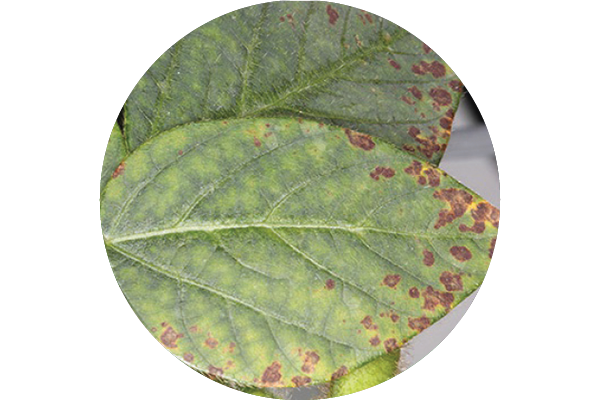
Copper deficiency manifests through a set of characteristic symptoms, including: dark green young leaves with possible necrotic spots, reduced growth due to shortened internodes, deformation of new leaves, and the appearance of asymmetric leaves (known as “pregnant leaves”).
Manganese deficiency

The young leaves of manganese-deficient soybean plants exhibit interveinal chlorosis with a greenish-yellow hue. The veins remain dark green in color.
Zinc deficiency

The new leaves are small, narrow, and elongated, with interveinal chlorosis, golden yellow in color, while the veins remain green. The adult leaves are yellow-brown in color. In addition, zinc deficiency results in soybean plants with shortened internodes.
Iron deficiency

Young leaves present varying degrees of interveinal chlorosis, from the tip to the base of the soybean leaves. As iron deficiency worsens, plants become chlorotic or whitish. The photograph on the left demonstrates iron deficiency caused by excess cobalt.


Early identification is key
This soybean nutrient deficiency guide should provide the information required to identify and address nutritional deficiencies in soybean crops. The key to successful farming lies in identifying such problems and taking prompt and proactive action to remedy the situation.
If you have any questions or need guidance specific to your situation, we are here to help. Contact us to discuss personalized strategies and ensure your crop meets its full potential.

