


 Whatsapp
  X
X  Mail
Mail  Copy link
 Seed and Seedling Phase of Paddy Rice
In this series Dr. Shin Hidaka explores rice cultivation in Japan, from its cultural roots to modern sustainable practices. Each post highlights a key aspect, like historical background, nutrients‘ role, growth stages, and high yield techniques, offering clear insights into the cultivation of one of the world’s most important crops.

On this page:
Introduction
The seed and seedling stages represent the foundation of paddy rice cultivation. Proper understanding of seed physiology, dormancy, storage, and early seedling development is essential for achieving strong crop establishment and maximizing yield potential.
Rice Seed and Seedling Organs
| Organ | Main Function | Key Risks if Mismanaged |
|---|---|---|
| Husk | Physical protection; silica-rich barrier against heat, drought, pests. | Poor husk integrity reduces seed resilience; low silica uptake weakens defense. |
| Embryo | Contains plumule (shoot) and radicle (root); initiates germination. | Aging or poor storage reduces viability; oxygen deprivation during soaking causes abnormal growth. |
| Endosperm | Stores starches and proteins for embryo nourishment. | Incomplete soaking or poor seed quality limits nutrient mobilization; weak early growth. |
| Aleurone Layer | Protein- and fat-rich outer endosperm layer; supports embryo during germination. | Degradation from poor storage or dormancy mismanagement impairs nutrient supply. |
| Plumule | Develops into shoot system. | Oxygen stress or temperature spikes cause elongation, weak stems, poor greening. |
| Radicle | Develops into root system. | Poor oxygen or deep water limits root formation; weak anchorage and nutrient uptake. |
| First Leaf | Marks transition to autotrophy; begins photosynthesis. | Delayed emergence or poor greening reduces vigor; affects transplant readiness. |
| Third Leaf (Weaning Stage) | Seedling becomes nutritionally independent. | Nutrient stress or poor soil aeration delays autotrophy; stunts growth. |
| Fourth Leaf (Tillering Initiation) | Triggers tiller formation, key for panicle development. | Excess nitrogen, heat stress, or deep water suppress tillering; yield loss. |
Seed in Paddy Rice
Structure and Function
In Japanese, the rice seed is referred to as the “momi” (grain with husk) and is enclosed in two protective layers: the lemma (outer husk) and palea (inner husk). Inside the husk, there are the embryo and the endosperm, and collectively this structure is called the seed.
- The embryo consists of the plumule (young shoot) and radicle (young rootwhich initiate germination.
- The endosperm is filled primarily with starch granules, which store nutrients necessary for embryo development. The outermost layer of the endosperm, called the aleurone layer, which is rich in proteins and fats and plays a critical role in supplying nutrients to the embryo during germination.
Role in the Rice Life Cycle
After fertilization and maturation, the seed detaches from the parent plant, disperses, and carries forward the genetic blueprint of its lineage. Rice seeds exhibit a unique adaptation: the husk can contain over 10% silica, absorbed from soil silicic acid. This silica strengthens the husk against heat, drought, pathogens, and pests, which is an evolutionary advantage in wetland ecosystems.
Rice Seed Dormancy
Immediately after harvest, rice seeds enter a natural dormancy phase which is a temporary inhibition of germination that prevents premature sprouting. This dormancy is a crucial adaptation, ensuring that seeds remain viable until conditions are favorable for growth. However, the aging process begins as soon as the seed matures on the parent plant, gradually reducing its ability to germinate. Moisture content and temperature are the two most critical factors influencing both the duration of dormancy and the overall lifespan of the seed, making careful post-harvest handling essential.
Best Practices for Rice Seeds Storage
To preserve seed quality for the following season, storage must begin immediately after threshing and cleaning. The moisture content should be reduced to between 11–14%, a range that balances longevity with safe storage. Once dried, seeds should be sealed in airtight containers and kept in a cool, dark indoor environment. These practices protect against premature deterioration and ensure that the seeds retain high germination potential, forming the foundation for a healthy and productive rice crop.
Saltwater Flotation: A Practical Tip to Test Seed Quality
To ensure high-germination-quality rice seed, growers often employ the saltwater flotation test. Seeds are placed in saltwater with a specific gravity of 1.06, which separates well-filled grains from lighter, less viable ones. The nutrient-rich seeds sink to the bottom, while empty or poorly developed grains float. After collection, the sunken seeds are rinsed thoroughly with fresh water to remove residual salt. This simple yet effective method helps farmers select vigorous seed stock, laying the foundation for strong seedling establishment and healthy crop development.
Seedling Development in Paddy Rice
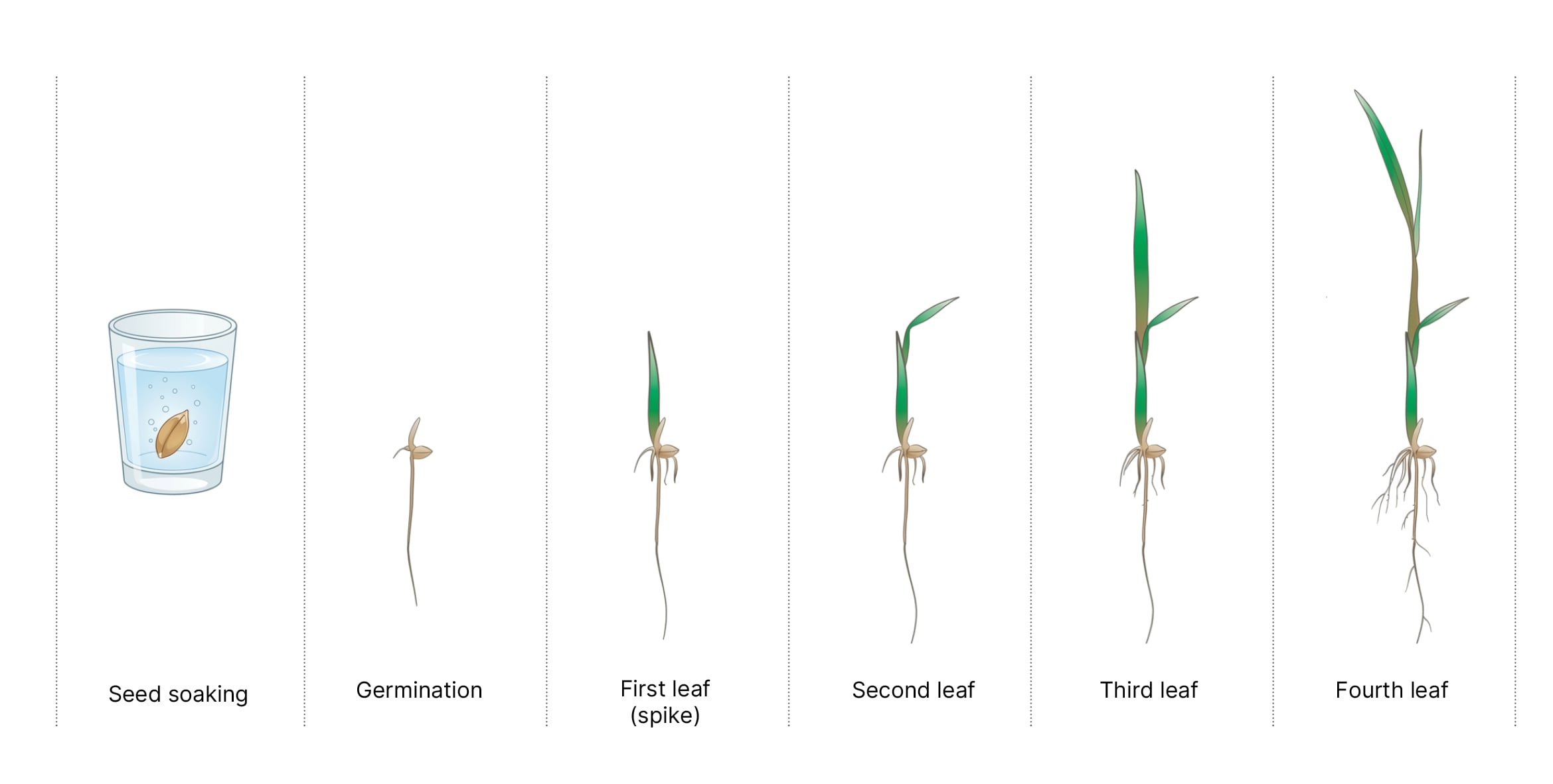
Rice Seedling Development Stages
Seed Soaking and Germination
The journey from seed to seedling begins with water. Dry rice seeds must first absorb moisture to activate the embryo, initiating germination. During this process, known as seed soaking, the endosperm near the embryo also takes in water, breaking down stored starches and proteins to nourish the emerging shoot (plumule) and root (radicle). The duration of soaking depends on water temperature, with a total accumulated temperature of 100°C (water temperature × days) serving as the standard guideline.
Rice Seeds‘ Oxygen Requirements
Because germination requires abundant oxygen, soaking water should be refreshed regularly. Without sufficient oxygen, seedlings may develop abnormally, with elongated shoots and poorly formed roots. In controlled germination chambers equipped with oxygen supply, this process can be completed within a single day.
Early Rice Seedling Establishment
Once the seed has absorbed enough water and the embryo is slightly swollen, reaching the “pigeon chest” stage, it is sown into soft, well-aerated seedling soil. Growth chambers maintained at 30–32°C promote uniform germination, with the first leaf typically emerging within two days. Seedlings are then transferred to cooler conditions (20–25°C) for greening, followed by outdoor hardening under natural sunlight and ambient temperatures.
Nutritional Transition to Autotrophy
Up to the second leaf stage, seedlings rely entirely on nutrients stored in the endosperm. By the third leaf stage (the “weaning stage”) these reserves are depleted, and the young plant starts being nutritionally independent, absorbing water and nutrients through its roots and performing photosynthesis.
Critical Tillering Initiation Stage
The period leading to the fourth leaf stage, known as the tillering initiation stage, is particularly critical in rice. Environmental stresses such as sudden temperature spikes, deep water that limits oxygen supply, or excessive soil nitrogen level can cause elongated, weak seedlings with suppressed tillering. Since tillers formed during this stage often develop into productive panicles, careful management is essential to ensure strong, compact growth. Healthy seedlings established quickly under optimal conditions form the basis for high-yielding rice crops.
Seedling Classification in Mechanized Systems
In mechanized transplanting systems, seedlings are classified by leaf age to match field requirements. Young seedlings are defined at the 3–3.5 leaf stage, while intermediate seedlings fall between the 4–5.5 leaf stage. This classification helps farmers select the most suitable seedlings for transplanting, balancing vigor, adaptability, and productivity.
Conclusion
The seed and seedling phases of paddy rice are decisive for crop establishment and yield. From dormancy and storage practices to precise soaking, oxygen management, and early seedling care, each step directly influences plant vigor and panicle productivity. The silica‑rich husk, nutrient transition from endosperm to autotrophy, and careful control during the tillering initiation stage all highlight the complexity of rice physiology.
These insights are grounded in decades of Japanese research, which has systematically documented the biological processes and agronomic practices that secure healthy seedlings and resilient crops. By applying this knowledge, rice growers can strengthen establishment, optimize transplanting systems, and ensure sustainable, high‑yielding production.
