


 Whatsapp
  X
X  Mail
Mail  Copy link
The groundbreaking total range of water-soluble straight fertilizers
Brand details Nova Growing Apple
crop nutrition advice
Everything you need to know about apple fertilization, best practice, suitable products, field trials and more.
Advice for growing Apple (Malus domestica)

An apple tree before harvest

Apple orchard
Introduction
Apple (Malus domestica) is one of the world’s most widely cultivated fruit crop, valued for its nutritional quality, storability, and versatility. Successful apple production depends on balanced nutrition, careful calcium management, and close attention to soil conditions.
Apples perform best in soils with a pH between 6 and 7, where nutrient availability is optimal. In high‑pH soils (above 8), phosphorus and micronutrient deficiencies, especially iron, are common due to reduced availability. Apple trees are also very sensitive to soil salinity, with a maximum tolerance of 2–3 mS/cm, and to high exchangeable sodium.
Water needs range from 600–800 mm/ha between bud break and leaf fall, depending on climate and canopy size.
Calcium management is essential for fruit firmness, storability, and resistance to physiological disorders (like bitter pit). A combined soil + foliar strategy is required for best results.
Apple Crop Characteristics
Apple trees are more cold‑tolerant than other pome fruits. They withstand temperatures down to –10°C without bark damage, however spple blossoms are very sensitive to spring frosts. In the pink bud stage, they can withstand temperatures as low as -3°C, while open blossoms can die at temperatures as low as -1.5°C to -2°C. The main limitation in warm regions is chilling requirement: while low‑chill varieties need around 500 hours, most commercial cultivars require >1500 hours.
Apples prefer humid climates and moderate light. Excessive light and heat on southern exposures can cause sunburn, internal browning, scald, and vitreous fruit.
Undemanding in soil type, apples have a shallow root system and perform best in deep, well‑structured clay loams.
Global Apple Production
Global apple production reached over 87 million tonnes in 2024, according to the latest FAO‑based datasets. Production is heavily concentrated in Asia, which accounts for 67 million tonnes, driven primarily by China, the world’s dominant producer with 51.29 million tonnes. Other major contributors include the United States (4.92 million tonnes), Turkey (4.42 million tonnes), Poland (3.38 million tonnes), and India (2.63 million tonnes). Europe collectively produces 16.89 million tonnes, with the EU‑27 contributing 11.52 million tonnes. These figures highlight the crop’s global importance and the strong regional specialization that shapes market supply and varietal availability.
| Country | Production (million tonnes) |
|---|---|
| China | 51.29 |
| United States | 4.92 |
| Turkey | 4.42 |
| Poland | 3.38 |
| India | 2.63 |
Apple Usage and Quality Preferences
Globally, around 70–75% of apples are consumed fresh, while the remaining 25–30% go into processing. The processing sector is diverse: the largest share goes into apple juice and concentrate, followed by cider, purées, jams, dried apples, and baby food. Quality preferences differ between the fresh and processing markets. Fresh‑market apples require high firmness, uniform size, attractive color, and long storability, while processors prioritize high dry‑matter content, sugar levels (°Brix), and consistent flavor over cosmetic appearance. These differing requirements influence cultivar choice, harvest timing, and nutrient management strategies on‑farm.
Apple Crop Growth Stages
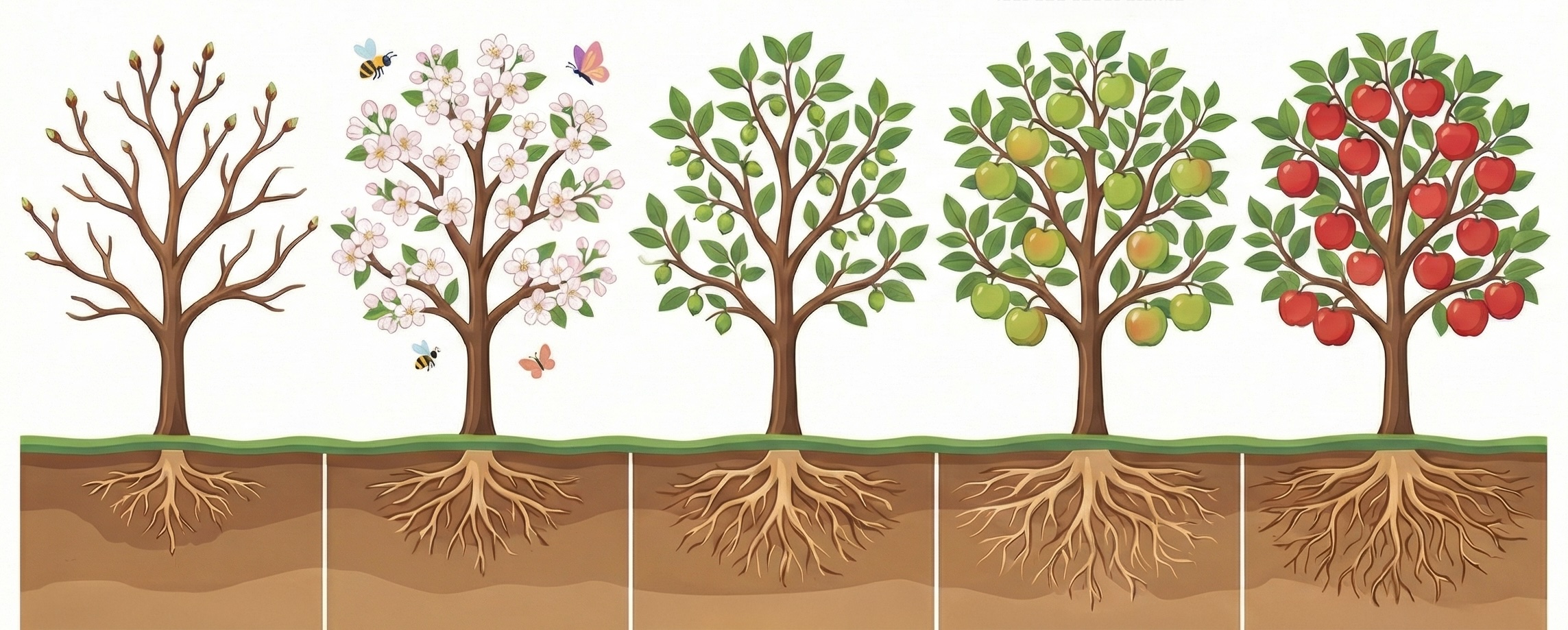
Apple Tree Growth Stages: From Dormancy to Harvest
Nutrient Roles in Apple Production
Nitrogen (N)
It is the most important mineral element in plant nutrition. It is a constituent of amino acids, proteins and nucleic acids and therefore is essential in growth, both in its cell division and elongation phase. It is part of the chlorophyll molecule, directly affecting photosynthesis, since it is part of the rubisco enzyme, fundamental in the cycle of carbon dioxide fixation by the leaf. Without an adequate supply of N, the crop takes too long to reach a development that makes it productive and in the case of a tree in production it does not achieve an agile renewal of the fruit wood for the following season.
Phosphorus (P)
The main role of phosphorus is structural, forming part of ATP. These compounds store the energy from photosynthesis and release it at specific sites in the plant where it is required. They are essential in all processes in which there is active cell division, such at times of root development and in flowering.
Potassium (K)
Potassium’s main role is directly related to quality and production. Increased potassium levels improve the quality and quantity of the crop. The main roles of potassium are; protein synthesis, photosynthetic processes and sugar transport from leaves to fruits.
Calcium (Ca)
It is essential for the formation of the plant structure and the cell wall. It is important for the proper functioning of absorption mechanisms, as well as to prevent the escape of elements outside the cells. It is also at the center of the plant’s defense mechanisms, which helps it detect and react against external factors.
Magnesium (Mg)
Magnesium supports chlorophyll formation, photosynthesis, and enzyme activation. It assists with nutrient uptake from the soil to the roots, especially with phosphorus.
Sulfur (S)
Sulfur contributes to amino acid and protein formation and supports nitrogen use efficiency.
Nutrient requirements
Estimated nutrient uptake (kg/t):| Year | N | P2O5 | K2O | MgO | SO3 | CaO |
|---|---|---|---|---|---|---|
| 1st year | 48 | 48 | 36 | 6 | 3 | 48 |
| 2nd year | 42 | 48 | 63 | 9 | 4.5 | 36 |
| 3rd year | 70 | 60 | 110 | 12.5 | 9 | 40 |
| Production (45 tones) | 100 | 90 | 220 | 40 | 30 | 110 |
| Month | Physiological stage | N (kg/ha) | P2O5 (kg/ha) | K2O (kg/ha) |
|---|---|---|---|---|
| February | Dormancy | 10 | 15 | 20 |
| March | Flower initiation | 15 | 15 | 20 |
| April | Fruit-set | 15 | 20 | 40 |
| May | Fruitlet development and bud initiation | 20 | 15 | 40 |
| June | Fruit development & vegetative development | 10 | 10 | 40 |
| July | Fruit development & vegetative development | 5 | 5 | 40 |
| August | Beginning of harvest | 5 | 5 | 10 |
| September | End of harvest | 10 | 5 | |
| October | End of harvest | 10 | ||
| Total application | (kg/ha) | 100 | 90 | 210 |
Dynamic of Nutrient Uptake in Apples

Nutrient Deficiency Symptoms
Nitrogen deficiency
- Pale green margins and tips
- Yellowing of older leaves
- Reduced growth and premature leaf fall
Phosphorus deficiency
- Retarded growth, especially early
- Purpling of lower leaves
- Poor leaflet development
Potassium deficiency
- Shortened internodes
- Bluish‑green leaves
- Yellowing and necrotic margins on older leaves
Calcium deficiency
- Weak cell walls
- Increased susceptibility to disorders (e.g., bitter pit)
- Reduced fruit firmness and storability
Magnesium deficiency
- Interveinal chlorosis on older leaves
- Marginal necrosis
- Leaf drop
Conclusion
Apple production relies on the careful balance of climate suitability, orchard management, and precise crop nutrition. While global consumption remains broadly stable—with growth in some emerging markets and maturity in others—buyers consistently expect high fruit quality, storability, and uniformity. Meeting these expectations requires strong attention to soil health, calcium management, and season‑long nutrient availability tailored to each orchard’s conditions. With a well‑designed nutritional program supported by research‑driven solutions, growers can optimize fruit quality, reduce physiological disorders, and maintain long‑term orchard productivity.
Apple Trials
Guides & Articles
How to Reduce Bitter Pit in Apple

Q&A
Here are some frequently asked questions we received from farmers regarding growing apples.
The most efficient strategy is to combine regular foliar calcium sprays with moderate nitrogen fertilization and consistent irrigation. Because calcium is very immobile inside the plant, soil applications alone cannot raise fruit calcium levels. Season‑long foliar sprays, from petal fall through fruit enlargement, are the only reliable way to increase calcium in the fruit and prevent disorders like bitter pit.
Yes. Research shows that high potassium (K) and high nitrogen (N) both increase the risk of bitter pit because they compete with calcium (Ca) for uptake and transport. There is no single ideal K:N ratio, but the consistent recommendation across pomology research is to avoid high K and high N inputs, especially early in the season, and to maintain moderate, balanced fertilization so that K:Ca and N:Ca ratios remain low. Keeping vegetative growth under control is key, because vigorous shoots out‑compete fruit for calcium, increasing bitter pit susceptibility.
Managing the tree’s natural hormonal balance is essential for achieving a healthy, uniform harvest. Practices such as avoiding excessive nitrogen, maintaining steady irrigation, and keeping vegetative growth under control all help stabilize the plant’s own growth regulators, which in turn supports better fruit development. Because conditions vary by region, cultivar, and orchard system, it’s important to consult your local technician or advisor to tailor the right approach for your orchard.
Keep the pH of your fertigation solution in the optimal range for apples, generally around 5.5–6.5, to ensure good nutrient availability and efficient uptake. This often requires acidifying hard or alkaline water and avoiding large pH fluctuations during the season. Because the right approach depends on your water quality, fertilizer program, and orchard conditions, it’s best to consult your local ICL advisor, who can recommend suitable acidifying products and help you set up a stable fertigation strategy.
Yes. After harvest, the tree is still actively storing energy and nutrients that determine next year’s bloom and fruit set. Supporting this period with post‑harvest nutrition helps maintain strong buds and a balanced start to the next season. Because needs vary by orchard, it’s best to consult your local ICL advisor for the right post‑harvest program for your conditions.
Explore Apple Solutions by Brand
Find the right solutions to improve crop quality and yield

The liquid fertilizer providing pinpoint precision in foliar feeding
Brand details Agroleaf Liquid
Every drop makes a big impact on your crop quality and yields
Brand details Agrolution Liquid
Nutrivant delivers advanced technology for improved, long lasting foliar nutrition.
Brand details Nutrivant<sup>®</sup>The groundbreaking total range of water-soluble straight fertilizers
Brand details NovaThe liquid fertilizer providing pinpoint precision in foliar feeding
Brand details Agroleaf LiquidEvery drop makes a big impact on your crop quality and yields
Brand details Agrolution LiquidNutrivant delivers advanced technology for improved, long lasting foliar nutrition.
Brand details Nutrivant<sup>®</sup>Discover Our Solutions for Growing Apple
Apple Solutions: Increase Your Harvest
Agroleaf Liquid

Nova

Nova

Agrolution Liquid

Agrolution Liquid
Nutrivant®

Nutrivant®

Digital Tools
Access calculators to improve nutrient management and boost productivity
More crops
Grow Better, Every Season


