


 Whatsapp
  X
X  Mail
Mail  Copy link
 Challenges and Role of Polysulphate Fertilizer in Acidic Soils
Polysulphate fertilizer helps manage acidic soils in Tamil Nadu & Kerala by reducing nutrient leaching and improving crop yields.



On this page:
Polysulphate fertilizer is a multi-nutrient mineral source containing sulfur, potassium, magnesium, and calcium in sulfate form. In acidic soils, it improves nutrient balance, reduces leaching, and enhances phosphorus availability. Its low chloride content and gradual nutrient release support root development, soil health, and sustainable crop productivity.

Understanding the Problem of Acidic Soils in Tamil Nadu & Kerala
Soil is the foundation of agriculture, but acidic soils in Tamil Nadu and Kerala are a major challenge for farmers. Due to high rainfall, lateritic parent material, and organic matter decomposition, these regions face widespread soil acidity problems.
Acidic soils reduce crop productivity by:
- Fixing phosphorus and making it unavailable.
- Causing deficiencies of calcium, magnesium, and molybdenum.
- Increasing toxic levels of aluminium and manganese.
- Accelerating nutrient leaching in acidic soils under heavy rainfall.
This article reviews the causes and impacts of acidic soils and explains how Polysulphate fertilizer provides a sustainable solution for soil acidity management.
Over 90% of soils in Kerala and large tracts in Tamil Nadu are acidic which is a major barrier to sustainable farming and crop productivity.
Causes of Acidic Soils in Tamil Nadu & Kerala
In Tamil Nadu and Kerala, heavy rainfall, lateritic soils, and organic matter decomposition are the leading causes of soil acidity
Heavy Rainfall & Nutrient Leaching
- Intense monsoons wash away basic cations like Calcium (Ca), Magnesium (Mg), and Potassium (K).
- Replaced by Hydrogen (H⁺) and Aluminium (Al³⁺), lowering soil pH and causing acidity.
Lateritic Parent Materials
- Soils formed from laterite rocks and gneisses are naturally acidic.
- They are rich in aluminium & iron oxides but poor in base minerals which leads to increase in acidity.
Organic Matter Decomposition
- Humid climate accelerates decomposition.
- Releases organic acids (humic, fulvic, carbonic) that worsen soil acidity.
Long-Term Fertilizer Use
- Heavy use of urea and DAP can intensify soil acidification in the long run.
Impact of Acidic Soils on Nutrient Management in South India

Soil acidity locks phosphorus, depletes calcium and magnesium, and increases aluminium toxicity—seriously reducing crop productivity
Plant Nutrient Uptake Problems
- Phosphorus fixation in acidic soils: Reacts with aluminium & iron, making it unavailable to crops.
- Calcium & Magnesium deficiency in crops: Causes weak plant structure, chlorosis, and poor root health.
- Molybdenum unavailability: Reduces nitrogen fixation in legumes.
- Aluminium & Manganese toxicity in plants: Stunted root growth, yellowing leaves, and poor yields.
Nutrient Fixation Issues
- Phosphorus forms insoluble compounds with Al³⁺ and Fe³⁺.
- This leads to phosphorus deficiency despite fertilizer use.
Leaching Losses in High Rainfall Areas
- Basic cations (Ca, Mg, K) are displaced and washed away.
- Sulfates may leach under very high rainfall conditions, reducing crop nutrient availability.
Polysulphate Fertilizer: The Best Solution for Acidic Soils

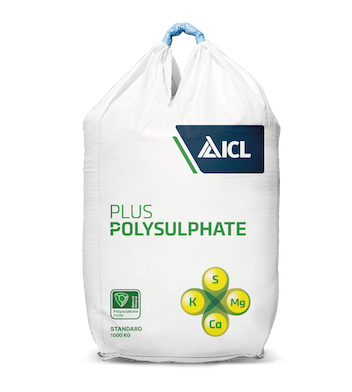
Polysulphate is a natural multi-nutrient fertilizer for acidic soils containing:
- Sulfur (19.2% S) – improves protein synthesis
- Potassium (14% K₂O) – boosts plant vigor & crop yield
- Calcium (17% CaO) – strengthens cell walls, reduces acidity stress
- Magnesium (5.5% MgO) – essential for photosynthesis
Key Benefits of Polysulphate in Acidic Soils
Polysulphate fertilizer reduces nutrient leaching and improves phosphorus availability, making it the best fertilizer for acidic soils in Tamil Nadu and Kerala.
Direct Nutrient Supply
- Replenishes calcium and magnesium deficiency in crops.
- Provides potassium & sulfur in a slow-release form for better crop yield improvement in Tamil Nadu and Kerala.
Reduces Phosphorus Fixation
- Calcium in Polysulphate forms more available calcium phosphates.
- Sulfate ions compete with phosphate for binding sites, improving P availability.
Minimizes Nutrient Leaching
- Its slow-release nutrients match crop demand, reducing losses.
- Trials show sulfur availability for up to 50 days post-application, making it ideal for high rainfall acidic soils.
Sustainable & Farmer-Friendly
- Four nutrients in one product that reduces fertilizer costs & applications.
- Neutral pH that does not worsen soil acidity.
- Recognized as an organic farming fertilizer for acidic soils with low carbon footprint.
Impact of Polysulphate Fertilizer on Crops in Tamil Nadu & Kerala Acidic Soils
Tamil Nadu and Kerala farmers grow a wide range of crops on acidic soils, where nutrient fixation and leaching reduce productivity. Field trials and farmer experiences show that Polysulphate fertilizer consistently improves crop yield and quality across coffee and tea plantations, spices, and vegetables.
Polysulphate for Cardamom Nutrient Management
- Highly sensitive to nutrient imbalances under acidic soils.
- Polysulphate strengthens vines, enhances flowering, and improves spice quality.
- Calcium improves plant tissue strength and better pest and disease resistance.
Polysulphate for Coffee Nutrient Management
- Acid soils in Tamil Nadu and Kerala often lead to nutrient imbalances and poor berry filling.
- Polysulphate supplies potassium & magnesium, improving berry size, uniform ripening, and bean quality.
- Calcium strengthens plant structure, while sulfur improves flavor and aroma.
Polysulphate for Tea Nutrient Management
- Acid soils cause magnesium deficiency, leading to leaf yellowing.
- Polysulphate provides Mg & K, improving leaf greenness, quality, and market value.

Conclusion: Overcoming Acidic Soils with Polysulphate
Acidic soils in Tamil Nadu and Kerala severely limit crop productivity due to phosphorus fixation, nutrient leaching, and aluminium toxicity. While liming is a traditional solution, farmers need a balanced nutrient management strategy.
ICL Polysulphate stands out as a sustainable farming solution by:
- Correcting nutrient deficiencies
- Reducing phosphorus fixation and leaching
- Improving crop yields in acidic soil conditions
Field trials on crops like onion and tomato prove that Polysulphate fertilizer enhances yield and quality.
For farmers in South India, Polysulphate is the most effective fertilizer for acidic soils which helps improving soil health, crop productivity, and long-term sustainability.
Related Crops

References
eagri.org. (n.d.). 8 Learning objectives a. To understand the transformation of phosphorus b. To know the factors affecting the fixation of phospho. Retrieved from http://eagri.org/eagri50/SSAC122/lec08.pdf
Gupta, N., et al. (2013). Plant aluminum stress: A global problem. IntechOpen.
Haifa Group. (n.d.). 17 Essential Plant Nutrients and Their Functions. Retrieved from https://www.haifa-group.com/articles/main-functions-plant-nutrients
Hoekenga, O.A., et al. (2006). The global extent of soil acidity. In S. Wood, J. H. H. van Uexküll, & L. R. Sanchez (Eds.), The geography of soil acidity: A global perspective.
ICL Growing Solutions. (n.d.). Polysulphate – Natural Fertilizer for All Crops & Soils. Retrieved from https://icl-growingsolutions.com/agriculture/brands/polysulphate/
IsraelAgri. (n.d.). Polysulphate: a unique natural multi-nutrient fertilizer for fruits and vegetables. Retrieved from https://israelagri.com/polysulphate-a-unique-natural-multi-nutrient-fertilizer-for-fruits-and-vegetables/
Latha, M.R., & Janaki, P. (n.d.). Acidic soil, Environmental extent, and different strategies of reclamation– A Review. The Bioscan. Retrieved from https://thebioscan.com/index.php/pub/article/download/3585/2940/6498
Lehmann, J., et al. (2003). Nutrient Leaching. In R. Lal, et al. (Eds.), Soil & Crop Sciences Section. CABI Publishing.
Oklahoma State University Extension. (n.d.). Cause and Effects of Soil Acidity. Retrieved from https://extension.okstate.edu/fact-sheets/cause-and-effects-of-soil-acidity.html
Origin Soil Nutrition. (n.d.). Polysulphate. Retrieved from https://www.originsoilnutrition.co.uk/our-range/efficiency-fertilisers/polysulphate/
Panda, N., & Chamuah, G.S. (2002). Soil acidity and its management in India.
Sivaguru, M., & Horst, W.J. (1998). The aluminum stress in plants. In Plant-Environment Interactions (2nd ed.).

