


 Whatsapp
  X
X  Mail
Mail  Copy link
The four-in-one natural fertilizer
Brand details Polysulphate<sup>®</sup> Growing Eucalyptus
Crop Nutrition Advice
Everything you need to know about fertilizing eucalyptus, best practice, suitable products, field trials, and more.

A close-up of eucalyptus ornamental foliage.
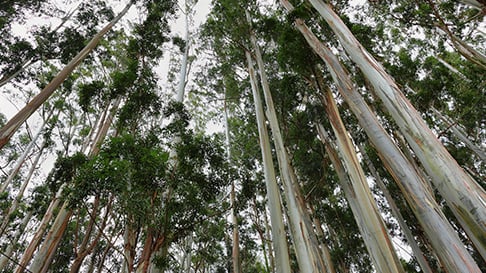
View of grown-up eucalyptus trees
Eucalyptus is one of the world’s most versatile forestry crops, valued for its rapid growth, adaptability, and wide range of industrial and environmental uses. Its ability to thrive in challenging soils and climates makes it a strategic species for modern plantation systems.
Origins and Global History of Eucalyptus
Eucalyptus (Eucalyptus obliqua) is native to Australia, Tasmania, and nearby Pacific islands, where it forms one of the dominant plant groups of the landscape. More than 700 species have been identified, many adapted to drought, fire, and nutrient‑poor soils.
The genus entered Western scientific knowledge in the late 18th century, when botanist Sir Joseph Banks collected specimens during Captain James Cook’s 1770 expedition. From the early 19th century onward, eucalyptus began spreading globally as foresters recognized its exceptional growth rate and biomass potential.
By the early 20th century, eucalyptus plantations were established across Southern Europe, South America, Africa, and Asia, where they remain essential for timber, pulp, biomass energy, and environmental restoration.
Eucalyptus Crop Overview
Eucalyptus plantations today serve multiple purposes:
- timber and construction materials
- cellulose for the paper and textile industries
- biomass and renewable energy
- beekeeping and honey production
- environmental uses such as windbreaks, erosion control, and reforestation
The species performs best in humid climates, with mild temperatures and high annual rainfall distributed throughout the year.
Global Importance
Eucalyptus is cultivated in 95 countries and covers more than 22.5 million hectares worldwide, making it the most widely planted broad‑leaf tree genus. Major producing regions include India (30%), Brazil (26%), China (7%), South Africa (5%), Vietnam (5%), and Uruguay (3%), which together account for over 75% of global plantation area. This global footprint reflects eucalyptus’ strategic role in pulp and paper production, timber, biomass energy, and environmental restoration.
Nutrients’ Role in Eucalyptus Production
Nitrogen
Nitrogen (N) is the primary driver of leaf area expansion, photosynthetic capacity, and overall biomass accumulation in eucalyptus. Because eucalyptus is a fast‑growing species with high annual dry‑matter production, its nitrogen demand is proportionally high. Adequate nitrogen supports rapid shoot elongation and canopy closure during the first two to three years, increases chlorophyll concentration to improve photosynthetic efficiency, and enhances cellulose synthesis, which is essential for pulp production. As the plantation matures, nitrogen also contributes to lignin formation, improving wood density and structural strength. Balanced nitrogen supply is therefore essential for achieving uniform growth without compromising wood quality.
Phosphorus
Phosphorus (P) is often one of the most limiting nutrients for eucalyptus, especially during establishment, because plantations are frequently grown on acidic, low‑P soils. Phosphorus stimulates root initiation, branching, and depth, enabling young trees to explore nutrient‑poor substrates more effectively. It plays a central role in energy transfer through ATP, which is crucial for rapid early growth, and supports nutrient transport and early shoot development. Adequate phosphorus also improves stress tolerance, particularly under drought or low soil fertility, making it a key nutrient for successful establishment and long‑term productivity.
Potassium
Potassium (K) is essential for eucalyptus due to its central role in stomatal regulation and osmotic balance, both of which are critical in regions with seasonal drought. Adequate potassium improves water‑use efficiency and reduces drought stress, strengthens cell walls to enhance resistance to wind and mechanical damage, and increases tolerance to diseases, including leaf‑spot pathogens. It also supports carbohydrate transport within the plant, directly influencing wood formation and pulp yield. In potassium‑deficient soils, eucalyptus typically shows reduced growth, thinner stems, and higher vulnerability to environmental stress.
Calcium
Calcium (Ca) is vital for the structural stability of fast‑growing eucalyptus tissues. It strengthens cell walls, contributing to improved wood quality and resistance to deformation, and supports root tip development, which is essential for deep rooting in poor soils. Calcium also enhances membrane stability, helping plants withstand abiotic stress, and plays a role in disease resistance, particularly against root pathogens. A deficiency in calcium can lead to weak stems, poor root development, and increased susceptibility to stress, all of which compromise plantation uniformity and long‑term performance.
Magnesium
Magnesium (Mg) is the central atom in chlorophyll, making it indispensable for eucalyptus’ high photosynthetic demand. It drives chlorophyll synthesis and light capture, supports the transport of carbohydrates from leaves to stems and roots, and enhances enzyme activation across key metabolic pathways. When magnesium is insufficient, photosynthesis declines, foliage becomes pale, and overall growth slows, ultimately reducing wood production and plantation efficiency.
Sulfur
Sulfur (S) is increasingly recognized as a limiting nutrient in fast‑growing forestry systems, including eucalyptus plantations. It supports amino acid and protein synthesis, enhances chlorophyll formation, and improves nitrogen efficiency by helping the plant convert absorbed nitrogen into functional compounds. Sulfur also contributes to enzyme activity and stress tolerance. Deficiency symptoms often resemble nitrogen deficiency but appear first in younger leaves, and inadequate sulfur can significantly reduce growth and biomass accumulation.
| Key parameter | N | P₂O₅ | K₂O | MgO | CaO | SO₃ | CaO | SO₃ | SO₃ |
|---|---|---|---|---|---|---|---|---|---|
| Early establishment | + | ++ | + | +/- | + | +/- | + | +/- | +/- |
| Root development | + | ++ | + | +/- | ++ | +/- | ++ | +/- | +/- |
| Shoot growth (first 2–3 years) | ++ | + | + | + | +/- | + | +/- | + | + |
| Biomass accumulation | ++ | + | ++ | + | +/- | + | +/- | + | + |
| Water‑use efficiency / drought tolerance | +/- | +/- | ++ | +/- | +/- | + | +/- | + | + |
| Wood formation & density | + | +/- | ++ | + | ++ | +/- | ++ | +/- | +/- |
| Disease tolerance | +/- | +/- | + | +/- | + | + | + | + | + |
| Nutrient transport & metabolism | + | + | + | ++ | +/- | + | +/- | + | + |
| Stress resilience (abiotic) | +/- | + | ++ | + | + | + | + | + | + |
++ = strong positive effect
+ = positive effect
+/- = moderate or indirect effect
– = little to no effect
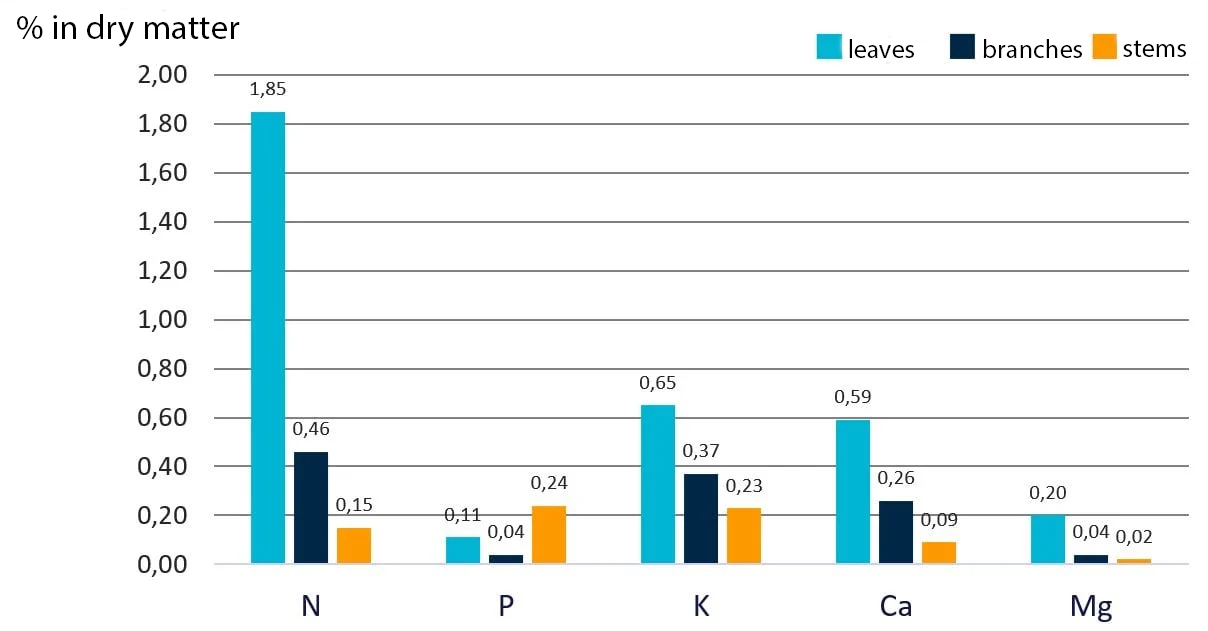
Distribution of macronutrients in above-ground parts in 2.5-year-old trees of eucalyptus (cv. Grandis)
Micronutrients
Boron (B)
Supports strong cell wall formation, active root elongation, and stable development of growing points, helping young eucalyptus trees establish quickly and uniformly. To avoid the loss of apical dominance it is recommended to include boron in all soil and foliar applications (the total B rate ranges between 2-6 kg/ha, depending on the growth stage and the amount of water applied).
Iron (Fe)
Drives chlorophyll formation and electron transport in photosynthesis, sustaining the high metabolic activity required for rapid biomass production.
Manganese (Mn)
Contributes to efficient photosynthesis and enzyme activation, reinforcing overall plant vigor and supporting healthy leaf and stem development.
Zinc (Zn)
Regulates hormone balance and internode elongation, promoting well‑structured growth and maintaining the natural architecture of the canopy.
Copper (Cu)
Essential for lignin formation and oxidative enzyme activity, strengthening woody tissues and supporting the structural integrity of fast‑growing stems.
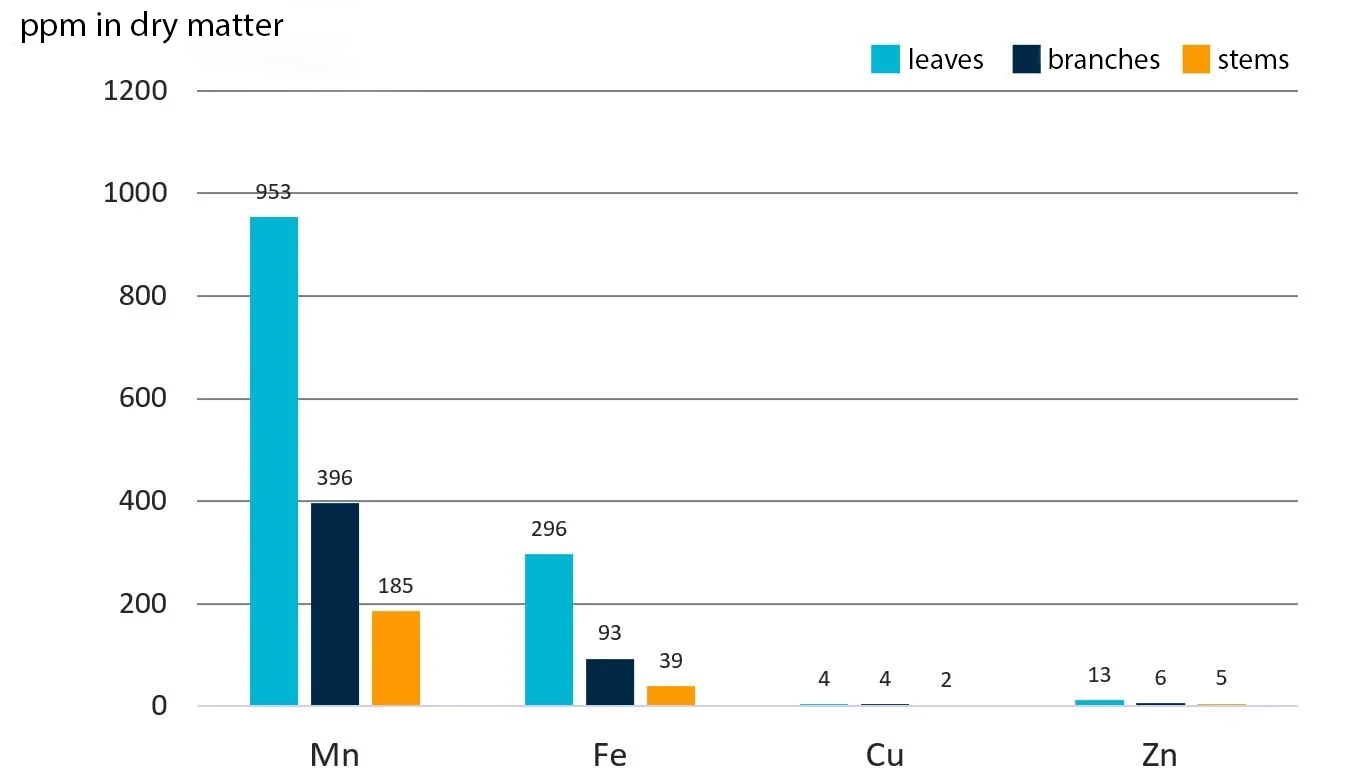
Distribution of micronutrients in above-ground parts in 2.5-year-old trees of eucalyptus (cv. Grandis)
Critical Leaf Nutrient Levels for Eucalyptus
Eucalyptus has well‑defined critical leaf nutrient levels that indicate adequate nutrition for sustained growth. According to the 2020 Brazilian study on critical nutrient levels, healthy eucalyptus leaves typically contain around 20–25 g/kg of nitrogen, 1.3–1.6 g/kg of phosphorus, and 10–12 g/kg of potassium, reflecting the species’ strong demand for N and K during rapid biomass accumulation. Calcium and magnesium are also important for structural development, with critical levels of approximately 4.0–5.0 g /kg Ca and 2.5–3.0 g/kg Mg, while sulfur sufficiency is reached at about 1.5–2.0 g/kg. These thresholds provide a reliable basis for diagnosing nutrient status and guiding fertilization in eucalyptus plantations.
Nutrient Deficiencies and their Symptoms in Eucalyptus
Healthy eucalyptus plantations depend on a balanced nutrient supply, and shortages quickly show up in the canopy, roots, and stem development. Each nutrient plays a distinct role, and its absence produces characteristic symptoms that help diagnose problems early.
Nitrogen deficiency
Nitrogen shortage reduces leaf area and weakens canopy development, slowing biomass accumulation in young eucalyptus stands. Growth becomes visibly lighter and less vigorous. Little or no lateral branching.
Phosphorus deficiency
Low phosphorus limits early root development, which is especially important for eucalyptus establishment on acidic or low‑P soils. Trees remain smaller and explore the soil profile less effectively. P deficiency severely reduces phosphorus levels in the stem from 0.5% in P-sufficient trees to 0.02%, and P-concentrations in bark from 0.2-0.9% – to < 0.1% in deficient trees. Phosphorus deficiency is more common when soil pH is too low (<5.5) or too high (>7.0).
Potassium deficiency
Potassium is central to water regulation in eucalyptus, so deficiency quickly increases drought sensitivity. Leaves may show marginal scorching and stems develop with reduced structural strength, premature leaf drop. Symptoms detected in seedlings of E. botryoides, E. saligna y E. pilularis. Larger branching than normal, due to a reduction in the length of the internodes. The branches grow in all the axils of the leaves of the main stem and some also produce secondary branches. K deficiency can be aggravated by the application of dolomitic limestone, which is done to raise the pH and enrich the soil with Mg. A severe K deficiency significantly reduces plant vigour and crop yield.
Calcium deficiency
Fast‑growing tissues depend on steady calcium supply. When levels are low, developing leaves and root tips become weak, leading to uneven growth and poorer stand uniformity. The younger leaves are deformed with pale green spots, but the regions near the veins are normal in color. The apical bud usually dies. Mature, older leaves are usually not affected. A serious deficiency causes the abortion of the inflorescence. If soil pH remains >5.8, there is only a little chance of Ca deficiency.
Magnesium deficiency
Magnesium supports chlorophyll formation and carbohydrate transport. Deficiency causes interveinal yellowing and reduces the flow of assimilates to stems and roots, slowing wood formation. Yellowing of older leaves, starting between the main veins, which retain a narrow green border. Younger leaves are less affected. Unless the deficiency is severe, it doesn’t become apparent until late summer. Fallen branches and larger than normal leaves. The deficiency is mainly revealed in plots with pH<5.5, and plots that have received high doses of N, Ca or K fertilizers, in light soils and in very dry years.
Sulfur deficiency
Sulfur shortage lowers protein synthesis and overall metabolic activity. Young leaves appear uniformly pale, and growth becomes noticeably slower. The yellowing begins in the veins and progresses outwards, leaving a speckled appearance and reddish margins and main veins. The symptoms are similar to those of nitrogen deficiency. However, as S is less mobile in the plant, these symptoms initially appear on the upper leaves, unlike N deficiency, which is more uniform throughout the plant.
Micronutrient deficiencies
Boron
Weak cell walls and reduced root elongation.
Iron
Pale young leaves and reduced photosynthetic activity.
Manganese
Light mottling and weaker leaf function.
Zinc
Short internodes and small, narrow leaves.
Copper
Poor lignification and weak shoot tips.
Fertilization Strategies in Eucalyptus
Eucalyptus fertilization typically follows an early, establishment‑focused strategy built around balanced NPK inputs, with nitrogen playing the strongest role in driving canopy expansion and biomass accumulation. Across commercial plantations, fertilization is concentrated in the first year to support rapid root development and stand closure, with phosphorus applied at planting to overcome low‑P soils and potassium added to improve water regulation and stress tolerance. Studies on Eucalyptus urophylla show that different fertilization strategies directly influence soil nutrient availability and microbial resource use, underscoring the need for site‑responsive programs that adjust N, P, and K rates to soil conditions. Broader plantation research in Brazil confirms that fertilization enhances light‑use efficiency and growth efficiency across soil and climate gradients, reinforcing the importance of early, balanced, and soil‑tailored nutrient management for sustained productivity.
Sources:
Lima Neto, A.J., Neves, J.C.L., Martinez, H.E.P., Sousa, J.S., & Fernandes, L.V. (2020). Establishment of critical nutrient levels in soil and plant for eucalyptus. Revista Brasileira de Ciência do Solo, 44, e0190150. https://doi.org/10.36783/18069657rbcs20190150
Viera, M., Ruíz Fernández, F., & Rodríguez‑Soalleiro, R. (2016). Nutritional prescriptions for Eucalyptus plantations: Lessons learned from Spain. Forests, 7(4), 84.
Bassaco, M.V.M., Motta, A.C.V., Pauletti, V., Prior, S.A., Nisgoski, S., & Ferreira, C.F. (2018). Nitrogen, phosphorus, and potassium requirements for Eucalyptus urograndis plantations in southern Brazil. New Forests, 49, 681–697.
Zhu, Z., & Wu, L. (2023). Fertilization and residue management improved soil quality of Eucalyptus plantations. Forests, 14, 1570.
Gu, X., Liu, L., Su, M. et al. Various Fertilization Strategies Regulates the Utilization Efficiency and Limitation of Microbial Resource Via Soil Nutrient Availability in Eucalyptus urophylla Plantations. J Soil Sci Plant Nutr (2025). https://doi.org/10.1007/s42729-025-02860-8
Eucalyptus Trials
Guides & Articles
Efficient fertilization in eucalyptus plantations

Q&A
Here are some frequently asked questions we received from farmers regarding growing eucalyptus.
No. One of the advantages of this crop is its high efficiency in using nutrients (N, P, K). Thanks to this, eucalyptus can be planted on marginal agricultural land where other crops are not economically viable. While this may not result in optimal tree‑growth rates, it does allow degraded land to be used productively and gradually regenerate over the long term.
With a precise fertilization plan, growth rates can be significantly increased. The planting year should begin with a controlled‑release fertilizer such as Agroblen®, followed in the second year by a product like Agromaster®.
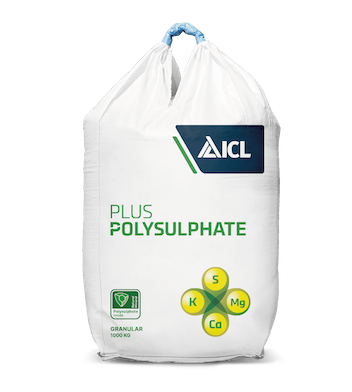
In soils with additional potassium and calcium requirements, the ideal complement is Polysulphate®.
A solid fertilization plan using products such as Agroblen®, Agromaster®, Polysulphate® and Agroleaf® will undoubtedly help increase growth rates and shorten the harvest cycle.
Explore Eucalyptus Solutions by Brand
Find the right solutions to improve crop quality and yield

Master your crop nutrition in any condition
Brand details Agromaster<sup>®</sup>The four-in-one natural fertilizer
Brand details Polysulphate<sup>®</sup>Master your crop nutrition in any condition
Brand details Agromaster<sup>®</sup>Discover Our Solutions for Growing Eucalyptus
Eucalyptus Solutions: Increase Your Harvest
Agromaster®

Polysulphate®
Digital Tools
Access calculators to improve nutrient management and boost productivity
