


 Whatsapp
  X
X  Mail
Mail  Copy link
State-of-the-art nutrition giving you higher Nutrient Use Efficiency (NUE) with fewer applications.
Brand details Agrocote<sup>®</sup> Growing Grass
crop nutrition advice
Everything you need to know about grass or grass-clover mixture fertilization, best practice, suitable products, field trials and more.
Crop nutrition advice for growing grass (Poaceae)

Grass and clover enhanced with Polysulphate

Grass field after cutting
Introduction & Origin
Grass species (Poaceae) and grass‑clover mixtures form the basis of productive forage systems, especially in temperate regions. These crops provide high‑quality forage for dairy and beef production due to their high biomass production, digestibility, and nutritional value. In mixed swards, clover contributes biologically fixed nitrogen (N), reducing dependence on mineral N fertilizers while improving forage protein concentration.
Long-term productivity depends on maintaining adequate soil fertility, appropriate soil pH, nutrient supply, and effective regrowth following grazing or cutting. Nutrient management is particularly important in intensive multi-cut systems where large quantities of nutrients are removed in harvested forage
Growing Conditions
Climate & temperature
Temperate forage grasses thrive under cool, moist conditions and exhibit their highest growth rates during spring and autumn when temperatures are moderate and soil moisture is adequate.
- Optimal growth occurs between 10-25 °C, depending on species.
- Regular rainfall or irrigation is required to support rapid regrowth following grazing or cutting.
- High temperatures and drought stress reduce tillering, leaf expansion, dry matter production, and forage quality.
Grass‑clover mixtures perform best under similar condition. Is it important to highlight that biological N fixation are generally favored by warm, moist soils and moderate temperatures, while prolonged drought or heat stress can reduce N contribution to the sward.
Soil requirements
Grassland productivity is strongly influenced by soil physical condition, pH, and nutrient availability. Well‑drained soils with good structure promote root development, nutrient uptake, and rapid regrowth after harvest..
For intensive grass production, the optimum soil pH generally ranges from 5.5 to 6.5. In grass‑clover mixtures, maintaining a pH of 6.0 is particularly important because clover establishment, nodulation, and biological N fixation are highly sensitive to soil acidity.
Loam and sandy loam soils with adequate organic matter generally provide the most favorable balance between drainage, water-holding capacity, aeration, and nutrient retention. Soil compaction should be avoided, as it restricts root growth and reduces the efficiency of water and nutrient use.
Water & irrigation
- Adequate water availability is essential for sustaining grassland productivity throughout the growing season. Water deficits can restrict tillering, leaf expansion, and canopy recovery following grazing or cutting, ultimately reducing both forage yield and quality. To support optimum growth:Maintain adequate soil moisture during establishment and after each harvest.
- Minimize moisture stress during active growth, as drought can reduce tillering, leaf expansion, forage quality, and nutrient use efficiency.
- Avoid prolonged waterlogging or soil saturation, which restricts root respiration, reduces nutrient uptake, and increases disease pressure.
- Where irrigation is available, pioritize water applications after mowing and during rapid vegetative regrowth.
Annual water requirements depend on climate, grass species, management intensity, and yield potential, but productive temperate grassland systems typically require between 500 and 800 mm of water per year.
Grass Growth Stages
- Establishment – seed germination, root development, and early tillering. Successful establishment is critical for sward density, and long-term productivity.
- Vegetative growth – rapid leaf production and canopy expansion, resulting in high dry matter accumulation and forage quality.
- Regrowth cycles – following mowing or grazing, new leaves emerge from existing tillers, restoring leaf area and supporting continued dry matter production.Stem elongation and heading – reproductive development in unmanaged or unmown swards, marked by stem extension and seed head emergence. Forage digestibility and quality typically decline during this stage.
- Dormancy or growth slowdown – growth slows in response to unfavorable conditions such as drought, excessive heat, low temperatures, or limited sunlight.
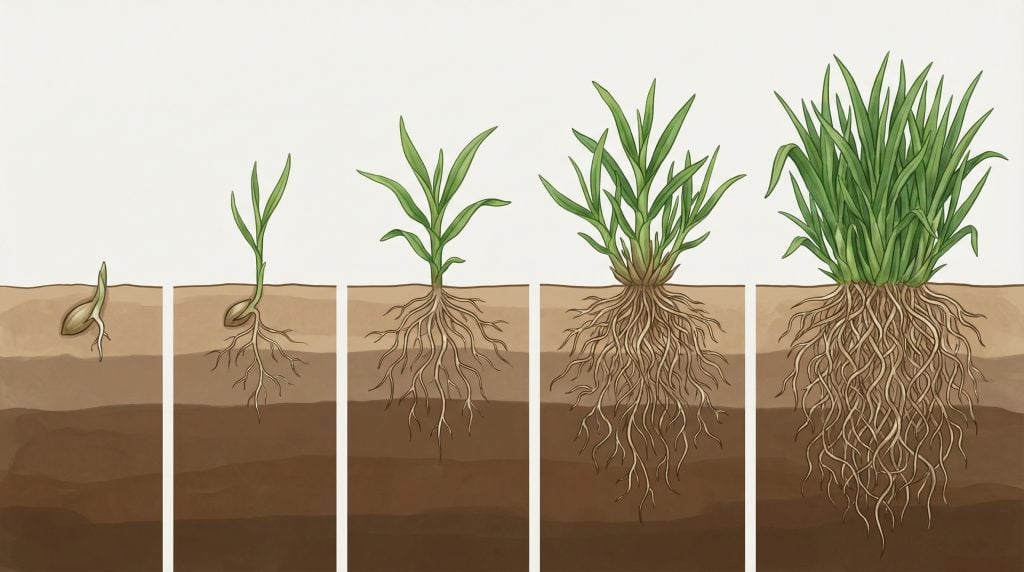
Grass growth stages from seed germination to a fully established plant with developed roots and leaves.
Nutrient Requirements
Nutrient uptake and fertilizer requirements vary according to grass and clover species, sward composition, yield level, cutting frequency, and soil fertility. Table 1 presents the typical nutrient uptake required to produce 12 t ha⁻¹ of dry matter from ryegrass (Lolium multiflorum L.).
Table 1. Nutrient requirements produce 12 t ha⁻¹ of dry matter from ryegrass (NEPAR, 2019).| Nutrient | N | P | K₂O | Mg | S | Ca |
|---|---|---|---|---|---|---|
| kg/ha | 300 | 41 | 474 | 36 | 26 | 75 |
| Nutrient | Fe | Cu | Zn | B | Mn | Mo |
| g/ha | 2,424 | 88 | 244 | 149 | 700 | 0,9 |
Dynamics of Nutrient Uptake Over the Growing Season
Grass growth and nutrient uptake are closely linked. Nutrient demand is greatest during periods of rapid vegetative growth and immediately following grazing or cutting, when the sward must rebuild leaf area and restore carbohydrate reserves. Maintaining an adequate nutrient supply throughout the growing season is essential to sustain dry matter production, and forage quality
Nitrogen (N)
Nitrogen is the primary driver of grass growth, protein concentration, and forage yield. Uptake is highest during periods of rapid growth. Split N applications are generally recommended to match crop demand, improve N use efficiency, support regrowth, and reduce the risk of nitrate losses. In addition, controlled-release or enhanced-efficiency N fertilizers can be used to provide a more gradual nutrient supply throughout the growing season. In grass-clover mixtures, biological N fixation can contribute a substantial proportion of the crop’s N requirement, reducing the need for fertilizer N inputs.
Phosphorus (P)
Phosphorus is particularly important during establishment and early regrowth because it supports root development, tillering, and energy transfer processes. Adequate soil P levels are essential for maintaining yield and promoting clover growth and N fixation in mixed swards.
Potassium (K)
Potassium is typically the most heavily removed nutrient in intensively managed grassland systems. It plays a central role in water regulation, photosynthesis, sugar transport, stress tolerance, and winter survival. Because large quantities are removed in harvested forage, regular replacement is essential, especially in high-yielding cutting systems.
Magnesium (Mg)
Magnesium is a key component of chlorophyll and is required for photosynthesis and carbohydrate production. Adequate Mg nutrition supports forage quality and helps maintain appropriate mineral balance for grazing livestock.
Sulfur (S)
Sulfur is essential for the synthesis of S-containing amino acids, protein formation, and efficient N utilization. Plants absorb S primarily as sulfate (SO₄²⁻), meaning that S contained in soil organic matter must first be mineralized before becoming plant-available. Because S mineralization is often limited under the cool soil conditions, S availability may not be sufficient to meet crop demand. As a result, S fertilization may be required to prevent deficiencies, especially on sandy soils, low-organic matter soils, or fields susceptible to sulfate leaching. Adequate S supply improves N use efficiency, supports protein production, enhances forage quality, and grassland yield.
Trace elements for animal health
In grassland systems, trace element management is often undertaken to support livestock health rather than to increase forage yield. Where soil or forage micronutrient concentrations are low, supplementation may be required to prevent animal deficiencies and maintain yield.
Impact of Nutrients on Forage Yield and Quality
| Key parameter | N | P | K | Mg | S | Ca |
|---|---|---|---|---|---|---|
| Dry matter yield | +++ | ++ | +++ | + | ++ | ++ |
| Protein content | +++ | + | + | + | +++ | + |
| Palatability | + | ++ | + | + | + | |
| Digestibility | ++ | + | ++ | + | ++ | + |
Deficiency Symptoms
Nitrogen
- Pale green to yellow olver leaves
- Reduced tillering and slower regrowth following grazing or cutting
- Lower dry matter yield and protein concentrationThin, less competitive swards
Phosphorus
- Stunted growth
- Poor root development
- Reduced tillering and slower establishment
- Delayed regrowth after harvest
Potassium
- Yellowing and scorching of leaf margins, starting on older leaves.
- Reduced drought, cold, and disease tolerance
- Poor water-use efficiency
- Lower dry matter yield
Calcium
- Restricted root growth
- Poor establishment
- Weakened cell wall development and tissue integrity
Magnesium
- Interveinal chlorosis on older leaves
- Reduced photosynthetic activity
- Lower forage quality and yield
Sulfur
- Pale green to yellow discoloration of young leavesLower protein and feed quality
- Reduced forage nutritional value and N use efficiency
Although sodium is not considered a nutrient for plants, inadequate sodium concentrations in forage can reduce palatability and voluntary intake by grazing livestock.
Fertilization Practices
A successful fertilization program begins with soil analysis and aligns nutrient supply with crop demand throughout the growing season. Nutrient management should account for expected yield, species composition, soil fertility, nutrient removal in harvested forage, and contributions from manure, slurry, or biological N fixation.
Key principles
- Maintain soil pH within the optimum range for grass and grass-clover systems to maximize nutrient availability and plant development.
- Base fertilizer applications on soil analysis, expected nutrient removal, and yield goals.
- Replace nutrients removed in harvested forage to sustain productivity and sward persistence.
- Apply N in split applications to match seasonal growth, improve N use efficiency, and support rapid regrowth following grazing or cutting.
- Consider controlled-release or enhanced-efficiency N fertilizers to provide a more continuous nutrient supply, and reduce nutrient losses.
- Ensure adequate S availability, particularly in early spring when mineralization rates are low.
- Monitor soil fertility regularly and adjust nutrient applications according to crop demand and soil test results.
- Follow the principles of 4R Nutrient Stewardship: Right Source, Right Rate, Right Time, and Right Place.
Conclusion
Grass and grass‑clover systems require an integrated nutrient management strategy that combines appropriate soil pH, efficient fertilization, and timely nutrient applications throughout the growing season. Adequate nutrition supports high dry matter yield, protein content, palatability, and digestibility which are all essential for productive livestock systems. Proper nutrient management according to soil testing enhances forage quality, improves regrowth, and contributes to sustainable and profitable grassland production.
References
NEPAR. (2019). Manual de adubação e calagem para o estado do Paraná [Fertilization and Liming Manual for the State of Paraná]. Sociedade Brasileira de Ciência do Solo.
Related Trials
Guides & Articles
Q&A
Here are some frequently asked questions we received from farmers regarding grass.
Sulfur is required for protein synthesis and efficient N utilization. Plants can only absorb S primarily as sulfate (SO₄²⁻), meaning organic S contained in soil organic matter must first be mineralized before becoming available. Because mineralization is often limited by low soil temperatures in early spring, S fertilization may be beneficial before the first cut, particularly on sandy soils or where S deficiency is likely.
It depends on the nutrient/potassium content of the slurry, application rate, soil fertility status, and expected yield. Grass removes large amounts of K in harvested forage, and slurry alone may not always replace the total amount removed. Soil testing should be used to determine whether additional K fertilization is required.
The products permitted in organic farming vary according to local regulations and certification schemes. Common S sources that may be approved include Polysulphate®, gypsum (calcium sulfate), and kieserite (magnesium sulfate).
Sulfur requirements depend on soil type, soil S status, organic matter content, rainfall, yield target, and previous manure applications. Sandy soils are generally at greater risk of S deficiency due to sulfate leaching, whereas soils with higher organic matter may supply more S through mineralization. Fertilizer recommendations should therefore be based on soil conditions, crop demand, and local recommendations rather than a single fixed rate.
Micronutrient deficiencies are relatively uncommon in grassland systems but may occur under specific soil and environmental conditions. In many grazing systems, micronutrients are managed primarily to support animal health rather than forage production. Where soil or forage levels are low, supplementation may be necessary to avoid deficiencies.
Explore Grass Solutions by Brand
Find the right solutions to improve crop quality and yield

Master your crop nutrition in any condition
Brand details Agromaster<sup>®</sup>
The four-in-one natural fertilizer
Brand details Polysulphate<sup>®</sup>State-of-the-art nutrition giving you higher Nutrient Use Efficiency (NUE) with fewer applications.
Brand details Agrocote<sup>®</sup>Master your crop nutrition in any condition
Brand details Agromaster<sup>®</sup>The four-in-one natural fertilizer
Brand details Polysulphate<sup>®</sup>Discover Our Solutions for Growing Grass
Grass Solutions: Increase Your Harvest
Polysulphate®
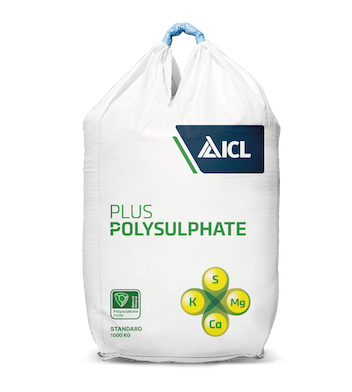
Polysulphate®

Agrocote®

Agrocote®
Agromaster®

Agromaster®
Digital Tools
Access calculators to improve nutrient management and boost productivity


