Whatsapp
  X
X  Mail
Mail  Copy link
 Growing Citrus
Crop Nutrition Advice
Everything you need to know about fertilizing citrus, best practice, suitable products, field trials, and more.
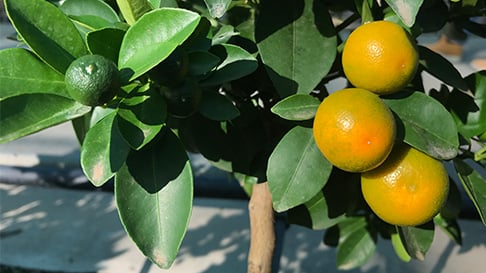
Ripening citrus fruits
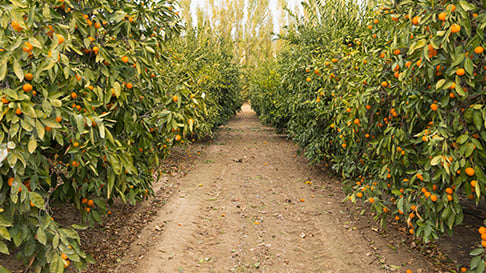
Mandarin plantations
Citrus (Citrus spp.) refers to a diverse group of evergreen fruit trees and shrubs within the Rutaceae family, including commercially important species such as Citrus sinensis (sweet orange), Citrus reticulata (mandarin), Citrus limon (lemon), Citrus aurantifolia and Citrus latifolia (limes), and Citrus paradisi (grapefruit). These species share similar physiological traits: glossy evergreen leaves, fragrant white flowers, and segmented fruits rich in aromatic oils and organic acids. Although genetically complex and highly inter‑hybridized, citrus species are broadly adapted to warm subtropical and tropical climates and are cultivated worldwide for fresh consumption, juice processing, and essential oil extraction. Their growth habit, nutrient demand, and sensitivity to soil conditions make them a crop where balanced nutrition and careful orchard management are essential for achieving consistent yield and high fruit quality.
Growing Conditions
Citrus performs best under warm, frost-free conditions with:
- Temperature: 20–32 °C
- Rainfall: 800–1,200 mm annually, supplemented by irrigation in dry periods
- Soils: well-drained, moderately acidic to neutral (pH 5.5–7.0), with good aeration
- Salinity: moderate sensitivity; high EC reduces fruit size and increases rind defects
Citrus is sensitive to waterlogging, prolonged drought, and extreme temperatures. Adequate irrigation and soil structure are essential for root health and nutrient uptake. In calcareous soils, micronutrient deficiencies, especially iron, zinc, and manganese, are common and require targeted correction.
Global Production and Systems
Citrus is cultivated in a wide range of production systems, from smallholder orchards to highly mechanized plantations, and global output exceeds 160 million tonnes annually. Major producers include Brazil, China, India, Mexico, the United States, and Mediterranean countries. Brazil dominates the orange‑juice sector, while China and India lead in fresh fruit, and Mediterranean regions specialize in high‑quality export citrus. Despite strong demand, yields and fruit quality vary considerably due to soil fertility constraints, salinity, drought stress, nutrient imbalances, and increasing pest and disease pressure. Production systems differ in planting density, irrigation method, and canopy management, yet they share common challenges such as soil nutrient depletion, salinity buildup, micronutrient deficiencies, and irregular fruit set. Modern citrus agronomy therefore emphasizes fertigation, balanced NPK supply, micronutrient management, and improved rootstocks to enhance resilience, fruit quality, and long‑term orchard productivity.
Citrus Usage and Quality
Citrus fruits are consumed fresh or processed into juice, concentrates, essential oils, and peel-derived products.
Key quality parameters include:
- fruit size
- peel color
- juice content (Brix, acidity, sugar–acid ratio)
- firmness
- absence of defects (e.g. creasing, splitting, rind breakdown).
Nutrition influences citrus quality both indirectly, through canopy vigor, flowering, and fruit set, and directly, by affecting sugar accumulation, peel strength, juice yield, and postharvest performance.
Nutrient Requirements
Citrus is a perennial crop with continuous nutrient demand throughout the year. The most absorbed macronutrients are potassium (K) and nitrogen (N), followed by calcium (Ca), phosphorus (P), magnesium (Mg), and sulfur (S). Micronutrients such as iron (Fe), zinc (Zn), manganese (Mn), boron (B), and copper (Cu) are also essential and frequently limiting, especially in high‑pH soils.
Average Nutrient Removal per 1 ton of Fresh Citrus Fruit
| Nutrient | Approx. removal per ton of fresh fruit | Notes |
|---|---|---|
| Nitrogen (N) | 1.5–2.0 kg | Needed for canopy + fruit set |
| Phosphorus (P₂O₅) | 0.3–0.5 kg | Important for roots + flowering |
| Potassium (K₂O) | 2.5–3.5 kg | Highest demand; key for fruit quality |
| Calcium (CaO) | 1.0–1.5 kg | Peel strength + root health |
| Magnesium (MgO) | 0.3–0.6 kg | Photosynthesis + sugar transport |
Role of Nutrients in Citrus Production
Nitrogen (N)
Nitrogen drives vegetative growth, leaf expansion, and canopy development, supporting flowering and early fruit sizing. Adequate N promotes strong shoot growth and photosynthetic capacity, which are essential for sustaining fruit load. However, because citrus is sensitive to excess nitrogen, oversupply can delay external coloring, thicken the rind, and reduce internal quality. Balanced nitrogen management is therefore critical for achieving both yield and desirable fruit characteristics.
Phosphorus (P)
Phosphorus supports root development, early establishment, flowering, and fruit set. It plays a central role in energy transfer (ATP) and is particularly important for young trees and orchards with high cropping intensity. In soils with strong P fixation, ensuring adequate availability is essential for maintaining canopy vigor and supporting long‑term productivity.
Potassium (K)
Potassium is the most influential nutrient for citrus fruit quality. It regulates water balance, sugar accumulation, juice content, and peel strength, and is essential for achieving good fruit size and internal quality. Citrus removes large quantities of potassium in harvested fruit, making K fertilization a primary driver of yield and quality response. Adequate K also improves tolerance to drought, salinity, and cold stress, which is especially important in regions with climatic variability.
Calcium (Ca)
Calcium strengthens cell walls, supports root growth, and improves peel integrity. It plays a key role in reducing physiological disorders such as creasing and rind breakdown and contributes to better postharvest performance. Because calcium is relatively immobile within the plant, consistent availability in the root zone is essential for high‑quality citrus production.
Magnesium (Mg)
Magnesium is the central atom in chlorophyll and is essential for photosynthesis and enzyme activation. It supports carbohydrate transport from leaves to developing fruit and helps maintain canopy function throughout the season. Adequate Mg prevents premature leaf drop, which would otherwise reduce photosynthetic capacity and limit fruit development.
Sulfur (S)
Sulfur is involved in amino acid and protein synthesis and supports several enzyme systems. It enhances nitrogen‑use efficiency and contributes to overall vegetative growth and canopy color. In low‑organic‑matter soils or regions with reduced atmospheric S deposition, supplemental sulfur can be important for maintaining balanced nutrition.
Micronutrients (Fe, Zn, Mn, B, Cu)
Micronutrients are essential for citrus productivity and fruit quality. Iron, zinc, and manganese directly influence chlorophyll formation, leaf function, and photosynthetic activity, and are frequently limiting in high‑pH or calcareous soils. Boron is required for flowering, pollen viability, fruit set, and peel development, while copper supports shoot strength, lignification, and disease resistance. Because citrus is highly responsive to micronutrient balance, regular soil and leaf analysis is essential to guide fertilization and maintain long‑term orchard performance.
Citrus Deficiency Symptoms
(Descriptions are generalized; local diagnosis should be confirmed with leaf analysis.)
Nitrogen deficiency
- Pale leaves
- Reduced shoot growth
- Small fruit
- Poor color development
Phosphorus deficiency
- Dark green foliage
- Reduced growth
- Thin canopy
- Delayed flowering
Potassium deficiency
- Leaf‑edge chlorosis
- Tip burn
- Weak peel
- Small fruit
- Low juice content
Calcium deficiency
- Distorted young leaves
- Weak roots
- Creasing
- Rind breakdown
Magnesium deficiency
- Interveinal chlorosis on older leaves
- Premature leaf fall
Sulfur deficiency
- Yellowing of younger leaves
- Reduced vigor
Iron deficiency
- Interveinal chlorosis on young leaves
- Most common in calcareous soils
Zinc deficiency
- Small leaves
- Rosetting
- Shortened internodes
Manganese deficiency
- Interveinal chlorosis
- Reduced photosynthesis
Boron deficiency
- Poor fruit set
- Misshapen fruit
- Internal breakdown
Conclusion
Citrus is a high‑value perennial crop whose productivity and fruit quality depend heavily on balanced nutrition, efficient irrigation, and careful canopy management. Nutrient deficiencies, especially of potassium, calcium, and micronutrients, are common and can significantly reduce yield and marketability. Regular soil and leaf analysis, combined with targeted fertilization, supports healthy canopies, strong root systems, and consistent fruit production. Investing in citrus nutrition is essential for long‑term orchard sustainability and profitability.
Sources & References
- FAOSTAT – Citrus Production & Area (Global Data) www.fao.org/faostat/en/#data/QCL
- USDA Foreign Agricultural Service – Citrus: World Markets and Trade www.fas.usda.gov/data/citrus-world-markets-and-trade
- World Citrus Organisation (WCO) & CIRAD – Citrus World Statistics worldcitrusorganisation.org
Citrus Trials

Q&A
Citrus removes large amounts of potassium in harvested fruit because K regulates sugar accumulation, juice content, peel strength, and water balance. High‑yielding orchards export more K than any other nutrient, making potassium the primary driver of fruit size and internal quality. Regular K replenishment is essential to avoid small fruit, low juice percentage, and weak peel.
For commercial orchards, leaf analysis should be done annually, ideally during the summer flush when nutrient levels stabilize. Soil analysis is recommended every 2–3 years, or more frequently in fertigated orchards or sandy soils. These diagnostics help fine‑tune NPK supply, detect micronutrient deficiencies early, and prevent over‑application.
Fertigation allows nutrients to be supplied in small, frequent doses that match the tree’s growth stages. Citrus responds well to split N and K applications, with higher N early in the season and increased K during fruit enlargement and maturation. Micronutrients, especially Fe, Zn, Mn, and B, can be applied through fertigation or foliar sprays to correct deficiencies quickly.
Many citrus‑growing regions have calcareous, alkaline, or sandy soils, which reduce the availability of iron, zinc, and manganese. Citrus has a relatively high demand for these micronutrients, and its evergreen canopy makes deficiencies more visible. Regular foliar feeding or chelated micronutrient applications are often required to maintain canopy color, photosynthesis, and fruit set.
Citrus is sensitive to both drought and waterlogging. Poor irrigation scheduling reduces nutrient uptake, increases salinity stress, and leads to smaller fruit and lower juice content. Consistent soil moisture combined with good drainage supports root health, improves nutrient availability, and enhances fruit size, peel strength, and overall quality.
Discover Our Solutions for Growing Citrus
Citrus Solutions: Increase Your Harvest
Combifert®

Nutrient & Unit Converter
Access calculators to improve nutrient management and boost productivity