


 Whatsapp
 X
 Mail
 Copy link


State-of-the-art nutrition giving you higher Nutrient Use Efficiency (NUE) with fewer applications.
Brand details Agrocote<sup>®</sup> Growing Soybean
Crop Nutrition Advice
Everything you need to know about soybean fertilization, best practice, suitable products, field trials and more.
Crop nutrition for growing soybean (Glycine max)

Young soybean plants

Soybean crop rows
Introduction
Soybean (Glycine max L.) is one of the world’s most important legume crops, grown for its high‑protein seed and versatile oil. Originating in East Asia, the crop was first domesticated in China thousands of years ago and later spread across Japan and Korea before reaching the Americas in the 19th century. Nowadays, soybean is cultivated across tropical, subtropical, and warm temperate regions, thriving in fertile, well‑drained soils and forming a central pillar of global food, feed, and oilseed production.
Soybean is valued for its dual role as a food and industrial crop. On a dry matter basis, the raw seed typically contains 35% to 45% protein and 15% to 25% oil, making it a major source of vegetable protein for human diets and livestock feed. Its ability to fix atmospheric nitrogen through symbiosis with Bradyrhizobium bacteria remains crucial to agriculture, supplying almost 100% of the crop’s total nitrogen requirements.
Growing Conditions
Climate and temperature
Soybean exhibits optimal physiological development under warm conditions, with ideal temperatures ranging from 20–35°C. Temperatures below 15°C retard germination and emergence while increasing susceptibility to early‑season diseases. Conversely, extreme heat exceeding 40 °C impairs pollen viability, disrupts fertilization, increases flower and pod abortion, and accelerates senescence. These negative effects intensify when high temperatures coincide with water deficits. Low relative humidity and dry conditions during late reproductive stages are required for uniform crop maturation and seed quality preservation.
Soil requirements
Soybean grows most successfully in well‑drained loamy soils that allow deep root exploration. Although the crop tolerates a wide pH range (5.5–7.5), slightly acidic to neutral soils optimize nutrient availability and promote effective nodulation. The plant develops a pivoting root system capable of reaching depths of up to 1.8 m, although 60–70% of totalroot mass remains concentrated in the top 15 cm. Compacted soils restrict root penetration and increase the risk of hypocotyl breakage during emergence, resulting in poor stand establishment and shallow rooting. Favorable soil physical structure, adequate calcium availablity, and the absence of aluminum toxicity are essential for deep root development. Furthermore, soybean fits well into cereal‑based rotation systems, enhancingnitrogen availability for subsequent crops through biological nitrogen fixation.
Water requirements
High soybean yields require approximately 700 mm of water over the season, with an ideal distribution of 200–250 mm (35%) during vegetative growth and 450–500 mm (65%) during the reproductive phase. Water shortages during flowering, even for a few days, can dramatically reduce yield, especially in sandy soils or in fields where root depth is limited by soil constraints. Maintaining an adequate soil moisture status until pod filling is essential, whereas dry conditions are preferred during ripening.
Global Production
Global production is dominated by Brazil, the United States, and Argentina, which collectively account for approximately 80% of worldwide soybean production. Global production has expanded significantly in recent decades, surpassing 350 to 400 million metric tons across more than 135–140 million hectares . This establishessoybean as the predominant oilseed crop globally and one of the most critical agricultural commodities by volume..
The crop’s economic importance continues to grow driven by its diverse commercial applications, ranging from high-protein animal feed – the global benchmark for livestock and aquaculture nutrition – to vegetable oil used in food processing and biofuels. Together with traditional human food products, such as tofu, soy milk, and fermented foods, as well as specialized industrial ingredients, soybean’s exceptional nutritional density, broad adaptability, and sustained market demand have earned it the enduring reputation of a “miracle crop” across major agricultural regions.
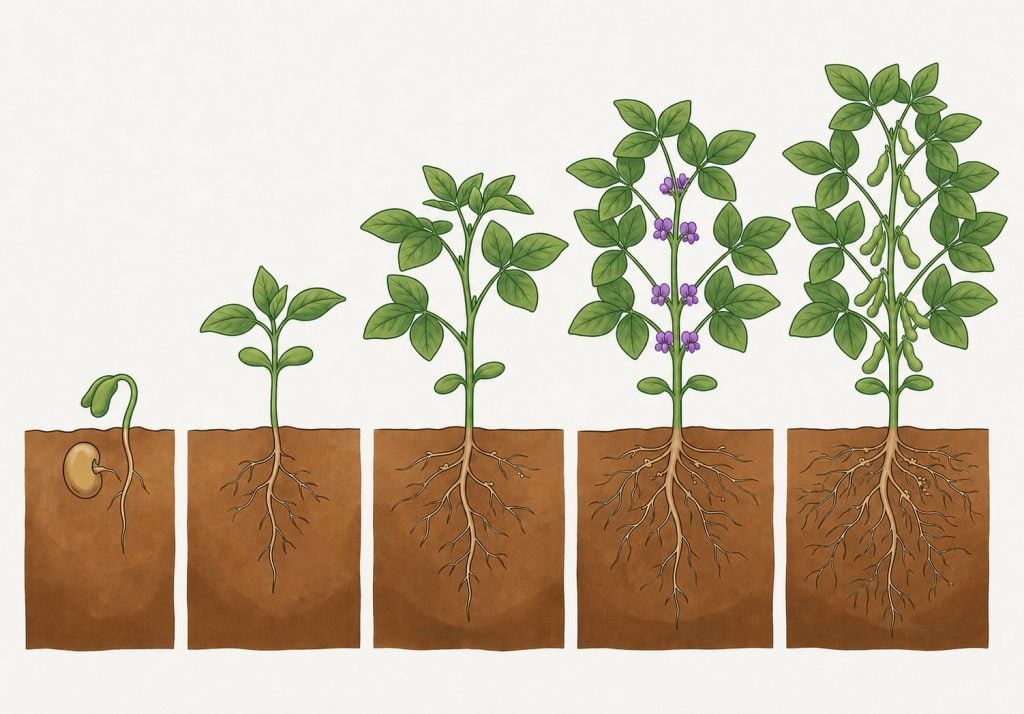
Growth Stages (VE–R8)
Soybean development is divided into vegetative (V) and reproductive (R) stages. Key stages include:
- VE – emergence
- VC – cotyledon stage
- V1–Vn – trifoliate leaf development
- R1 – beginning bloom
- R2 – full bloom
- R3 – beginning pod set
- R4 – full pod set
- R5 – beginning seed set
- R6 – full seed set
- R7 – beginning maturiry
- R8 – full maturity
An understanding of these developmental stages is fundamental for synchronizing nutrient applications, irrigation management, and crop protection decisions.
Nutrient Requirements
Nitrogen (N)
Soybean has a high N requirement, needing more than 80 kg N to produce 1,000 kg of grain. Under high-yield conditions, recent studies have reported total N requirements exceeding 140 kg N per tonne of grain produced (Guidorizzi et al., 2023). Most of this demand is met through biological N fixation, carried out by Bradyrhizobium bacteria in root nodules. When nodulation is effective, fixation can supply nearly all the N the crop needs throughout the season. A small starter dose of mineral N may be used, but rates should remain below 20 kg/ha N to avoid suppressing nodulation. Effective nodulation is essential for vigorous vegetative growth, pod formation, and high protein content.
Phosphorus (P)
Phosphorus plays a central role in plant metabolism as a fundamental component of adenosine triphosphate (ATP) and nucleic acids; consequently, all physiological processes that demand metabolic energy require P. In soybean, an adequate P supply supports root development, nodulation, and seed oil synthesis. Because P availability strongly influences early growth and reproductive performance, maintaining sufficient soil P is critical for achieving high yields and superior seed quality.
Potassium (K)
Potassium regulates plant water balance and stomatal activity, improving drought tolerance and cellular hydration. It acts as an activator for more than 60 enzymes involved in photosynthesis, carbohydrate synthesis, and protein metabolism. During reproductive development – particularly throughout grain filling – K drives the transport of sugars from leaves to developing pods, directly determining 1,000-grain weight, uniform seed size, and final yield.
Calcium (Ca)
Calcium serves a dual physiological function in soybean as a structural component of cell walls and membranes, and as a key second messenger in intracellular stress-signaling cascades. By forming Ca pectate in the middle lamella, it regulates cell division, meristematic elongation, and structural integrity in young developing tissues Adequate Ca throughout the soil profile allows the crop to establisha deep, well‑developed root system capable of sustaining vigorous growth and effective nodulation with Bradyrhizobium bacteria. In soils with low Ca availability or subsoil acidity, root penetration is severely restricted, limiting access to moisture and nutrients.
Magnesium (Mg)
Magnesium is the central atom of the chlorophyll molecule, playing a key role in photosynthesis. It also regulates plant energy transfer by activating vital enzymes and supporting ATP metabolism. In soybean, Mg supports both the synthesis and the phloem transport of carbohydrates needed for vegetative growth and grain filling. Adequate Mg nutrition helps sustain photosynthesis, optimize energy utilization, and ensure an adequate supply of photoassimilates to developing pods and seeds, supporting uniform grain filling and high yield.
Sulfur (S)
Sulfur is required for protein synthesis and directly influences soybean seed quality. Because soybean grain contains high protein levels, the crop has a relatively high S demand throughout the season. Adequate S supports amino acid formation, improves N use efficiency, and is essential for biological N fixation. When S supply is adequate, plants maintain vigorous growth, improved stress tolerance, and produce seeds with high protein content and superior overall quality.
Molybdenum (Mo)
Molybdenum is a key component of nitrogenase and nitrate reductase, the enzymes responsible for biological N fixation and N metabolism. Working in synergy with nutrients such as iron, nickel, P, and S, as well as the beneficial element cobalt (Co), Mo ensures efficient nodule activity and supports the N supply required throughout the cycleIn many soybean‑growing regions, supplying Mo and Co has become standard practice to optimize nodulation and maximize Navailability.
Manganese (Mn)
Manganese is a key component of the oxygen-evolving complex in Photosystem II, driving the water-splitting reaction that powers photosynthesis. It activates many enzymes involved in carbohydrate, protein, and lipid metabolism, while also serving as a vital cofactor in antioxidant defense (Mn-SOD) to protect plant cells from oxidative stress. Manganese deficiency has become increasingly common in high-pH or over-limed soils, as well as in glyphosate‑tolerant (RR) varieties, where Mn availability is often lower.
Boron (B)
Boron plays a structural role in cell wall synthesis and membrane integrity, while also supporting carbohydrate transport throughout the plant. It is especially critical during the reproductive phase, where it governs pollen germination, and pollen tube elongation, directly influencing flowering, pod formation, and seed set. Even mild B deficiency during flowering can impair pollination, leading to increased flower and pod abortion. Maintaining an adequate B supply is therefore important for securing reproductive success and high yields.
Zinc (Zn)
Zinc is essential for activating plant enzymes and driving protein synthesis. It is directly required for the production of auxin, a key plant growth hormone responsible for stem elongation, leaf expansion, and early root development. Zinc also strengthens cell membranes and supports the plant’s antioxidant defense.
Iron (Fe)
Iron is critical for chlorophyll synthesis, energy production, and photosynthesis. In soybean, it is also indispensable for efficient biological N fixation. In high-pH or calcareous soils, Fe availability can be severely restricted, causing Iron Deficiency Chlorosis (IDC) and early yield losses.
Copper (Cu)
Copper plays a vital role in photosynthesis and plant respiration. In addition, it is essential for the synthesis of lignin, which strengthens cell walls and keeps stems standing strong. Adequate Cu supply also supports pollen viability, improves disease tolerance, and prevents flower and pod drop.
Nickel (Ni)
Nickel is required for urease activation, which plays a key role in N metabolism by converting urea into plant-usable forms. When Ni supply is insufficient, urea can accumulate in leaf tissues, particularly at the leaf tips, leading to chlorosis and necrosis along the margins. In soybean, adequate Ni nutrition also supports nodule development and activity, enhancing biological N fixation and improving overall N use efficiency.
Chlorine (Cl)
Chlorine is fundamental for photosynthesis and water regulation. It helps manage stomatal movement and cellular hydration, improving the plant’s water-use efficiency and drought tolerance.
Requirements in temperate region, USA
| Part of plant | N kg/t | P kg/t | K kg/t | Ca kg/t | Mg kg/t | S kg/t | B g/t | Cu g/t | Fe g/t | Mn g/t | Zn g/t |
|---|---|---|---|---|---|---|---|---|---|---|---|
| Grains (offtake) | 58.9 | 11.5 | 22.7 | 2.9 | 2.6 | 3.4 | 32.2 | 11.2 | 72.1 | 27.9 | 41.7 |
| Other parts | 22.7 | 3.2 | 29.3 | 31.6 | 12.6 | 2.3 | 64.4 | 7.5 | 181.0 | 91.7 | 59.2 |
| Total (uptake) | 81.6 | 14.7 | 52 | 34.5 | 15.2 | 5.7 | 96.6 | 18.7 | 253.2 | 119.5 | 100.9 |
| % offtake | 72% | 78% | 44% | 8% | 17% | 60% | 33% | 60% | 28% | 23% | 41% |
Requirements in tropical region, Oxisol, Brazil
| Part of plant | N kg/t | P kg/t | K kg/t | Ca kg/t | Mg kg/t | S kg/t | B g/t | Cu g/t | Fe g/t | Mn g/t | Zn g/t |
|---|---|---|---|---|---|---|---|---|---|---|---|
| Grains (offtake) | 55.6 | 9.3 | 20.6 | 2.1 | 2.6 | 2.8 | 34.6 | 11.0 | 123.1 | 15.7 | 43.8 |
| Other parts | 90.2 | 20.1 | 86.3 | 41.4 | 12.4 | 4.6 | 125.5 | 21.8 | 550.8 | 182.7 | 96,3 |
| Total (uptake) | 145.8 | 29.4 | 106.9 | 43.5 | 14.7 | 7.4 | 160.1 | 32.8 | 673.9 | 198.4 | 140.1 |
| % offtake | 38% | 32% | 19% | 5% | 18% | 37% | 22% | 33% | 18% | 8% | 31% |
Nutrient Deficiencies
Nitrogen
- Chlorosis in older leaves and reduced vegetative growth
- Low protein content in grains
- May occur when biological N fixation is limited by other deficiencies

Phosphorus
- Stuned plant growth
- Low pod insertion
- Older leaves with bluish‑green color

Potassium
- Marginal chlorosis on older leaves
- Marginal necrosis (“leaf scorch”) in severe deficiency
- Reduced seed quality and grain filling

Calcium
- Reduced growh of young tissues
- Chlorosis, deformation, and death of young leaves and growing points
- Stunted root system development

Magnesium
- Older leaves show interveinal chlorosis (light yellow)
- Veins remain pale green
- Reduced photosynthesis and yield

Sulfur
- Chlorosis on young leaves
- Reduced nodulation and biological N fixation
- Lower grain protein concentration and yield

Molybdenum
- Reduced biological N fixation due to impaired nitrogenase activity
- N deficiency-like symptoms
- Reduced plant growth and lower biomass accumulation
Manganese
- Interveinal chlorosis on young leaves
- Dark green veins contrasting with yellow-green tissue

Boron
- Thick and deformed young leaves
- Apical meristem death
- Excessive branching (witches’ broom)

Zinc
- Small, narrow, and elongated young leaves
- Golden-yellow interveinal chlorosis with green veins
- Shortened internodes (rosetting)

Copper
- Dark-green young leaves with necrotic spots
- Shortened internodes and reduced plant growth
- Deformed and asymmetric young leaves (“pregnant leaves”)

Iron
- Interveinal chlorosis on young leaves
- Chlorosis progressing from the leaf tip toward the base
- Severely deficient plants become pale yellow to nearly white

Chloride
- Less common in soybean
- Wilting and reduced leaf expansion
- Chlorosis and necrosis of young leaves under severe deficiency
Nickel
- Less common in soybean
- Leaf tip necrosis due to urea accumulation
- Nitrogen deficiency-like symptoms
Fertilization Practices
Soybean productivity depends on a well-planned fertility program that supports crop establishment, root development, and efficient biological N fixation. Nitrogen is the nutrient required in the largest quantity by soybean. The crop typically needs more than 80 kg N for each tonne of grain produced, while recent studies have estimated total N requirements exceeding 140 kg N per tonne under high-yield conditions (Guidorizzi et al., 2023). Because of this substantial demand, efficient nodulation with Bradyrhizobium is essential. Inoculation should supply at least 1.2 million viable cells per seed to ensure adequate nodule formation and the conversion ofatmospheric N into ammonium within root nodules. When nodulation is effective, mineral N is generally unnecessary; if applied, rates should remain below 20 kg N/ha to avoid suppressing biological N fixation.
Maintaining adequate soil pH is fundamental for soybean nutrition and nodulation. The crop performs best within a pH range of 5.5 to 6.0, where nutrient availability, root growth, and biological activity are optimized. Liming acidic soils increase pH, supplies Ca and Mg, and neutralize aluminum toxicity. In situation where subsoil acidity restricts root penetration, gypsum (CaSO₄) application can improve Ca availability deeper into the soil profile and reduce aluminum-related constraints in subsurface layers, promoting deeper rooting and better access to water and nutrients.
Fertilizer recommendations should be based on soil test results, yield targets, and local calibration guidelines. Water-soluble P sources are commonly used to supply P. Potassium is most often supplied as potassium chloride (KCl), although multi-nutrient fertilizers such as Polysulphate can simultaneously provide K, Ca, Mg and S. Calcium and Mg are usually supplied through liming, but supplemental applications may be beneficial in highly weathered tropical soils with low cation exchange capacity and limited nutrient reserves. In addition, S application has become increasingly important in production systems, particularly in regions with low organic matter levels, reduced atmospheric S deposition, or limited gypsum use.
Furthermore, micronutrients also play a critical role in soybean nutrition, especially those involved in biological N fixation and reproductive development. These nutrients can be applied via seed treatment, soil application, or foliar sprays. In alkaline soils, Fe, Mn, Cu and Zn are the most frequent deficiencies. Ensuring adequate micronutrient availability helps supports efficient N fixation, healthy plant growth, successful reproductive development, and high yield.
Conclusion
Achieving high and stable soybean yields requires an integrated management approach that combines good soil physical structure, adequate nutrition, and effective biological N fixation. A well-structured root zone promotes deep root growth, improving access to water and nutrients throughout the growing season and increasing resilience to environmental stress. Synchronizing nutrient availability with crop demand sustains photosynthetic activity, supports reproductive development, and contributes to uniform grain filling. When fertility programs are aligned with realistic yield targets, soil test results, and regional nutrient removal rates, growers can maximize nutrient use efficiency, preserve grain quality, and enhance the long-term productivity and sustainability of the production system.
References
Bender, R.R. et al. (2015). Nutrient Uptake, Partitioning, and Remobilization in Modern Soybean Varieties. Agronomy Journal, 107(2): p. 563-573.
Guidorizzi, F.V.C., et al. (2023) Extração e Exportação de Nutrientes em Cultivares de Soja Xtend®, Enlist® e Roundup Ready®. Informações agronômicas nutrição de plantas.
Marschner, P. (2012). Marschner’s Mineral Nutrition of Higher Plants (3rd ed.). Academic Press, London, UK.
Soybean Trials
Guides & Articles
Explore Soybean Solutions by Brand
Find the right solutions to improve crop quality and yield

Grow stronger crops, today
Brand details Agroleaf Power
The four-in-one natural fertilizer
Brand details Polysulphate<sup>®</sup>
Fertilizers for Precision Drone Application
Brand details FertiBuzzState-of-the-art nutrition giving you higher Nutrient Use Efficiency (NUE) with fewer applications.
Brand details Agrocote<sup>®</sup>Grow stronger crops, today
Brand details Agroleaf PowerThe four-in-one natural fertilizer
Brand details Polysulphate<sup>®</sup>Fertilizers for Precision Drone Application
Brand details FertiBuzzDiscover Our Solutions for Growing Soybean
Soybean Solutions: Increase Your Harvest
Agrocote®

Agrocote®
Agroleaf Power
Polysulphate®

FertiBuzz

Ultra-Low Volume Fertilizer for drone 0-44-36+0.5B+0.2Mn+0.2Zn
See productDigital Tools
Access calculators to improve nutrient management and boost productivity


