


 Whatsapp
  X
X  Mail
Mail  Copy link
 Faster Water Spreading in Pots with H2Gro ED
Weihenstephan, Germany
Key Conclusions
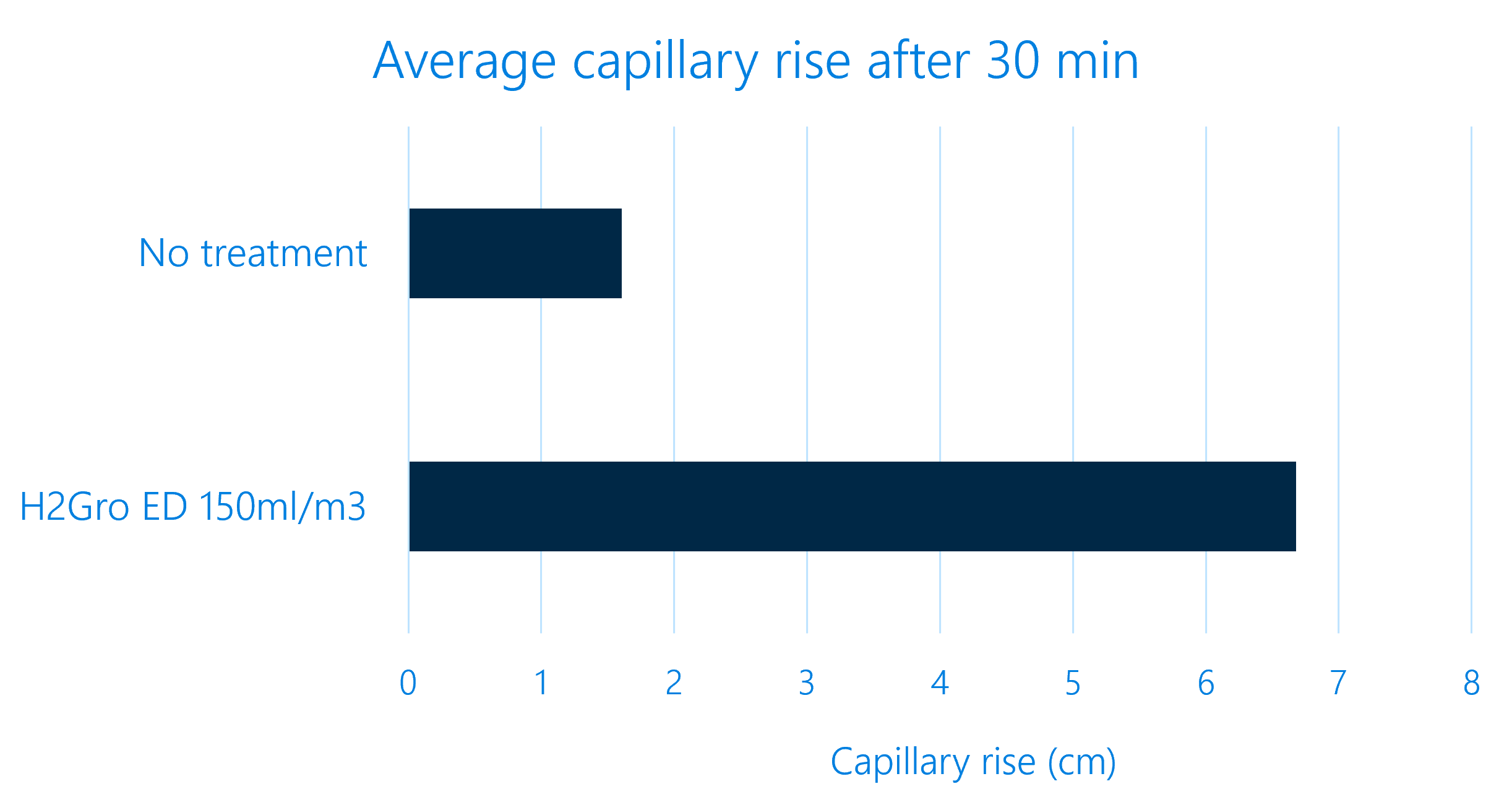
- H₂Gro ED increased capillary rise more than four times compared with untreated substrate after 30 minutes.
- Faster and more uniform water movement through the peat profile ensures quicker wetting of the entire pot.
Objective
To assess the impact of H₂Gro ED on water distribution and capillary rise in peat-based substrates under ebb-flood watering conditions.
Trial Details
Treatments
The trial was conducted on a peat-based substrate watered by ebb-flood at a 2.5 cm level to evaluate the effect of H₂Gro ED on water movement. Two treatments were compared: untreated control and substrate treated with H₂Gro ED at the rate of 150 ml/m³. Capillary rise was measured 30 minutes after watering to assess the rate and uniformity of water uptake.
Treatments
The trial was conducted on a peat-based substrate watered by ebb-flood at a 2.5 cm level to evaluate the effect of H₂Gro ED on water movement. Two treatments were compared: untreated control and substrate treated with H₂Gro ED at the rate of 150 ml/m³. Capillary rise was measured 30 minutes after watering to assess the rate and uniformity of water uptake.
Results
After 30 minutes of ebb‑flood irrigation, the substrate treated with H₂Gro ED 150 ml/m³ showed a markedly higher capillary rise, reaching approximately 7 cm compared with around 1.5–2 cm in the untreated control. This demonstrates substantially faster and more efficient upward water movement through the peat profile, resulting in quicker and more uniform wetting of the pot.
Digital Tools
Use our advanced calculators
Other Interesting Trials
Related Product
H2Gro

H2Gro
See product
Our knowledge
Tips & tricks, disease prevention, crop and market related information
Explore our knowledge