


 Whatsapp
  X
X  Mail
Mail  Copy link
 New fairway trial explores integrated approaches to reducing herbicide reliance
How a new multi-year fairway trial is testing nutrition, overseeding and mechanical maintenance as part of a more integrated approach to weed management.
On this page:
Golf course managers across Europe are facing a growing challenge.
Expectations for high-quality playing surfaces remain as high as ever, yet the options available for managing broadleaf weeds are changing.
As herbicide availability comes under increasing pressure in some markets, greenkeepers are asking an important question:
How can we maintain fairway quality while becoming less reliant on herbicides?
There is no single solution. Instead, the future is likely to lie in Integrated Turf Management, combining sound agronomy, appropriate nutrition and cultural practices to encourage a stronger, more competitive sward.
To help build practical evidence, a new multi-year field trial has been established at Golfcentrum de Batouwe in the Netherlands.
The fairway weed trial brings together Golfcentrum de Batouwe, the DGB Group and ICL Growing Solutions to investigate how nutrition, overseeding and mechanical maintenance can work together to reduce broadleaf weed pressure while maintaining fairway quality under real golf course conditions.
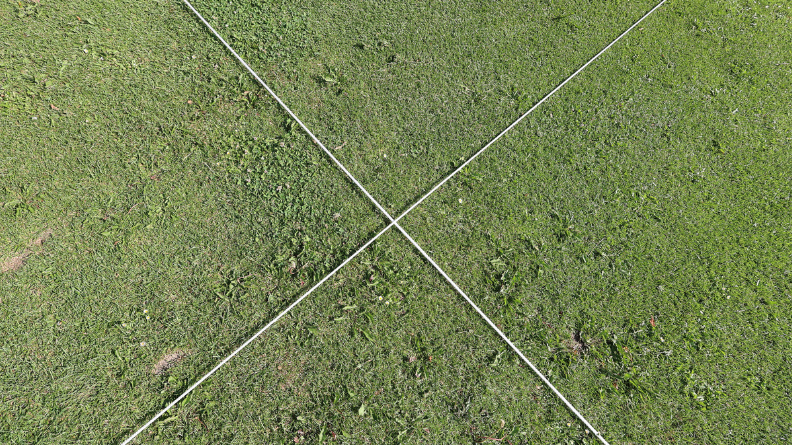
Individual fairway trial plots are marked to compare different combinations of nutrition, overseeding and mechanical maintenance.
DGB (stands for Duurzaam Golfbaan Beheer) is a Dutch network of golf course turf managers established in 2005 to support more sustainable, future-ready course management.
Its members use shared monitoring protocols to collect and compare data across different courses and over multiple seasons. DGB also supports field trials, research and knowledge exchange, turning long-term monitoring into practical insights for day-to-day greenkeeping.
For Dr Andy Owen, International Technical Manager, Turf & Landscape at ICL, that practical approach is exactly what makes the project valuable.
“We’re working with the DGB Group to manage golf courses more sustainably. It’s a long-term trial with a long-term vision.”
Looking beyond a single solution
One of the principles behind the trial is that no single management practice is likely to replace herbicides on its own. Instead, the project explores how multiple agronomic practices can work together to produce healthier, denser turf that is naturally more competitive against weeds.
As Andy explains: “Healthy turf isn’t the result of one great decision. It’s the result of hundreds of good decisions working together. That’s why we’re investing in understanding how nutrition, overseeding and cultural practices interact, rather than looking for a single solution.”
The trial focuses on three practical management decisions available to virtually every golf course:
- Nutrition strategy
- Mechanical surface management
- Overseeding
By studying these approaches individually and in combination, the team hopes to better understand which integrated programs provide the greatest benefit.
A trial designed around real golf course management
Rather than testing ideas under highly controlled research conditions, the trial has been established on Fairway 7 of Golfcentrum de Batouwe, allowing treatments to be assessed under the day-to-day realities of golf course maintenance.
The project builds on earlier work at GC Princenbosch while expanding both the scope of the trial and the number of management practices being investigated.
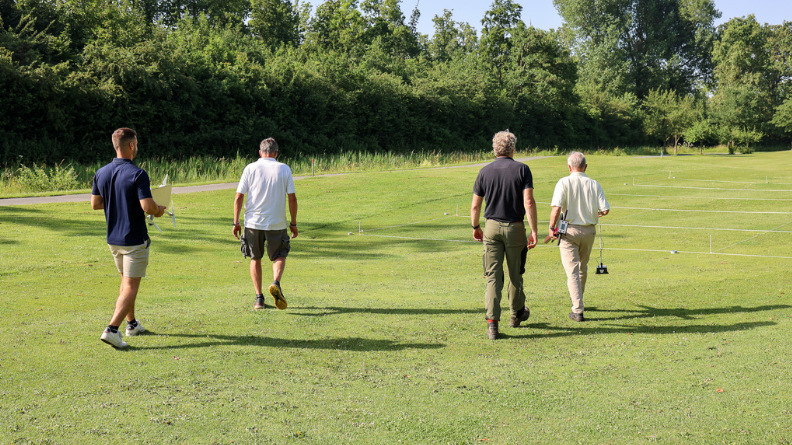
The trial team walks through the marked plots on Fairway 7 at Golfcentrum de Batouwe during an on-site assessment.
To understand how different nutrition strategies influence weed pressure and turf quality, the trial compares a range of nitrogen programs.
These include a zero-nitrogen control, controlled-release fertilizer (CRF) eqo.s applied in spring, CRF eqo.s applied in autumn, CRF eqo.s applied in both spring and autumn, and a liquid fertilizer program based on the golf course’s standard approach.
These are combined with mechanical raking and perennial ryegrass overseeding to evaluate both individual effects and integrated management strategies.
By testing combinations of practices rather than individual treatments alone, the trial better reflects how golf courses are actually managed, making the findings more relevant to everyday decision-making.
Working together for more sustainable course management
For Head Greenkeeper Jan Huibers, the trial reflects the club’s wider ambition to manage the course responsibly while continuing to deliver the playing quality golfers expect.
“At De Batouwe, we want to manage the course more sustainably step by step while maintaining playing quality. This trial fits that ambition well.
Together with the DGB Group and ICL, we can see in practice which measures contribute to a stronger fairway and less reliance on herbicides.”
Flip Wirth is the founder of DGB. His work focuses on bringing greenkeepers together around practical research, consistent monitoring and the interpretation of long-term course data.
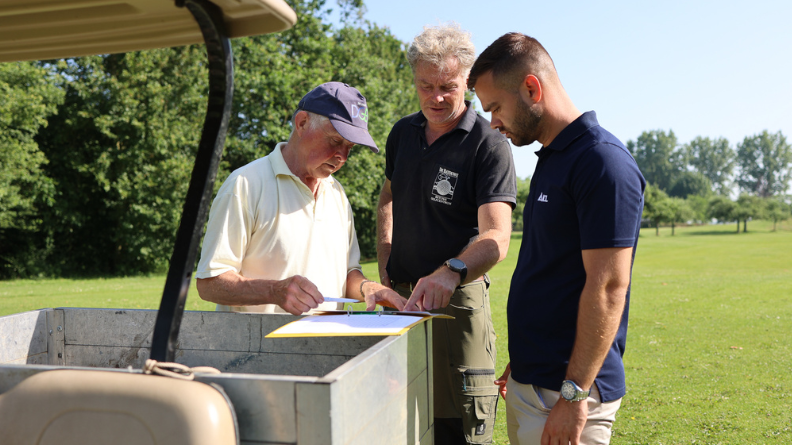
Reviewing the fairway trial.
This trial reflects that approach: testing management choices under real playing conditions and turning the results into knowledge that can be discussed and applied across the sector.
“For many greenkeepers, using collected data to guide management decisions is not yet part of day-to-day practice. With this trial, we can show which maintenance choices affect the fairway. That helps make sustainable golf course management more tangible and easier to discuss.”
Learning from real course conditions
The questions being explored at De Batouwe extend well beyond the Netherlands.
Regulations, available products and golfer expectations vary across Europe, but the underlying challenge is shared by many golf courses: how to maintain resilient, high-quality turf with fewer chemical inputs.
For Andy, generating robust field evidence is essential before drawing conclusions. “I’m not expecting miracles. There will still be weeds probably, but I want to see just a reduction in the number of weeds, an increase in the quality of turf.”
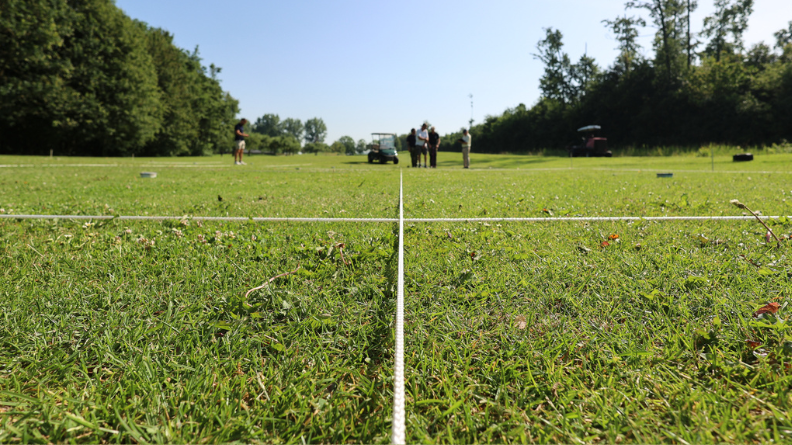
Trial plots on Fairway 7 at Golfcentrum de Batouwe, where nutrition, overseeding and mechanical maintenance are being assessed under real golf course conditions
Over the coming seasons, the trial will be assessed four times each year. Weed populations, turf quality and visual performance will be monitored across all 80 plots using field assessments, photography and drone imagery where appropriate.
By following the trial over multiple seasons, the team aims to build a clearer understanding of how different management programs influence weed pressure and fairway performance.
Importantly, the aim is not to identify a single solution. Instead, the project seeks to provide practical evidence that helps greenkeepers make informed decisions based on Integrated Turf Management principles.
While there may never be one answer to reducing herbicide reliance, every well-designed trial improves our understanding of how good management decisions work together to produce healthier, more resilient turf.
As Andy concludes: “This trial very much leads the way in collecting evidence. It’s not going to solve the problem completely, and hopefully it will be a nice, robust piece of information for us.”
Turning field data into practical knowledge
At ICL, field trials are designed to answer practical questions faced by turf managers every day.
By combining nutrition, cultural practices and field evidence, projects such as the De Batouwe trial help build a stronger understanding of how Integrated Turf Management can support healthier, more resilient playing surfaces.
Whatever the results ultimately show, the trial will add to our understanding of integrated weed management. That knowledge will help greenkeepers make more informed decisions, adapt to changing challenges and continue delivering the high-quality playing surfaces golfers expect.
