


 Whatsapp
  X
X  Mail
Mail  Copy link
 Phosphorus in Turf Management
Understanding the role of phosphorus in turf growth, how its availability changes within the rootzone and when additional phosphorus may be required.

On this page:
Phosphorus is an essential nutrient for turf growth, but unlike nitrogen, applying more phosphorus does not necessarily produce a greater turf response.
Many established soils already contain significant reserves of phosphorus, while only a relatively small proportion may be available to the plant at any one time. Its availability is also strongly influenced by the rootzone, soil pH and biological activity.
This means phosphorus management should not simply be based on how much phosphorus is present in a soil analysis.
ICL’s approach is to consider phosphorus alongside turf growth, nitrogen input, rootzone characteristics and the objective of the nutrition program. The aim is to provide enough phosphorus to support plant demand without applying it unnecessarily.
What is phosphorus?
Phosphorus (P) is one of the essential macronutrients required by turfgrass.
Although turf requires considerably less phosphorus than nitrogen, phosphorus remains essential for normal growth and development.

Typical mineral composition of turfgrass plant dry matter, showing potassium as a major macronutrient alongside nitrogen, phosphorus, calcium, magnesium and sulphur.
As turf growth increases, its requirement for phosphorus also increases. This is part of the principle of nitrogen-led nutrient demand, where increasing growth through nitrogen also increases the plant’s requirement for phosphorus, potassium and other nutrients.
Where those nutrients are not supplied through fertilizer, the turf must obtain them from reserves already present within the rootzone.
The question is therefore not simply whether phosphorus is present, but whether enough is available to support the growth being produced.
What does phosphorus do in turf?
Phosphorus is required throughout plant growth and plays an important role in the processes that allow turf to develop new tissue.
A turfgrass plant cannot grow normally without an adequate phosphorus supply.
However, this is sometimes simplified into the claim that phosphorus promotes root growth.
That is not strictly correct.
Applying phosphorus does not itself cause the plant to produce more roots.
Instead, phosphorus is one of the nutrients required for plant growth.
Where phosphorus availability is limiting, supplying enough phosphorus allows the plant to develop normally, including the development of its root system.
This distinction is particularly important when considering phosphorus applications during establishment.
Why doesn’t turf always need additional phosphorus?
Unlike nitrogen, phosphorus can accumulate within the soil.
Many established soil-based turf surfaces therefore contain substantial phosphorus reserves built up naturally or through previous fertilizer applications.
This is one reason many turf fertilizers contain little or no phosphorus.
There are also good reasons to avoid unnecessary applications.
High phosphorus availability can reduce the strength of mycorrhizal associations that plants can form to help acquire phosphorus.
Research into the relationship between phosphorus and annual meadow grass (Poa annua) is less clear-cut, although increased phosphorus has been associated with increased seed production.
Phosphorus is also an important consideration environmentally because phosphate entering surface water can contribute to water pollution.
The objective should therefore be to supply phosphorus where there is a genuine plant requirement rather than routinely adding it to every fertilizer application.
How does phosphorus behave in the rootzone?
Understanding phosphorus requires looking beyond the total amount contained in the soil.
Turfgrass primarily takes up phosphorus from the soil solution through its roots. However, only a relatively small proportion of the total phosphorus within a soil is present in, or readily able to replenish, that solution.
As phosphorus is removed from the soil solution by the plant, some phosphorus held on soil surfaces can move back into solution and become available.
Phosphorus can also be released from organic matter. As soil microorganisms break organic material down, organically bound phosphorus can be mineralized into forms that can enter the soil solution and be taken up by the plant.
The result is a continually changing phosphorus cycle between:
- Phosphorus in the soil solution.
- Phosphorus associated with soil particles.
- More stable phosphorus reserves.
- Phosphorus contained within organic matter.
- Phosphorus taken up by the turf.
When a soluble mineral phosphorus fertilizer is applied, it initially increases the phosphorus concentration within the soil solution. Some can be taken up by the plant, while some will subsequently become associated with solid surfaces within the rootzone.
This behaviour is one reason simply measuring the total amount of phosphorus present does not tell the complete story.
How do soil type and pH affect phosphorus availability?
The type of rootzone has a major influence on phosphorus management.
Established soils can contain considerable reserves of phosphorus associated with clay minerals, iron and aluminium compounds and organic matter.
A clean, sand-dominated rootzone is very different.
Pure silica sand contains very little phosphorus and has much less capacity to supply phosphorus from existing reserves.
Intensively managed golf greens and sports pitches constructed using high proportions of sand may therefore require a different approach from established soil-based surfaces.
Soil pH is also important because it influences how strongly phosphorus becomes associated with the solid phase of the rootzone.
Under acidic conditions, phosphorus can become strongly associated with iron and aluminium compounds.
At higher pH, it can react with calcium and magnesium and form less soluble phosphates.
Phosphorus availability can therefore become restricted at both low and high pH.
This is why soil analysis should be interpreted as a combination of phosphorus level, pH and rootzone characteristics rather than looking at the phosphorus result in isolation.
When should phosphorus be applied?
A soil test is a useful starting point, but it should not become an automatic fertilizer prescription.
A relatively low soil phosphorus result does not necessarily mean phosphorus must be applied.
The decision should also consider:
- The amount of nitrogen being supplied.
- The growth response required.
- How the turf has been performing.
- The type of rootzone.
- Soil pH.
- Whether the surface is being established or overseeded.
- The existing condition of the turf.
If an established surface is performing well with relatively low soil phosphorus, there may be little benefit in increasing phosphorus simply to move a soil analysis number towards a predetermined target.
Conversely, a low-phosphorus, sand-based rootzone receiving sufficient nitrogen to drive substantial growth may have a greater requirement for additional phosphorus.
The important question is whether phosphorus availability is sufficient to support the growth required from that particular surface.
Why is phosphorus important during establishment?
Establishment is one situation where phosphorus availability deserves particular attention.
A germinating grass seed initially relies on nutrient reserves contained within the seed itself.
As the seedling develops, those reserves are depleted and the young plant becomes dependent on photosynthesis and nutrients obtained from its surrounding rootzone.
At this stage, the developing root system is small.
Nitrogen and potassium can move relatively freely through the soil solution, but phosphorus is much less mobile and is generally present in the soil solution at relatively low concentrations.
The developing roots therefore need to encounter an adequate phosphorus supply.
This is why phosphorus is commonly included in pre-seeding and establishment fertilizers.
Again, the purpose is not to force the plant to produce additional roots. It is to ensure phosphorus does not become a limiting nutrient while the new plant is trying to establish.
The source and placement of phosphorus can also influence how effectively it supports establishment.
In a one-year study at Bangor University, seeded perennial ryegrass grown in a sand-based rootzone produced significantly greater root mass where higher proportions of Pearl recycled struvite phosphorus were used compared with conventional mono-ammonium phosphate.
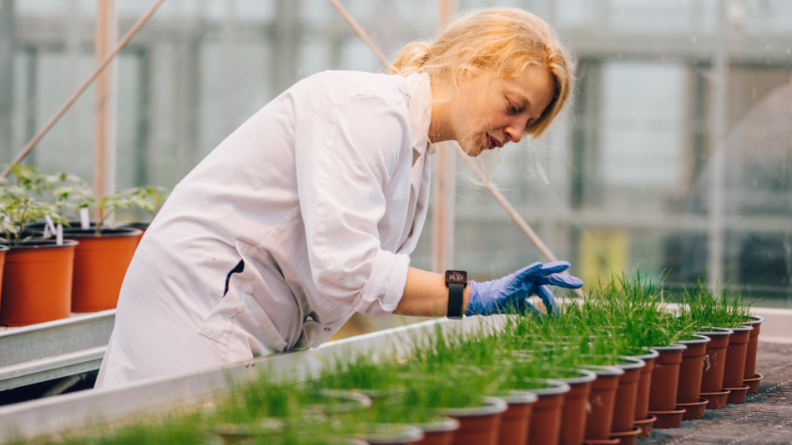
Assessing turf quality during the Bangor University trial investigating struvite as a recycled phosphorus source for turfgrass.
The same work also showed significantly greater rooting where seed fertilizer was incorporated into the rootzone rather than left on the surface.
This helps illustrate an important principle: phosphorus needs to be available where developing roots can access it.
Read the Bangor University trial on recycled phosphorus in sports turf for the full results, or learn more about Pearl technology and how it provides recycled phosphorus to developing turf roots.
Managing phosphorus as part of the nutrition program
Phosphorus is essential, but it should not be managed in isolation.
Its requirement is closely connected to the amount of turf growth being produced and therefore to the nitrogen program.
Where nitrogen inputs are relatively low and the rootzone contains sufficient available phosphorus, additional applications may provide little benefit.
Where growth is being increased, turf is being established or a low-phosphorus rootzone has limited reserves, additional phosphorus may become more important.
Effective phosphorus management therefore means considering:
- What growth the turf needs to produce.
- How much nitrogen is being supplied to support that growth.
- Whether the rootzone can provide sufficient phosphorus.
- How soil type and pH affect its availability.
- Whether additional phosphorus is actually required.
- Which phosphorus source is most appropriate for the situation.
The objective is not to maintain the highest possible phosphorus level in the soil.
It is to ensure phosphorus does not limit the required turf response while avoiding applications the plant does not need.

