Whatsapp
  X
X  Mail
Mail  Copy link
 Understanding Pearl: Recycled Phosphorus for Turf
How recycled struvite provides a targeted source of phosphorus for turf establishment and renovation.

On this page:
Pearl is a recycled phosphorus source for turf establishment and renovation, with research demonstrating increased root development compared with conventional soluble phosphorus.
Made from recovered struvite, Pearl provides phosphorus and magnesium in a form that can be incorporated into the developing rootzone, bringing the nutrient source into close association with actively growing roots.
This combination of recycled phosphorus, rootzone placement and demonstrated rooting response provides turf managers with a phosphorus source particularly suited to establishment and renovation.
What is Pearl made from?
Pearl is made from struvite, a mineral containing phosphorus, magnesium and nitrogen.
It has an analysis of 5-28-0 + 16% MgO, with phosphorus and magnesium held within the struvite crystal structure.
From wastewater to recycled phosphorus
The struvite used in Pearl is recovered from wastewater through a nutrient-recovery process developed by Ostara.
During wastewater treatment, phosphorus and other nutrients are recovered from the waste stream and crystallized to form struvite granules. This converts phosphorus that would otherwise remain within the wastewater stream into a nutrient source that can be used again.
This creates a circular source of phosphorus while reducing reliance on finite reserves of mined phosphate used to manufacture conventional phosphorus fertilizers.
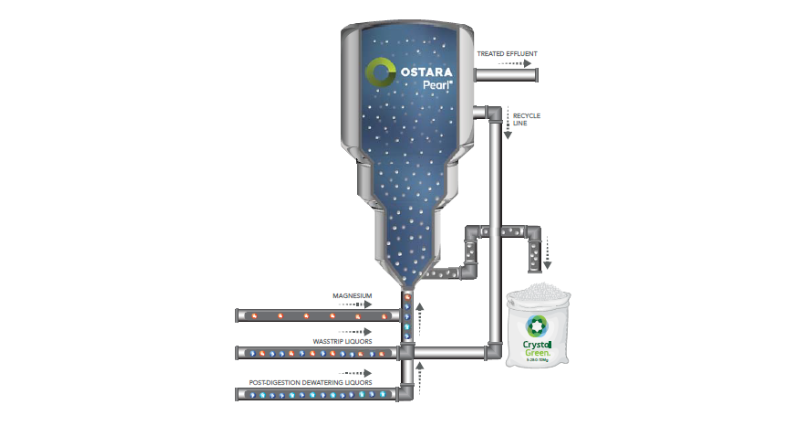
The Pearl process recovers phosphorus from wastewater and converts it into struvite, creating a recycled nutrient source for use in turf fertilizers.
How does Pearl release phosphorus?
The nutrients contained within Pearl are not water-soluble.
Place a Pearl granule in water and it does not simply dissolve and release all of its phosphorus into the surrounding solution.
Struvite instead dissolves under acidic conditions.
This is important because actively growing turf roots naturally release small quantities of organic acids into the area immediately surrounding them.
As fine roots and root hairs grow alongside a Pearl granule, these acids help dissolve the struvite at the root-granule interface. Phosphorus and magnesium are then released close to the developing root system.
Pearl’s nutrients are not water-soluble. Acidic conditions around actively growing roots help dissolve the struvite granule, releasing phosphorus and magnesium close to the developing root system.
This is why Pearl is described as having root-driven nutrient release.
Why does root contact matter?
Phosphorus behaves differently in the rootzone from highly mobile nutrients such as nitrate.
Only a relatively small proportion of soil phosphorus is present in soil solution at any one time. Once soluble phosphorus is applied, it can also become associated with solid surfaces within the rootzone, with the extent and strength of this interaction influenced by factors including soil type and pH.
For a broader explanation of phosphorus availability, plant demand and how phosphorus should be managed in turf, read our Phosphorus in turf management guide.
Pearl takes a different approach. Rather than immediately placing a large proportion of its phosphorus into the soil solution, the struvite remains as a solid granule.
This makes its position within the rootzone important. Fine turf roots grow through the rootzone and encounter Pearl granules as they develop, bringing the root system into close proximity with the phosphorus source.
Positioning Pearl within the developing rootzone therefore increases the opportunity for this close root-granule interaction.
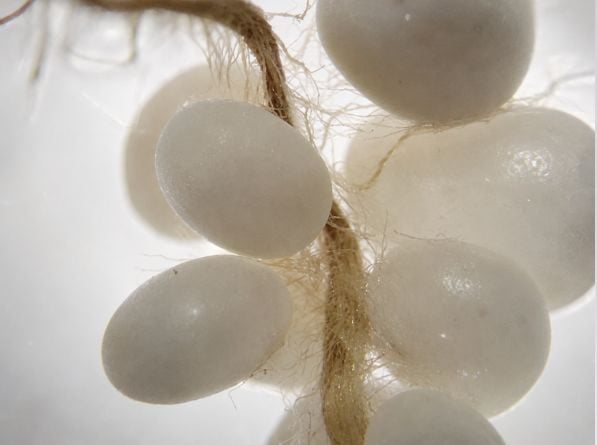
Turf roots growing in close proximity to Pearl struvite granules, with no visible scorch or dieback.
Does Pearl increase rooting?
Phosphorus is commonly associated with root development, but it is important to distinguish between supporting root growth and stimulating it.
Phosphorus does not directly cause a grass plant to produce more roots. Instead, phosphorus is an essential nutrient required for plant growth.
During establishment, a developing seedling initially relies on the nutrient reserves contained within the seed.
As these reserves are exhausted and roots and shoots develop, the young plant becomes increasingly dependent on nutrients available from the surrounding rootzone.
If phosphorus availability is limiting, plant development can also be limited.
Providing an appropriate phosphorus supply therefore allows the developing turf plant to grow without phosphorus becoming a constraint.
With Pearl, the close association between developing roots and the struvite granule can maintain phosphorus availability around the root system as growth continues.
What does research show?
Research has investigated how struvite behaves compared with conventional soluble phosphorus sources and how its position within the rootzone influences turf response.
A one-year Masters-by-Research study at Bangor University compared recycled struvite with monoammonium phosphate (MAP) in sports turf.
The study found that treatments containing struvite produced greater root mass than the treatment receiving phosphorus entirely from MAP. The strongest rooting response was recorded from a blend containing 80% struvite and 20% MAP.
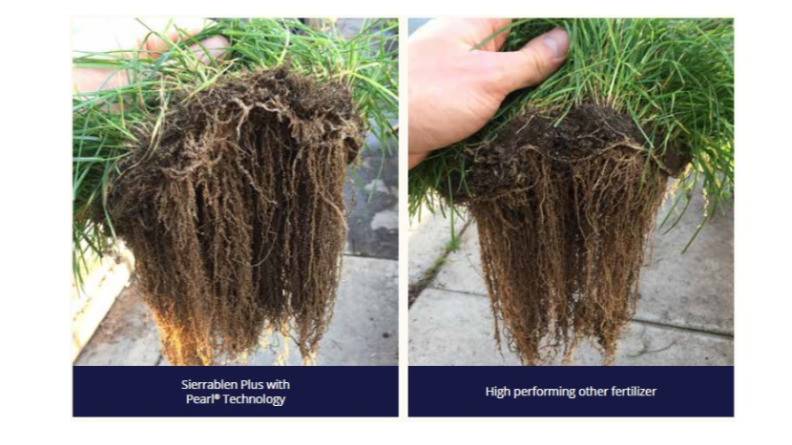
Comparison of turf root development following treatment with Sierrablen Plus with Pearl technology (left) and another fertilizer treatment (right).
Placement was also important. Incorporating the phosphorus source to a depth of 60 mm produced approximately twice the root mass of equivalent surface-applied treatments.
Independent research at Bangor University found that treatments containing higher proportions of struvite produced significantly greater root mass than conventional MAP, with placement within the rootzone also influencing the response.
These results support the importance of bringing Pearl into the developing rootzone, where roots can establish close contact with the struvite granules.
The study also found negligible effects on the measured soil microbial and mycorrhizal communities.
Where does Pearl fit in turf management?
Pearl is particularly relevant where additional phosphorus is required during seeding, renovation and establishment. Newly developing roots initially explore only a small volume of the rootzone.
Positioning the phosphorus source within that developing rootzone can therefore be important, giving emerging roots the opportunity to encounter it as they grow.
Low salt index for establishment
Pearl has a very low salt index, allowing it to be positioned close to seed without the osmotic stress associated with highly soluble fertilizer salts.
This means the struvite granules can be incorporated into the area where the new root system will develop, bringing the phosphorus source into close proximity with emerging roots.
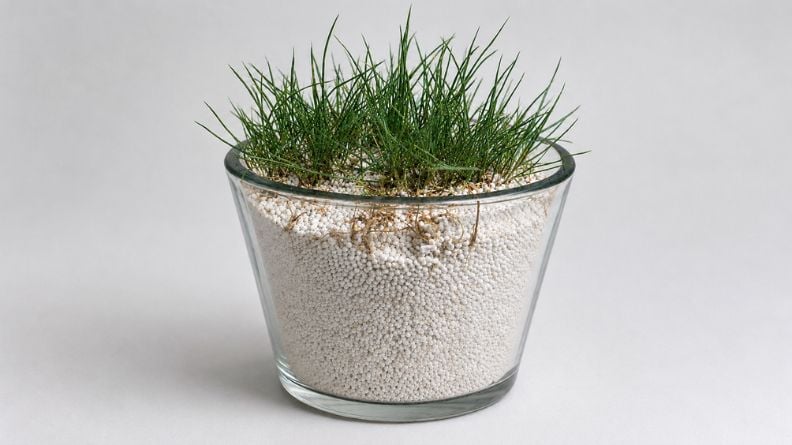
Grass established directly in Pearl struvite granules, demonstrating the low salt index of the recycled phosphorus source.
This makes incorporation particularly relevant during operations such as:
- Seeding and new turf establishment.
- Overseeding and renovation.
- Construction of new turf surfaces.
- Situations where rootzone analysis and turf requirements indicate that additional phosphorus is appropriate.
Pearl should not be viewed as a reason to apply phosphorus where it is not required.
The requirement for phosphorus should still be considered alongside the existing phosphorus status of the rootzone, pH, turf condition, nitrogen input and the growth being targeted.
Pearl in Sierrablen Plus
Pearl is incorporated into selected Sierrablen Plus Pearl fertilizers, combining recycled struvite with other nutrient sources and fertilizer technologies.
This allows phosphorus nutrition to form part of a wider fertilizer program rather than being considered in isolation.
The principle behind Pearl is relatively simple: retain phosphorus within a stable granule and make it available in close association with actively growing roots.
For turf managers establishing or renovating turf where additional phosphorus is required, that provides a different approach to conventional soluble phosphorus nutrition.