


 Whatsapp
  X
X  Mail
Mail  Copy link
 Potassium in Turf Management
Understanding potassium as an essential macronutrient, how it behaves in the rootzone and turfgrass plant, and its role in turf health and stress tolerance.

On this page:
Potassium is one of the essential macronutrients required by turfgrass and is typically present in plant tissue at higher concentrations than any mineral nutrient other than nitrogen.
Unlike nitrogen, however, applying potassium does not normally produce an obvious increase in growth. Its importance lies primarily in the processes taking place within the plant, including water regulation, enzyme activity, photosynthesis and the movement of carbohydrates.
Potassium is also widely associated with improved tolerance to drought, heat, cold, disease and wear. The important distinction is between maintaining an adequate supply and applying more than the plant needs.
Turf needs an adequate supply of potassium, but applying more than the plant requires does not necessarily provide additional benefit.
Effective potassium management is therefore about maintaining sufficient availability to prevent deficiency, particularly where rootzone conditions make potassium vulnerable to loss.
What is potassium?
Potassium (K) is one of the three primary macronutrients required by turfgrass, alongside nitrogen and phosphorus.
It commonly accounts for around 1–3% of plant dry matter and is often the second most abundant mineral macronutrient within the plant after nitrogen.

Typical mineral composition of turfgrass plant dry matter, showing potassium as a major macronutrient alongside nitrogen, phosphorus, calcium, magnesium and sulphur.
Unlike some nutrients, potassium does not become incorporated into structural components such as cell walls or plant tissue. Instead, it remains highly mobile within the plant and supports many of the physiological processes that allow those tissues to function.
Applying nitrogen generally stimulates turf growth where nitrogen is limiting. Applying potassium alone will usually produce little visible growth response unless the plant is potassium deficient.
Its role is less about driving growth and more about supporting plant function.
What does potassium do in turf?
Potassium plays an important role in enzyme activity, photosynthesis, energy metabolism and the movement of carbohydrates through the plant.
It is also critical to osmoregulation, the regulation of water within plant cells and tissues.
By helping regulate the movement of water, potassium contributes to:
- Maintaining cell hydration.
- Regulating transpiration.
- Supporting stomatal function.
- Maintaining photosynthetic activity.
- Moving carbohydrates through the plant.
- Supporting plant function during periods of environmental stress.
This relationship with water is particularly important during stressful conditions. Maintaining appropriate potassium concentrations within plant cells can help them retain water and continue functioning as stress develops..
How does potassium behave in the rootzone?
Turfgrass takes up potassium as the positively charged potassium ion, K⁺.
Because potassium is a cation, its behaviour in the rootzone is closely connected to cation exchange capacity (CEC).
Potassium in the soil solution can be taken up directly by turfgrass roots. As that concentration falls, potassium held on cation exchange sites can move back into solution and become available to the plant.
Rootzones with a higher CEC can generally retain more potassium, while sand-dominated rootzones with low CEC have a much lower capacity to hold it.
This is particularly important on sand-based golf greens and sports rootzones. Their good drainage characteristics also mean soluble potassium can be more vulnerable to movement through the profile with rainfall or irrigation.
Potassium is also removed through clipping collection, while relatively little is stored in soil organic matter.
For this reason, potassium availability can change relatively quickly, particularly in low-CEC rootzones.
Soil pH can also influence potassium retention. At very low pH, hydrogen ions increasingly occupy exchange sites, reducing the capacity of the rootzone to retain potassium.
Soil analysis should therefore be interpreted alongside rootzone characteristics, pH, rainfall and irrigation rather than considering the potassium value in isolation.
What does potassium deficiency look like in turf?
Severe potassium deficiency is relatively uncommon in managed turf, but it can occur.
Because potassium is highly mobile within the plant, turfgrass can move it from older leaves to younger, actively growing tissue when supply becomes limited.
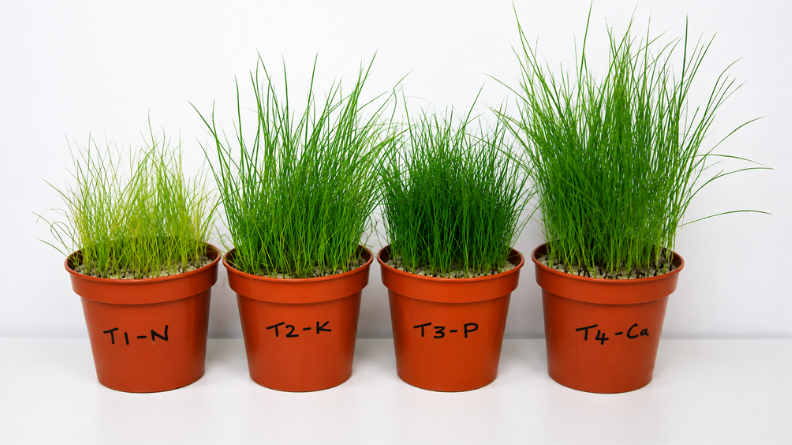
Perennial ryegrass nutrient omission trial. The T2-K pot was grown without potassium, helping demonstrate the effects of potassium deficiency compared with other nutrient omissions.
Deficiency symptoms therefore tend to appear first on older leaves and can include:
- Yellowing of older leaves.
- Yellowing or discoloration around leaf margins.
- Reduced turf quality.
- Some reduction in growth.
- Greater susceptibility to environmental stress.
Potassium uptake is also closely linked with water uptake. Conditions that restrict water movement into the plant can therefore restrict potassium uptake at the same time.
This becomes particularly relevant during hot, dry conditions or where root function has been compromised.
Does potassium improve turf stress tolerance?
Potassium is strongly associated with plant responses to abiotic stress because of its role in water regulation and cellular function.
Adequate potassium can help turf maintain important physiological processes during periods of drought, heat, cold, salinity and other environmental stresses.
Turf-specific research is less extensive than research in some other crops, but there is evidence that potassium is particularly important for cold tolerance.
The distinction between adequate and excessive potassium is important.
Studies examining increasing potassium rates have not consistently found further improvements in turf quality or stress tolerance once plant requirements have been met.
Potassium deficiency can compromise the plant’s ability to respond to stress. Applying potassium beyond the plant’s requirement does not necessarily make turf more stress tolerant.
The practical objective is therefore to ensure adequate potassium is available before and during periods of stress.
What about disease and wear?
Potassium is also commonly associated with disease resistance and wear tolerance, although the evidence is more nuanced.
Research on anthracnose has associated low potassium levels in the rootzone and plant tissue with increased disease.
ICL trial work investigating Microdochium patch also found substantially less disease where Sierraform GT K-Step, supplying nitrogen and potassium, was applied compared with untreated turf.
However, other research has reported increased Microdochium patch at high potassium rates.
The same caution applies to wear. Some studies support a role for adequate potassium, while others have found little additional benefit from increasing potassium once plant requirements are met.
Potassium should therefore form part of balanced turf nutrition, but it should not be treated as a standalone disease-control or wear-management treatment.
How much potassium does turf need?
Potassium requirements should be considered as part of the complete nutrition program rather than as a standalone target.
Nitrogen is particularly important because increasing nitrogen supply and turf growth also increases demand for other nutrients.
Research has shown an interaction between nitrogen and potassium. Where nitrogen supply increases without sufficient potassium availability, turf quality can decline.
As a general guide, a seasonal ratio of approximately 1 part nitrogen to 0.6 parts potassium can provide an appropriate starting point for many turf situations.
This does not mean every fertilizer application needs to use that ratio.
Individual applications can be adjusted through the season according to turf requirements, rootzone conditions and anticipated stress. The important consideration is the overall nutrition program.
When should potassium be applied?
A soil analysis provides a useful starting point for assessing potassium availability.
Applications should therefore be considered alongside:
- Rootzone type and CEC.
- Soil potassium levels.
- Nitrogen inputs and expected growth.
- Rainfall and irrigation.
- Clipping removal.
- Root health.
- Time of year.
- Expected environmental stress.
Where potassium retention is limited, smaller applications through the growing season can help maintain supply.
Potassium is also commonly included in nutrition programs ahead of periods of summer stress to help ensure the plant does not become deficient during drought or high temperatures.
In cool-season turf, higher-potassium fertilizers are traditionally used during autumn as turf prepares for winter.
ICL includes higher-K analyses across ranges such as Greenmaster Pro-Lite, Sierraform GT, Sierrablen and Sportsmaster CRF Mini, allowing potassium inputs to be adjusted at different points within the annual nutrition program.
Potassium is also well suited to foliar application because it is highly mobile within the plant. This can be particularly useful where root uptake is compromised.
What sources of potassium are used in turf fertilizers?
Potassium can be supplied from several fertilizer sources, including potassium chloride, potassium sulfate, potassium nitrate, polyhalite and coated potassium sources.
ICL uses a range of these sources across its turf fertilizers depending on the formulation and nutritional objective.
Soluble potassium sources provide readily available potassium but can be more vulnerable to leaching in low-CEC rootzones. Coated or slower-release sources can help extend nutrient availability where appropriate.
The choice of potassium source should therefore reflect the fertilizer formulation, application method, rootzone and nutritional requirement.
Managing potassium effectively
Potassium is essential to turfgrass, but its role is different from that of nitrogen.
Rather than primarily driving growth, it supports the processes that allow turf to function effectively, particularly water regulation, photosynthesis, enzyme activity and carbohydrate movement.
Good potassium management therefore means maintaining adequate availability while accounting for rootzone CEC, nutrient losses, nitrogen inputs and expected periods of stress.
The central principle is straightforward: maintain enough potassium to support normal plant function and prevent deficiency, rather than assuming that more potassium will automatically produce stronger or more resilient turf.

