Whatsapp
  X
X  Mail
Mail  Copy link
 New turf research at Mendel University
Two new ICL research projects at Mendel University are exploring how turf nutrition can support performance under very different challenges: increasing salinity stress and the growing use of autonomous mowing systems.
On this page:
ICL has initiated two research projects at Mendel University in Brno, Czechia, examining how modern nutrition technologies perform under changing turf management conditions.
The first is investigating how Greenmaster Liquid Advance, combining MTU® technology and pidolic acid, can support turf exposed to different levels of salinity stress. The second moves into the field, exploring how controlled release fertilizers interact with autonomous mowing systems and what that could mean for future nutrition programs.
The projects are being led by Dr. Antonio Pompeiano, with Dr. Andy Owen, International Technical Manager, Turf & Landscape at ICL, recently visiting Brno to review progress and discuss the implications of the work for turf managers.
Supporting turf under salinity stress
In a controlled greenhouse trial, researchers are exposing turf to different levels of salinity stress and monitoring color, growth and overall resilience following applications of Greenmaster Liquid Advance.
Salinity is becoming an increasingly important issue for turf managers, particularly where irrigation water quality is declining or recycled water sources are being used. Maintaining turf performance under these conditions is therefore a growing priority.
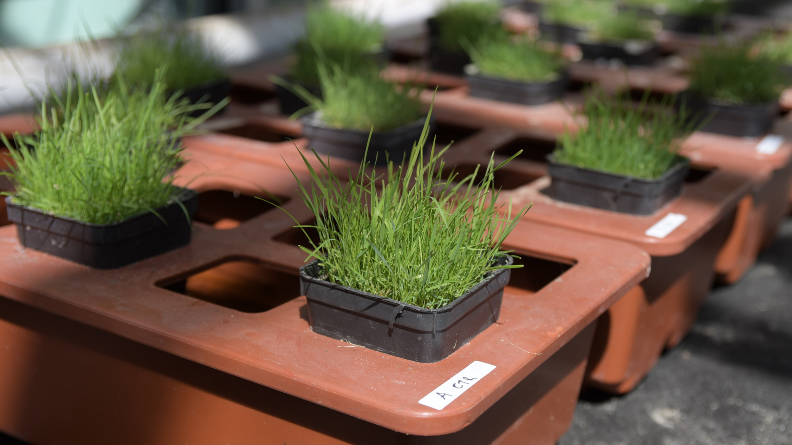
What makes the trial particularly interesting is the inclusion of MTU®, a patented biostimulant molecule discovered by scientists at the Institute of Experimental Botany and Palacký University in Czechia, led by Dr Jaroslav Nisler.
Now exclusively available to ICL within the turf sector , MTU® acts directly on the plant’s photosynthetic machinery, helping the plant maintain energy production and continue using nitrogen efficiently before, during and after stress. Pidolic acid further supports nitrogen assimilation and nutrient use efficiency.
Together, the technologies are designed to help turf maintain quality through challenging conditions such as heat, drought, low light and salinity.
For Dr. Owen, the trial builds on a growing body of evidence around the technology.
“Over the last few years we’ve seen very positive results with MTU® under a range of different stresses. This trial gives us an opportunity to better understand how the technology performs specifically under salinity stress and how it can help turf maintain quality when conditions become more challenging.”
The controlled greenhouse environment allows researchers to evaluate plant responses in detail and compare how different levels of stress influence turf performance.
When nutrition meets autonomous mowing
While the first project focuses on plant stress physiology in the greenhouse, the second moves into the field to examine the relationship between nutrition and autonomous mowing.
Robotic mowers are becoming increasingly common on golf courses and sports facilities. Their frequent mowing pattern can influence turf growth, clipping production and overall surface performance, creating new opportunities to optimize nutrition programs.
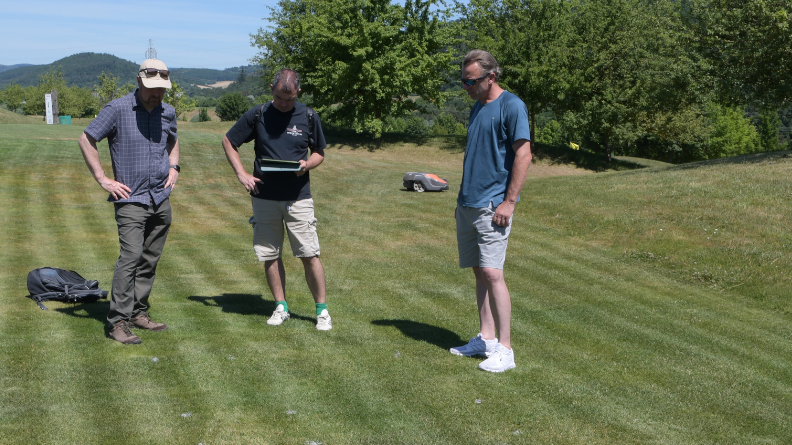
The field trial investigates how controlled release fertilizers perform under autonomous mowing management, with researchers assessing growth consistency, turf quality and seasonal performance.
“Autonomous mowing is changing the way some turf areas are maintained,” says Dr. Owen. “We’re interested in understanding how nutrition strategies can work alongside these technologies to help managers achieve consistent performance throughout the season.”
Rather than investigating nutrition or mowing independently, the project looks at how both factors interact under real field conditions. The aim is to generate practical information that can help turf managers adapt to evolving maintenance systems.
Building knowledge through practical research
Although both trials are still ongoing, clear differences between treatments are already beginning to emerge. Final assessments will provide a more complete picture of how turf responds to both environmental stress and changing management practices.
For Dr. Owen, the value of the work lies in generating evidence that turf managers can apply in practice.
“Whether we’re looking at stress management or new maintenance technologies, decisions need to be based on reliable data. These trials are helping us understand what works under real conditions and how different approaches can contribute to better turf performance.”
Once complete, the trials will provide further evidence on how nutrition programs can be adapted to help manage salinity stress and work alongside emerging maintenance technologies.