


 Whatsapp
  X
X  Mail
Mail  Copy link
 Perennial Ryegrass
Understand where perennial ryegrass performs best, its key strengths and limitations, and why cultivar choice matters.
On this page:
What is perennial ryegrass?
Perennial ryegrass (Lolium perenne) is one of the most widely used cool-season turfgrass species in professional turf management. Its combination of rapid establishment, wear tolerance and recovery makes it particularly valuable for sports turf, golf, lawns, amenity areas and renovation.
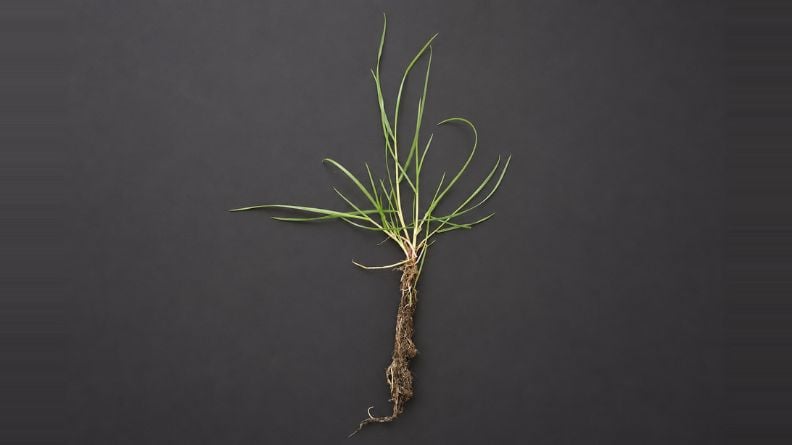
Perennial ryegrass specimen showing leaf, crown and root structure. Original photograph enhanced using AI for illustrative purposes only.
| Characteristic | |
|---|---|
| Latin name | Lolium perenne |
| Grass type | Cool-season |
| Growth habit | Primarily bunch-type, developing density through tillering |
| Germination | Typically 5–10 days under suitable conditions |
| Wear tolerance | High |
| Recovery | Good |
| Shade tolerance | Moderate to poor |
| Drought tolerance | Moderate |
| Common uses | Sports turf, golf, amenity turf, lawns, landscaping, overseeding and renovation |
Perennial ryegrass is a cool-season grass naturally suited to temperate climates. It typically has an upright, bunch-type growth habit, with narrow green leaves and turf density developing through tillering.
In managed turf it can form a dense, durable and visually strong surface. Under suitable conditions, seed can germinate within around 5–10 days, although establishment will depend on factors including temperature, moisture and seed-to-soil contact.
Where does perennial ryegrass perform best?
Perennial ryegrass is widely used on sports pitches, stadiums, training grounds, racecourses, golf tees and fairways, as well as amenity turf, landscaping, lawns and turf production.
It is particularly useful for renovation and overseeding, and performs well where turf is exposed to frequent wear and needs to establish or recover quickly.
It is generally less suited to heavy shade, prolonged drought without irrigation or extremely close mowing. Performance can also vary considerably between cultivars, so the right choice depends on the surface, environment and management objective.
How does perennial ryegrass perform under stress?
Wear
Perennial ryegrass has strong wear tolerance, making it particularly well suited to sports turf and other intensively used surfaces. Individual cultivars can differ significantly in their ability to withstand and recover from wear.
Drought
Perennial ryegrass generally has moderate drought tolerance. During prolonged dry periods, turf may lose colour, thin and recover more slowly, particularly where rooting is restricted or irrigation is limited.
Some modern cultivars have been bred for improved drought and stress tolerance.
Shade
Perennial ryegrass is generally less well suited to heavily shaded environments. Prolonged low light can reduce turf density and recovery, particularly where it is combined with heavy wear or restricted airflow.
Modern perennial ryegrass cultivars
Not all perennial ryegrass cultivars perform in the same way. Modern breeding has produced significant differences in characteristics including wear tolerance, turf density, recovery, leaf fineness, colour, disease tolerance, drought tolerance, lateral growth and cutting quality.
Cultivar choice can therefore have a major influence on how perennial ryegrass performs under different conditions and management regimes.
ICL’s perennial ryegrass portfolio includes both European and US genetics, with cultivars selected for different applications and performance requirements.
Modern breeding can change growth habit
Although perennial ryegrass is generally described as a bunch-type species, modern breeding has produced cultivars with different growth characteristics.
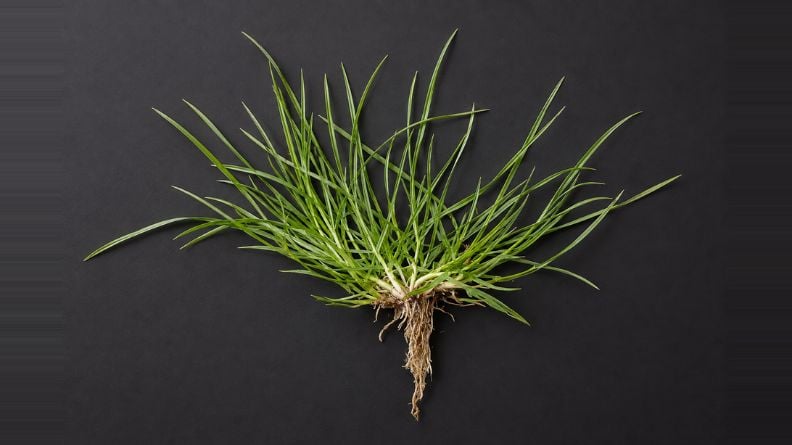
Torsion grass specimen showing dense tillering, leaf growth, crown and root structure. Original photograph enhanced using AI for illustrative purposes only.
Torsion TRT is one example. Compared with the more open, upright plant shown earlier, it develops a much denser and more compact growth habit, with fine leaves, turf-repairing tillers and strong cutting characteristics.
This demonstrates how cultivars within the same species can have noticeably different growth characteristics.
Diploid and tetraploid perennial ryegrass
Perennial ryegrass cultivars may be diploid or tetraploid. Diploid cultivars are generally associated with finer leaves, higher shoot density and a tighter turf appearance, while tetraploid cultivars can offer strong establishment, vigour and recovery.
The most appropriate type depends on the turf environment and the performance required.
ICL perennial ryegrass cultivars
ICL offers perennial ryegrass cultivars selected for different turf applications and performance characteristics.
- Grandslam GLD – dark-green US genetics with strong drought and Gray Leaf Spot tolerance
- Torsion TRT – fine-leaved, high-density growth with turf-repairing tillers
- Stellar 4GL – improved Gray Leaf Spot tolerance and wear tolerance
- Slugger 3GL – strong Gray Leaf Spot tolerance and spring green-up
- Fastball 3GL – strong turf quality, cold tolerance and Crown Rust tolerance
- Groundforce – European-bred cultivar suited to sports, landscaping and sod production
- GreenPlanet – European genetics with Red Thread, Leaf Spot and rust tolerance
- Veralynn – strong wear tolerance and visual appeal
- Calico – fine-leaved, hard-wearing European type with good summer colour
- Eurobeat – high-performance European cultivar with strong wear tolerance for stadium use
- Europitch – high-performance European cultivar with strong wear tolerance for stadium use
These cultivars are available through the ProSelect range as ProSelect Straights containing a single cultivar or within ProSelect Blends combining selected cultivars.
Some cultivars may be reserved for use within ICL blends rather than being available as individual Straights, and availability can vary by market.


