Whatsapp
  X
X  Mail
Mail  Copy link
 Greenheaven: tall fescue cultivar profile

On this page:
Greenheaven is a European-bred tall fescue selected from plants originating in the Po Valley region of Italy. It combines fine leaf texture and dense growth with heat, drought and disease tolerance, making it suited to turf where both appearance and resilience are important.
Greenheaven at a glance
| Species | Tall fescue (Festuca arundinacea) |
| Breeding | European |
| Leaf color | Rich mid-green |
| Leaf texture | Fine |
| Growth habit | Compact |
| Key strengths | Heat, drought and disease tolerance |
| Additional characteristic | Compatible in leaf texture with European-type Poa pratensis |
| Typical uses | Sports turf and sod production |
What makes Greenheaven different?
Greenheaven combines the resilience of tall fescue with a finer, denser turf character.
Its compact growth habit, fine leaf texture and rich mid-green color help produce a high-quality turf surface, while its heat, drought and disease tolerance support performance under more demanding growing conditions.
It also has a leaf texture compatible with European-type Poa pratensis, allowing the two species to be combined where a mixed sward is required.
Fine, dense turf quality
Greenheaven has been selected for dense growth and a relatively fine leaf texture.
These characteristics are particularly useful where tall fescue is being used not only for resilience, but also for the quality and appearance of the finished turf.
In practical sports-turf use, Greenheaven has shown good germination and development following overseeding, with its finer leaf texture and visual quality standing out against other tall fescue cultivars previously used on the same site.
Heat and drought tolerance
Heat and drought tolerance are key characteristics of Greenheaven.
These characteristics are particularly relevant where turf needs to maintain performance through warmer or drier periods.
In practical use on intensively managed sports turf, drought tolerance has also been an important selection factor where irrigation is used selectively and the sward can experience periods without supplementary water.
Disease tolerance
Greenheaven has been selected for disease tolerance alongside its heat and drought performance.
This gives turf managers another consideration when selecting tall fescue for sites where maintaining turf quality through environmental and disease pressure is important.
Performance under intensive wear
Greenheaven is well suited to demanding sports-turf situations where wear tolerance and surface stability are important.
On an intensively used polo pitch, Greenheaven remained hard wearing through a high level of match play. Dense rooting also contributed to stability within the turf.
This combination of wear tolerance, rooting and surface stability makes Greenheaven a strong option for sports turf exposed to repeated physical stress.
Compatibility with Poa pratensis
Greenheaven has a leaf texture compatible with European-type Poa pratensis.
This allows tall fescue and Poa pratensis to be combined without creating an obvious contrast in turf texture.
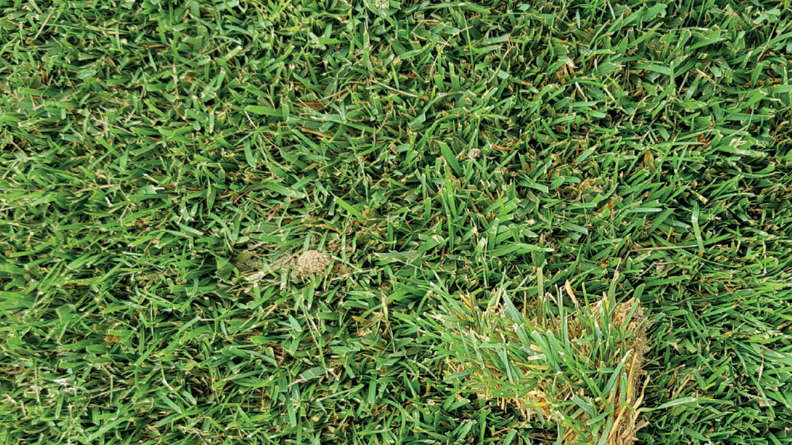
Greenheaven tall fescue in the background with Traction Poa pratensis in the foreground, showing their similar leaf texture and color.
Greenheaven can be used alongside cultivars such as Traction, providing an option where the characteristics of both species are required within the same turf.
Establishing Greenheaven
Greenheaven has an average sowing rate of 40 g/m².
The recommended mowing height is 25–50 mm.
Practical sports-turf experience has also shown good germination and development following post-season overseeding.
When should you choose Greenheaven?
Greenheaven is particularly suited to situations where fine turf quality needs to be combined with heat, drought and disease tolerance.
Its dense, compact growth and relatively fine leaf texture make it suitable where appearance matters, while its compatibility with Poa pratensis gives it additional flexibility in mixed-species turf.
Field experience under intensive sports use also supports its suitability where wear, rooting and surface stability are important.