


 Whatsapp
  X
X  Mail
Mail  Copy link
 Root Structure: How Roots Grow and Explore the Growing Medium
Understanding root structure and development in ornamental crop: root tips, root hairs, what improves absorption, how tissues transport water and nutrients throughout the plant.
On this page:
Understanding how roots grow and expand, how they absorb water and nutrients as well as their respiration processes is of great importance from ornamental plant growers. Roots are a complex system that may look relatively simple from the outside, but their internal structure is highly specialized.
How Roots Explore the Growing Medium
Root growth is a dynamic process. As roots grow, they continuously explore new volumes of the growing medium, allowing the plant to encounter different physical and chemical conditions and establish contact with additional water, nutrients and oxygen. For container-grown ornamental crops, this process is particularly important because roots are confined to a limited volume of growing medium.
“The distribution of roots within the container has a major influence on how effectively the plant can access available resources.”
- The continuous exploration of the rootzone is driven by specialized structures at the root tip.
- The root cap protects the delicate growing tissues as the root moves through the substrate.
- The elongation zone allows the root to extend into new areas of the growing medium.
- Just behind the root tip, root hairs develop. These fine extensions of root cells greatly increase the absorptive surface area available for water and nutrient uptake.
Because root hairs have a relatively short lifespan and the function of individual root sections changes as they mature, plants must continuously produce new roots and root hairs to maintain active uptake zones. An effective root system is continuously growing, branching and generating new active tissues capable of supporting plant growth.
Root Tips: Where New Root Growth Begins
Root growth occurs primarily near the root tip. At the very end of the root is the root cap. This structure protects the delicate growing tissues as the root pushes through the growing medium. The root cap also contributes to gravity perception, helping the root orient its growth in response to gravity. Behind the root cap is the region where new cells are produced. Newly formed cells then enter the elongation zone, where they increase in size. Cell division and elongation allow the root to extend into new areas of the growing medium. This continuous extension enables the plant to meet new sources of water, oxygen and nutrients.
Root Hairs: Where Absorptive Surface Increases
Further behind the root tip, root hairs develop. Root hairs are fine extensions of individual root epidermal cells. Although they are extremely small, they greatly increase the surface area through which the root can interact with the surrounding growing medium.
This is particularly important for water and nutrient uptake because absorption depends on close contact between the root surface and the surrounding solution. Root hairs are relatively short-lived; in fact, as sections of the root mature, the existing root hairs disappear while new ones are produced further along the growing root. The root system therefore needs continuous new growth to maintain active absorptive surfaces.
The Building Blocks of a Root: the Different Tissues
Inside the root, different tissues perform specialized functions.
- The outer layer is the epidermis. It forms the interface between the root and its surrounding environment and includes the cells from which root hairs develop.
- Beneath the epidermis is the cortex. The cortex consists of several layers of cells through which water and dissolved substances move towards the central vascular tissues.
- The central region contains the vascular tissues responsible for long-distance transport. The xylem transports water and dissolved mineral nutrients from the roots towards the above-ground parts of the plant. The phloem transports sugars and other assimilates produced in photosynthetically active tissues to other parts of the plant, including the roots.It means that the root is also a transport organ connecting the root environment with the rest of the plant.
Water and dissolved nutrients that enter the root must move through its tissues before reaching the vascular system. The movement of water and solutes through the root is influenced by the structure and properties of the different tissues.
The root therefore functions as a selective interface rather than an open tube through which everything in the surrounding solution can simply enter. This selectivity is important because plants need to regulate the movement of mineral nutrients and maintain appropriate internal concentrations.
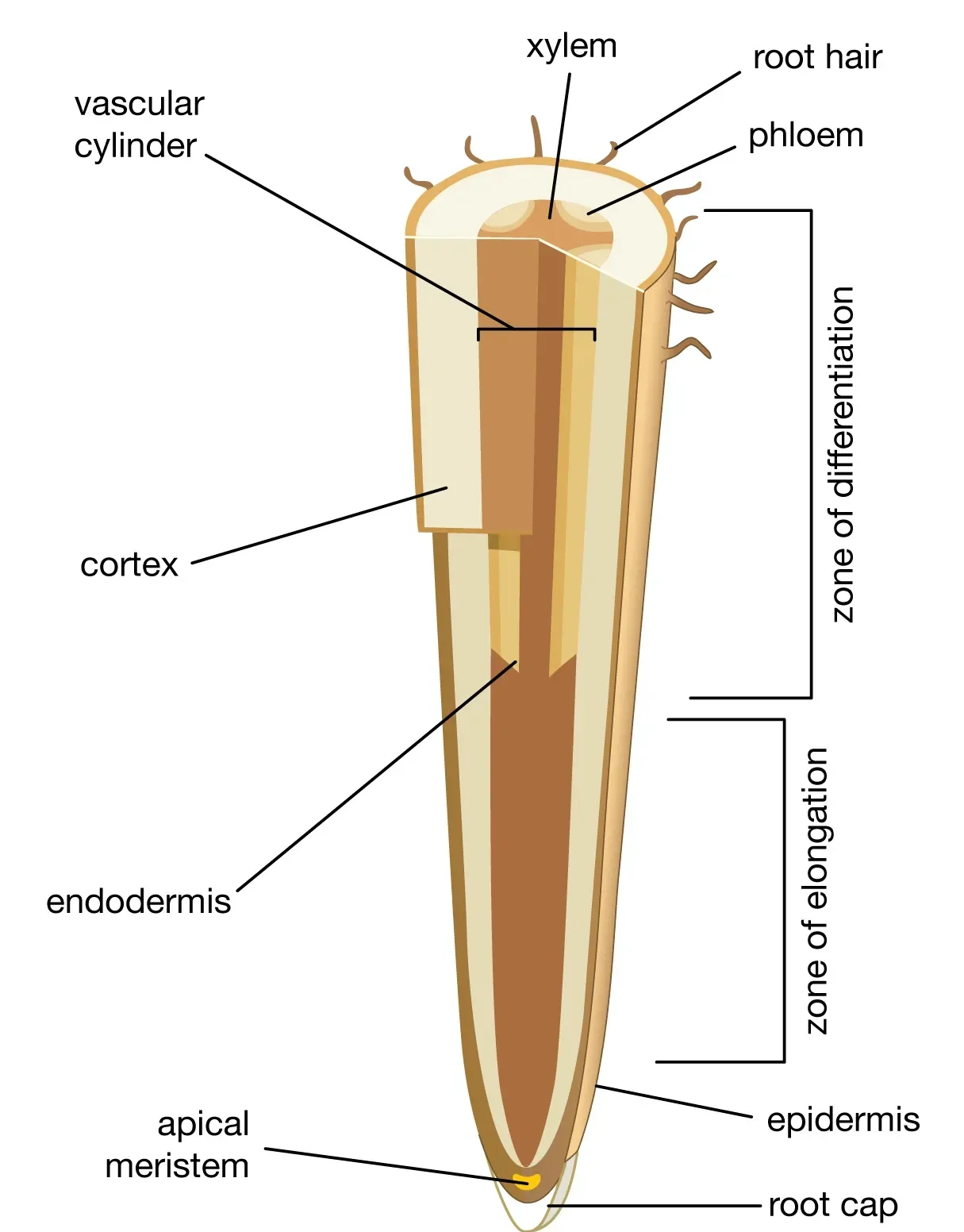
Root structure (www.britannica.com)
Root Structure and Substrate: a Dynamic System
We have seen that the structure of a root determines how it interacts with the surrounding growing medium. At the same time it is important to know that the also the growing medium influences root development.
- Physical conditions such as water availability, aeration and resistance to root penetration can influence where roots grow and how effectively they explore the available volume.
- Chemical conditions, including nutrient availability, pH and salt concentration, also influence the root environment.
- If interested to learn more about substrate’s parameters that might influence root development, follow this link
Conclusion
Understanding root’s structure and roots functions clarifies the interaction between the rootsystem and its environment, letting the implications for successful ornamental plant production surface. To dig deeper on this subject, read our other articles as listed at the bottom of this page.







Our knowledge
Tips & tricks, disease prevention, crop and market related information
Explore our knowledge