


 Whatsapp
  X
X  Mail
Mail  Copy link
 Raptor LS: tall fescue cultivar profile

On this page:
Raptor LS is a turf-type tall fescue (Festuca arundinacea) developed for durable, high-quality turf. Selected for its Lateral Spread characteristics, it combines compact growth, dark-green color, wear and drought tolerance, and strong resistance to brown patch.
Developed in the United States, Raptor LS has demonstrated strong performance in National Turfgrass Evaluation Program (NTEP) trials, including evaluations of turf quality, traffic stress, drought and disease resistance.
Raptor LS at a glance
| Species | Tall fescue (Festuca arundinacea) |
| A-LIST cultivar | No |
| Breeding | US genetics |
| Growth habit | Compact. Lateral Spread™ technology, selected for increased lateral growth and turf density |
| Key strengths | Wear tolerance, drought tolerance and brown patch resistance |
| Additional characteristic | Strong turf quality under relatively low mowing heights |
| Typical uses | Sports fields, lawns, landscape and amenity turf |
| Sowing rate | 30 – 50 g/m² |
| Recommended mowing height | 50 – 75 mm |
What makes Raptor LS different?
Raptor LS combines the durability associated with tall fescue with lateral growth characteristics and strong turf quality.
It was selectively bred from plants exhibiting Lateral Spread characteristics, with the aim of encouraging greater turf density and improving the ability of the sward to maintain coverage.
Alongside its growth habit, Raptor LS offers a combination of wear tolerance, drought tolerance and brown patch resistance.
Its performance in US NTEP trials provides supporting evidence for these characteristics, particularly under traffic stress, drought conditions and lower mowing heights.
Lateral Spread technology
Tall fescue is predominantly a bunch-type grass, establishing through the production of tillers rather than the extensive lateral spreading found in strongly rhizomatous species.
Raptor LS was developed using Lateral Spread breeding technology, selecting plants with greater lateral growth characteristics.
This helps encourage dense turf development and can contribute to maintaining coverage as the sward establishes and matures.
For turf managers, these characteristics are particularly relevant where surface density and wear tolerance are important.
Lateral Spread does not mean Raptor LS spreads like a strongly rhizomatous grass, but it offers a different growth characteristic compared with conventional bunch-type tall fescue cultivars.
Performance in NTEP trials
Raptor LS has demonstrated strong performance across several categories in the US National Turfgrass Evaluation Program (NTEP).
The results below highlight its performance under different growing conditions and management regimes.
| Characteristic | Raptor LS rating |
|---|---|
| Turf quality (LP Group 1) | 6.8 |
| Turf quality under low mowing | 8.1 |
| Turf quality under drought conditions | 6.7 |
| Brown patch resistance | 7.4 |
| Mountain region turf quality | 7.2 |
Source: NTEP 2019–2020 tall fescue evaluations. Ratings use a 1–9 scale, where 9 represents the best performance. Results were collected across different trial locations and growing conditions.
These results demonstrate Raptor LS’s combination of turf quality, disease resistance and tolerance to challenging growing conditions, particularly its performance under lower mowing heights and resistance to brown patch.
Wear tolerance, drought tolerance and turf quality
Raptor LS has demonstrated strong turf quality under traffic stress and challenging growing conditions, making it suitable for sports and amenity turf where durability and resilience are important.
In the 2020 NTEP traffic evaluation at Ames, Iowa, Raptor LS achieved a mean turf quality rating of 6.5, compared with a trial high of 6.9.
It also performed well across NTEP Transition Region locations, achieving a mean turf quality rating of 6.2, compared with a trial high of 6.4.
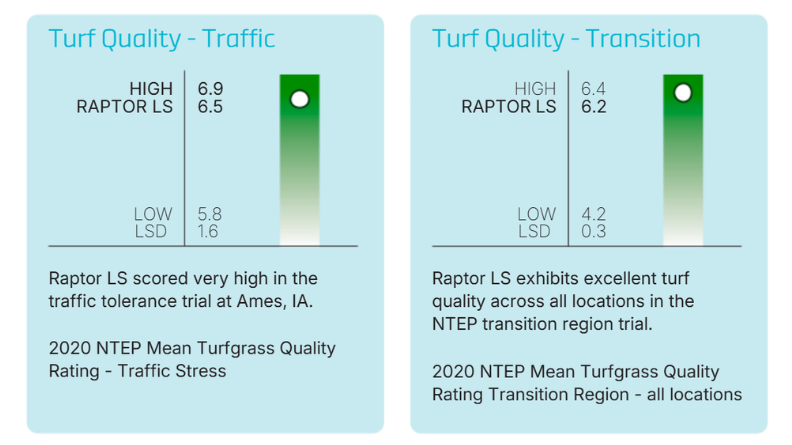
2020 NTEP mean turfgrass quality ratings under traffic stress at Ames, Iowa (left) and across Transition Region locations (right). Raptor LS achieved ratings of 6.5 and 6.2 respectively, on a 1–9 scale where 9 represents the best performance.
In a separate NTEP drought evaluation, Raptor LS achieved a turf quality rating of 6.7, further supporting its suitability for turf exposed to periods of limited moisture availability.
Combined with its compact growth habit and Lateral Spread characteristics, these results highlight Raptor LS’s potential to maintain turf quality and coverage under demanding growing and management conditions.
Brown patch resistance
Brown patch, caused by Rhizoctonia solani, is an important disease of tall fescue, particularly during warm, humid weather.
Raptor LS has demonstrated strong resistance to brown patch in NTEP evaluations.
In the 2020 trial data, it achieved a brown patch resistance rating of 7.4, compared with ratings of 5.8–6.8 for the other cultivars shown in the comparison.
This was the highest numerical brown patch resistance rating among the selected cultivars.
Strong disease resistance is particularly valuable where summer disease pressure can affect turf quality and appearance.
Although resistance does not eliminate the possibility of infection, it provides an important consideration when selecting cultivars for turf exposed to periods of disease pressure.
Compact growth and mowing tolerance
Raptor LS combines a compact growth habit with strong turf quality under relatively low mowing heights.
In NTEP trials conducted at Blacksburg, Virginia, it achieved a turf quality rating of 8.1 at a mowing height of approximately 38 mm.
This was the highest numerical rating among the cultivars included in the comparison table.
For routine maintenance, the recommended mowing height is 50–75 mm, although Raptor LS can tolerate lower heights under suitable management conditions.
This flexibility makes it useful for sports, landscape and amenity applications where mowing requirements may vary.
Establishing Raptor LS
Raptor LS is suitable for new seedings and overseeding existing tall fescue.
The recommended sowing rate is 30–50 g/m², with an overseeding rate of 25–35 g/m².
Tall fescue generally germinates best when soil temperatures are approximately 12–15°C, making late summer and early autumn suitable establishment periods in many temperate regions.
Good seed-to-soil contact and consistent moisture are important during germination and early establishment.
Seeding following aeration or using suitable overseeding equipment can help improve establishment by ensuring seed reaches the soil surface.
The recommended routine mowing height is 50–75 mm.
When should you choose Raptor LS?
Raptor LS is particularly suited to situations where turf durability, drought tolerance and disease resistance are important selection criteria.
Its Lateral Spread characteristics help support dense turf development, while its compact growth habit and dark-green appearance contribute to overall turf quality.
NTEP trial results demonstrate its performance under traffic stress, drought conditions and relatively low mowing heights, making it a strong option for sports fields, lawns, landscape and amenity turf where consistent coverage and resilience are priorities.
Where can you find Raptor LS?
Raptor is used in selected ProSelect grass seed mixtures. Product availability and blend compositions vary by country, so please check your local ProSelect range for details.


