Whatsapp
  X
X  Mail
Mail  Copy link
Effective and convenient precision nutrition every time
Brand details Solinure GT Growing Grapevine
Crop Nutrition Advice
Everything you need to know about grapevine fertilization, best practice, suitable products, field trials, and more.
Advice for growing grapevine (Vitis vinifera)

Burgundy vineyard landscape

Grapes of Meunier in Champagne region before closing of the cluster
Introduction
Grapevine (Vitis vinifera) is one of the world’s most valuable perennial fruit crops, cultivated across temperate and Mediterranean regions for wine, table grapes, raisins, and juice. Its global importance stems from its economic value, cultural heritage, and the diversity of products derived from the fruit.
More than 10,000 grape varieties exist, though only approximately 1,100 are used in commercial production. Major producers include Italy, France, Spain, China, the USA, Chile, Argentina, South Africa, and Australia. Grapevine follows an annual cycle of dormancy, budbreak, flowering, berry set, veraison, and harvest. Its productivity and fruit quality depend on balanced nutrition, soil structure, climate, and careful canopy and water management.
Growing Conditions
Grapevines adapt to a wide range of soils and climates, but optimal performance requires:
Soil
When it comes to soil, grapevines care much more about structure and drainage than raw fertility. If soil waterlogs, the roots suffocate, which opens the door to devastating root rot diseases.
- The right pH: Grapevines thrive best in slightly acidic to neutral soils (pH 5.5 to 7.0).
- Acidic soils (below 5.5): These restrict how well the grapevine can take up essential nutrients like phosphorus. Agronomists usually fix this by adding limestone.
- Alkaline/chalky soils (above 7.5): High-calcium soils lock up iron and zinc. This often triggers a “lime-induced chlorosis”. The leaves turn yellow because they cannot produce enough chlorophyll. However many famous vineyards (Champagne, Cognac) are grown on high-pH soils, which gives the wines a distinctive characteristics.
- Organic matter: A moderate organic matter level of 2% to 3% is ideal. Too much nitrogen in the soil causes grapevines to grow wild, thick leaves. This creates a dense canopy that blocks sunlight and traps humidity, inviting fungal diseases like powdery mildew.
Climate
Commercial viticulture requires distinct seasonal patterns to balance vegetative growth with fruit ripening. Ideally, grapevine thrives in regions that offer a long growing season with warm days, cool nights, low humidity during the ripening phase to mitigate disease pressure, and sufficient winter chilling to induce uniform bud dormancy.
The grapevine’s physiological performance throughout the season is dictated by specific temperature thresholds:
- Spring frost vulnerability: During early spring budbreak, young emerging shoots and green tissues possess no frost hardiness. A sudden drop in temperature below -2°C (28°F) can kill the primary buds, severely reducing the season’s yield potential in a single event.
- Optimal photosynthesis: The vine’s photosynthetic engine operates most efficiently within a daytime temperature range of 25°C to 30°C (77°F to 86°F).
- Heat stress responses: When ambient temperatures exceed 35°C (95°F), the vine enters a protective survival mode, slowing down metabolic activity and carbohydrate production. If extreme heat occurs during spring flowering, it disrupts pollination, causing high rates of flower drop (coulure) and leading to loose, unevenly set grape clusters.
Irrigation
While many traditional European vineyards rely strictly on rainfall, modern vineyards use precision drip irrigation to secure consistent yields and crop quality.
The goal isn’t to give the grapevine all the water it wants. Instead, agronomists use a technique called Regulated Deficit Irrigation (RDI). By intentionally withholding a little bit of water between the time the berries form and when they start to change color (veraison), the vine stops growing new leaves and focuses all its energy on pumping sugars, flavors, and rich color into the grapes.
Global Production
Global vineyards cover roughly 7.1 million hectares (about 17.5 million acres). While Europe still holds the largest portion, production has expanded heavily into China, the Americas, and Australia.
Today, the global crop is split almost evenly: about 47% is grown for wine, 46% for fresh table grapes, and 7% for raisins (OIV/FAO data).
China has emerged as the world’s largest producer of fresh grapes (17.0 million tonnes in 2024), primarily driven by its massive table grape sector. In contrast, the European Union maintains dominance in the wine sector, producing ~60% of the world’s wine, though 2025 estimates (232 mhl) remain ~7% below the five-year average due to climatic instability (OIV, 2026).
Grape Usage
While the global harvest yields a variety of agricultural goods, it is primarily driven by the international wine and fresh table grape industries.
- Wine production: This is the most complex economic driver of the viticulture industry. According to the OIV, global wine production stands at 227 million hectolitres (2025). Due to three consecutive years of severe climate volatility (such as late frosts, droughts, and flash rains), global wine volumes have remained at historically low levels—about 7% below the long-term historical average. The market is overwhelmingly dominated by the European Union (especially Italy, France, and Spain), which commands roughly 60% of global wine production.
- Industrial byproducts: Beyond standard commercial wine, approximately 30 million hectolitres of the wine grape harvest are diverted annually into industrial distillation, spirits (Brandy, Cognac, Grappa), and specialized wine vinegars. This sector acts as a crucial market safety valve to absorb excess volumes and stabilize grape prices.
- Fresh consumption (Table Grapes): Driven by strict physical standards, this sector focuses on crisp texture, thin skins, large berry size, and seedlessness. China and India lead global production volumes.
- Drying (raisins): Grapes with high natural sugars and thin skins (predominantly Thompson Seedless) are dried to a 15% moisture content. This highly regionalized market is dominated by Turkey and the United States.
- Juices and concentrates: A multi-billion-dollar industry where major producers like Spain and Argentina process unfermented grape must into concentrates. These are exported globally as natural sweeteners for the beverage, baking, and canning industries.
Grapevine Quality Parameters
Grape quality is a measurable balance between chemistry and physical integrity, shifting depending on the final market product.
- Sugar-acid balance: Cultivars are evaluated by sugar accumulation—measured in degrees Brix (percentage of sugar by weight)—paired against natural organic acids (tartaric and malic). Wine grapes require higher sugar levels (typically 22° to 26° Brix) to provide for fermentation, whereas table grapes target a lower Brix (16° to 18° Brix) combined with low acidity for a immediate sweet flavor profile.
- Phenolic and aromatic compounds: Located primarily within the skins and seeds, these compounds dictate the final product’s market value. Anthocyanins provide red and purple color development, while tannins supply structure and mouthfeel. Managing sunlight exposure through canopy pruning is essential to maximize these compounds without sunburning the fruit.
- Physical integrity and uniformity: Consistent berry size and structural skin integrity are critical quality controls. Thin, elastic skins are favored for fresh table consumption, yet they must remain strong enough to resist splitting during late-season rains. Cracked skins open the door to devastating fungal pathogens like Botrytis cinerea (bunch rot), which can rapidly ruin entire clusters.
Grapevine Growth Stages
A visual overview of grapevine development. It starts with winter dormancy and moves through budbreak, the vegetative shoot & leaf development phase, flowering & fruit set, and berry development. A crucial transition is veraison, where berries soften and change color, leading to final harvest at peak maturity. This visual breakdown highlights how the annual cycle balances vegetative growth with fruit production.
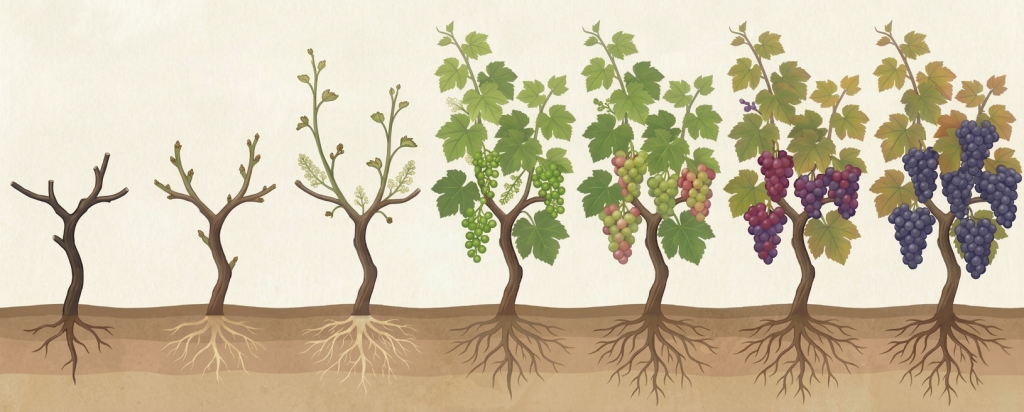
From dormancy to harvest: a visual journey of grapevine development.
Nutrient Requirements
Grapevines have fewer mineral deficiencies and a lower plant nutrients demand than many other horticultural crops. Phosphorus, potassium, and lime applications should be based on soil tests and leaf-analysis results. Nitrogen-based fertilizers should be applied during periods of active uptake, to minimize loss through soil leaching. This includes the period from bud-break to veraison and, if leaf fall has not occurred, immediately after harvest or wood maturation stage. To ensure an effective and efficient nutrition, applying fertilizers several times during the season guarantees the best nutrient bioavailability. Because of this, fertigation and controlled-release fertilizers fit the grapevines needs perfectly.
Dynamic of nutrient uptake over a crop season in vineyards

The following dynamics patterns can be seen above:
- N uptake is relatively low at early season, it rises sharply until fruit-set, then decreases sharply until veraison, and increases sharply again after harvest or wood maturation stage.
- P uptake is higher at the beginning of the season, progressively decreasing till veraison. The uptake restarts after harvest and wood maturation.
- K uptake rate starts highest of all the above, falls steeply until harvest, and slightly recovers after harvest
Role of Nutrients
Nitrogen (N)
This element serves as the primary driver of vegetative development, dictating shoot vigor, leaf area expansion, and chlorophyll production. In the vineyard, nitrogen availability must be carefully managed; insufficient levels stunt growth and reduce fruit set, while excessive nitrogen triggers aggressive canopy growth that shades fruit, increases fungal disease pressure, and delays grape ripening. In wine grapes, it is also essential for building Yeast Assimilable Nitrogen (YAN), which prevents stalled fermentations.
Potassium (K)
Potassium acts as the grapevine’s primary metabolic regulator, managing cellular water transport, osmotic pressure, and the opening and closing of leaf stomata. During fruit development, it is heavily translocated to the berries to drive sugar accumulation and fruit sizing. However, over-fertilization with potassium at wine grapes can lead to excessive uptake that displaces magnesium and spikes the juice pH (over 3.5), resulting in flat, chemically unstable wines.
Phosphorus (P)
Required in smaller quantities than nitrogen or potassium, phosphorus is the energy currency of the vine, vital for root architecture development, nucleic acid synthesis, and early cluster formation. Adequate phosphorus levels ensure strong flowering and uniform fruit set, particularly in cool, damp spring soils where natural phosphorus availability is locked up.
Calcium (Ca)
Calcium is a structural component of cell walls, binding the pectin that holds berry skins together. Maintaining high calcium levels in the fruit tissue strengthens the skin’s physical integrity. This significantly reduces the risk of late-season berry splitting during sudden harvest rains and extends the shelf life and crunch of fresh table grapes.
Magnesium (Mg)
As the central atom of the chlorophyll molecule, magnesium runs the photosynthetic engine of the grapevine. It ensures the leaves can manufacture the carbohydrates required to fully ripen a heavy crop load. A deficiency manifests as interveinal chlorosis (yellowing or reddening between leaf veins), which triggers premature leaf drop and poor wood acclimation before winter.
Boron (B) and Zinc (Zn)
These two trace minerals are critical during the early-season reproductive phase. Boron governs pollen tube elongation for successful pollination, while zinc regulates the growth hormones needed for cellular expansion and leaf development. Missing the tight window for these micronutrients causes severe millerandage (a condition where grape clusters contain a mix of unevenly sized, poorly pollinated berries).
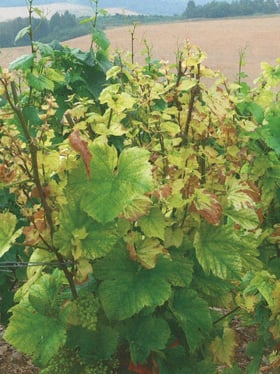
Grapevine Deficiency Symptoms
Nitrogen Deficiency
- Uniform yellowing across the entire vine.
- Symptoms appear first on the older, basal leaves.
- Drastically stunted shoot growth and thin canes.
- Smaller, pale green leaves that may develop red tints on the leaf stems.
Potassium Deficiency
- Discoloration starts at the outer leaf margins and moves inward.
- Leaf edges turn yellow on white varieties and bright red or purple on red varieties.
- Leaf edges curl upward and can die or turn brown in severe cases.
- Grapes fail to color properly, remain small, and struggle to build sugar.
Phosphorus Deficiency
- Older leaves develop a dark, dull green color.
- Red or purple discoloration appears on leaf margins and stems, especially in red varieties.
- Poor root development and delayed budbreak in the spring.
- A noticeable drop in flowering and overall fruit set.
Calcium Deficiency
- Necrotic brown spots develop along the margins of young leaves.
- Young leaves may cup downward or become distorted and misshapen.
- Poor canopy structure due to dieback of growing shoot tips.
- Increased fruit splitting, soft berry textures, and poor shelf life in table grapes.
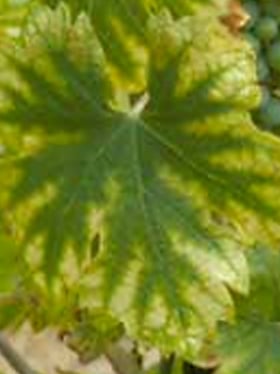
Magnesium Deficiency
- Yellowing or reddening occurs specifically between the main veins of older leaves.
- A sharp, distinct outline of green remains directly around the leaf veins.
- Premature leaf drop in late summer, leaving the fruit zones exposed to sunburn.
- Halts sugar production and prevents proper wood ripening before winter.
Iron Deficiency
- Striking yellow or almost white chlorosis that targets the youngest leaves at the shoot tips first.
- The entire leaf turns pale yellow, but the intricate net of veins stays dark green.
- Severe stunting of new shoots.
- Highly common in high-pH, chalky, or waterlogged soils.
Zinc Deficiency
- Young leaves remain small, misshapen, and stunted.
- The V-shaped notch where the leaf stem meets the blade looks flattened or stretched wide.
- Severe stunting of shoot tips.
- Loose, straggly grape clusters filled with a mix of normal and tiny, seedless berries.
Boron Deficiency
- Young leaves become distorted, cupped downward, and develop yellow mottled patches.
- Shoot tips die back, causing lateral buds to grow into a bushy appearance.
- Poor pollen viability that leads to massive flower drop.
- Distorted, unevenly ripened berry clusters.





Conclusion
Grapevine represents a highly sophisticated, high-value perennial system where fruit quality and vineyard longevity depend entirely on precise agro-ecological management. Achieving premium fruit composition, whether targeted for fresh table consumption or premium wine production, requires an advanced understanding of the intersections between soil structure, bioclimatic thresholds, and targeted water management strategies.
Ultimately, vineyard productivity is anchored by balanced plant nutrition. By actively monitoring nutrient requirements and recognizing visual deficiency symptoms early, growers can optimize canopy efficiency, safeguard fruit skin integrity, and ensure stable, high-quality yields year after year. Integrated management remains the definitive tool for mitigating environmental pressures and unlocking the true commercial and aromatic potential of the vineyard.
References:
Keller, M. (2020). The Science of Grapevines: Anatomy and Physiology. Academic Press.
Marschner, P. (2012). Marschner’s Mineral Nutrition of Higher Plants. Academic Press.
International Organisation of Vine and Wine (OIV). (2025/2026). State of the World Vitiviniculture Sector Report. Paris, France.
Christensen, L. P., Kasimatis, A. N., & Jensen, F. L. (2000). Grapevine Nutrition and Fertilization in the San Joaquin Valley. University of California, Division of Agriculture and Natural Resources.
Vineyard trials
Q&A
Here are some frequently asked questions we received from farmers regarding growing vineyards.
The planting stage is an important time with regards to fertilizing, when plenty of potassium, magnesium and phosphorus in particular should be provided. But when the plant is producing, the harvest means uptake so every year the grapevine should receive a dose of N, P, K, and Mg based on soil and leaf analysis.
Any of these is ok. In some areas, irrigation isn’t allowed so you should opt for solid or foliar. If drip irrigation is allowed it can be the best way to cater for the crop’s needs.
Usually K/Mg in grapevine soil should be between 2 and 3, so a fertilizer such as Polysulphate will maintain such a ratio.
A supply of potassium in the plant will ensure a sufficient harvest and good sugar content. Polysulphate ensures availability of these nutrients throughout the crop cycle. However, the excessive potassium uptake at wine grapes can drive the juice pH up, resulting in flat, chemically unstable wines.
Explore Grapevine Solutions by Brand
Find the right solutions to improve crop quality and yield

The groundbreaking total range of water-soluble straight fertilizers
Brand details Nova
Nutrivant delivers advanced technology for improved, long lasting foliar nutrition.
Brand details Nutrivant<sup>®</sup>Effective and convenient precision nutrition every time
Brand details Solinure GTThe groundbreaking total range of water-soluble straight fertilizers
Brand details NovaNutrivant delivers advanced technology for improved, long lasting foliar nutrition.
Brand details Nutrivant<sup>®</sup>Discover Our Solutions for Growing Grapes
Grapes Solutions: Increase Your Harvest
Solinure GT

Solinure GT

Nova

Nova

Nutrivant®

Digital Tools
Access calculators to improve nutrient management and boost productivity