


 Whatsapp
 X
 Mail
 Copy link
The liquid fertilizer providing pinpoint precision in foliar feeding
Brand details Agroleaf Liquid Growing Oilseed Rape
Crop Nutrition Advice
Everything you need to know about oilseed rape (or canola, Brassica napus L.) fertilization, best practice, suitable products, field trials and more.

Oilseed rape crop in the field

Young oilseed rape plant in bloom
Introduction
Oilseed rape (Brassica napus L.) is one of the world’s most important oilseed crops and represents a major source of vegetable oil, biodiesel feedstock, and high-protein meal for animal nutrition. Modern canola varieties were developed through breeding programs that reduced seed erucic acid concentrations and glucosinolate content, improving both oil and meal quality. Today, oilseed rape is widely cultivated across temperate regions of Europe, North America, Asia, and Oceania and plays a crucial role in diversified cropping systems.
The crop is characterized by rapid biomass accumulation, a deep and extensive rooting system, high nutrient demand, and exceptional nitrogen uptake efficiency during the autumn growth period. These traits allow oilseed rape to reduce nitrate leaching while contributing to active nutrient cycling within crop rotations.Key agronomic advantages of oilseed rape include:
- high seed oil content (40-45%)
- strong autumn N uptake (catch‑crop effect)
- rapid canopy development
- contribution to crop diversification
soil physical and biological quality enhancementBecause oilseed rape is an annual crop with high nutrient removal rates, each production cycle requires careful fertilization planning based on soil fertility tests, target yield, nutrient removal, and nutrient use efficiency principles (Right Source, Right Rate, Right Time, Right Place).
Growing Conditions
Climate & temperature
Oilseed rape performes best under cool to moderate climatic conditions. Optimal growth occurs between 10 and 22 °C, while temperatures outside this range may reduce biomass production, flowering, pollen viability, and seed development. Autumn establishment is critical for winter-type cultivars. Vigorous early growth – characterized by a well-developed leaf canopy, a thick root collar diameter, and a deep taproot system before winter dormancy – strongly determines over-winter survival, spring regrowth, and final seed yield.
Soil requirements
Oilseed rape is highly sensitive to soil physical structure, drainage, and root-zone fertility. Optimal growth conditions include:
- Soil pH between 7–7.0.
- Good soil fertility with adequate nutrient availability
- Best performance on medium‑textured soils (loam, clay loam)
- Avoid sandy soils due to low water-holding capacity and high nutrient leaching risks
- Requires deep, well‑drained, and uncompacted soils; it is sensitive to waterlogging and soil compaction
- Rotation planning is essential to reduce disease pressure and volunteer issues (1 years in 3 to 4 years).
Water & irrigation
Oilseed rape is highly responsive to water availability, particularly during stem elongation, flowering, and seed filling, when crop water use and biomass accumulation are greatest. Conversely, waterlogged conditions impair root respiration, nutrient uptake, and root growth, underscoring the importance of well-drained soils with good porosity.
Global Production
Global oilseed rape production has expanded steadily over the past two decades, driven by increasing demand for high-quality edible oil, renewable biofuels, and high‑protein meal. According USDA forecasts, global production is expected to reach approximately 97.6 million tonnes in the 2026/27 season, continuing an upward trend from95.6 million tonnes in 2025/26 and 86.3 million tonnes in 2024/25. Canada, the European Union, China, and India, and Australia remain the leading producing regions and collectively account for the majority of global production and trade. Long‑term economic analyses show that global oilseed rape production grew at an average annual rate of 2.5%between 2000 and 2013, reflecting both improvements in yield and expansion of cultivated area. Today, oilseed rape is one of the world’s most important oilseed crops, ranking second only to soybean in global oilseed production.
Oilseed Rape Growth Stages (BBCH)
- Establishment (BBCH 10–19) – leaf expansion and root development
- Overwintering – canopy maintenance, nutrient storage, and winter survival
- Stem extension (BBCH 30–39) – rapid biomass accumulation and nutrient uptake
- Flowering (BBCH 50–69) – peak reproductive growth
- Pod development (BBCH 70–79) – seed filling
- Ripening (BBCH 80–89) – seed maturation, oil accumulation, and dry matter deposition
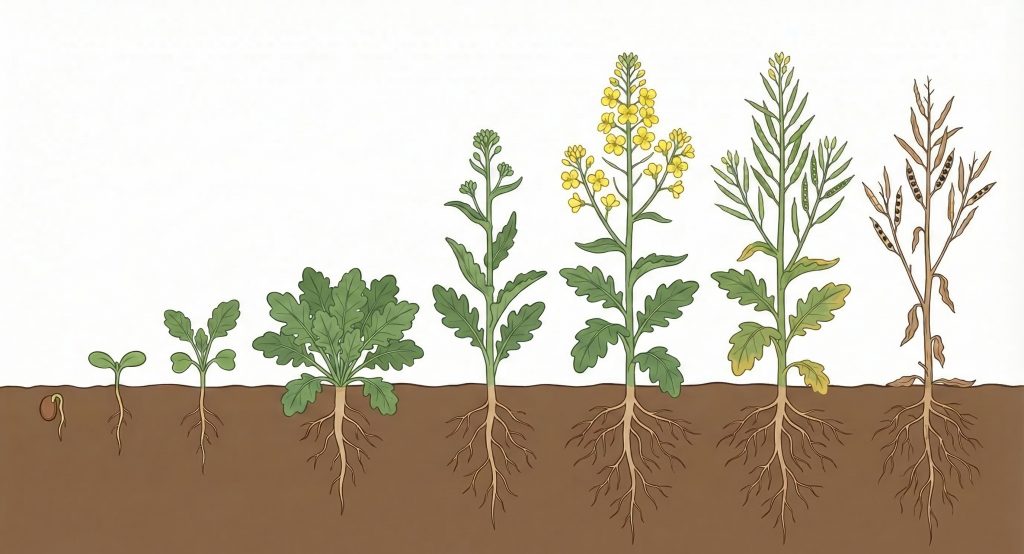
Oilseed rape growth stages from germination and rosette formation to flowering, pod development, and final maturity.
Oilseed rape macronutrient removal (kg/t) (NEPAR, 2019)
| Nutrient removal | N | P | K | Mg | Ca | S |
|---|---|---|---|---|---|---|
| Extraction | 80 | 15 | 95 | 24 | 41 | 29 |
| Export | 40 | 7 | 10 | 7 | 6 | 7 |
Sufficiency ranges for macronutrients in canola, based on analysis of the uppermost recently matured leaf prior to flowering (Campbell, 2000).
| Nutrient | % | |
|---|---|---|
| N | 4.0 – 6.4 | |
| P | 0.42 – 0.69 | |
| K | 3.5 – 5.1 | |
| Mg | 0.15 – 0.62 | |
| Ca | 2.1 – 3.0 | |
| S | 0.65 – 0.9 |
Sufficiency ranges for micronutrients in canola, based on analysis of the uppermost recently matured leaf prior to flowering (Campbell, 2000).
| Nutrient | ppm | |
|---|---|---|
| B | 25-54 | |
| Mn | 30-250 | |
| Fe | 100+ | |
| Zn | 33-49 | |
| Cu | 5-25 |
Nutrient Requirements
Nitrogen (N)
Oilseed rape has a high capacity for N uptake during autumn growth and can accumulate more than 100 kg ha⁻¹ N before winter under favorable conditions.. This characteristic contributes to rapid canopy development and helps reduce nitrate leaching. Nitrogen applications are commonly split to better match crop demand, improve N use efficiency, and reduce N losses. However, single N applications can also be effective under certain management systems, particularly when controlled-release fertilizers, or products containing urease and/or nitrification inhibitors are used
Phosphorus (P)
Phosphorus is essential for root development, early canopy establishment, and energy transfer processes. Its availability in soil is strongly influenced by soil mineralogy and chemistry, particularly soil pH and interactions with calcium, iron, and aluminum, which can reduce the concentration of plant-available P. Maintaining soil pH within the optimum range (~6.5 – 7.0) enhances P availability by increasing labile P.
Potassium (K)
Potassium is required in large quantities by oilseed rape (~95 kg/t) (NEPAR, 2019) and plays critical roles in osmoregulation, photosynthesis, enzyme activation, assimilate transport, and stress tolerance. Potassium availability is influenced by soil texture and mineralogy. In sandy soils, K is more susceptible to leaching due to the lower cation exchange capacity. In contrast, in clay-rich soils containing 2:1 clay minerals, part of the applied K may become temporarily fixed between clay layers, reducing its short-term availability to plants. Maintaining adequate soil K levels is particularly important during periods of rapid biomass accumulation, flowering, and pod filling, when crop demand is greatest.
Magnesium (Mg)
Magnesium is the central atom of the chlorophyll molecule and is involved in photosynthesis, carbohydrate transport, and numerous enzymatic processes. Deficiency is most common on acidic, sandy, and low-cation-exchange-capacity soils where Mg is more prone to leaching. Adequate Mg nutrition is important throughout the growing season, particularly during reproductive stage when high photosynthetic activity is required to support seed filling. ollowing winter, weak or poorly developed crops often respond positively to Mg fertilization.
Calcium (Ca)
Calcium contributes both to soil quality and plant nutrition. In soil, it promotes aggregate stability, improves pore continuity, and enhances water infiltration and root growth. Maintaining adequate soil pH through liming remains the primary strategy for ensuring sufficient Ca supply and sustaining nutrient availability.
Sulfur (S)
Oilseed rape has one of the highest sulfur requirements (29 kg/t) (NEPAR, 2019) among field crops due to its high production of proteins, S-containing amino acids, and glucosinolates. Plants absorb S as sulfate (SO₄²⁻), meaning that S from soil organic matter must be mineralized before becoming available for uptake. Under cool soil conditions, mineralization is often insufficient to meet crop demand, increasing the risk of S deficiency. Consequently, S fertilization is essential to ensure an adequate S supply, particularly in soils prone to sulfate leaching, and with low organic matter content. Adequate S nutrition improves nitrogen use efficiency, seed yield, oil content, and seed quality.
Micronutrients
Among micronutrients, boron is particularly important in oilseed rape because it supports cell wall formation, reproductive growth, pollen viability, and seed set. Manganese plays an essential role in photosynthesis and enzyme activity and is most likely to be deficient on high-pH soils. Molybdenum is required for N metabolism and is most commonly deficient in acidic soils. . Zinc (Zn), copper (Cu), iron (Fe), nickel (Ni), and chlorine (Cl) are also required for plant growth; however, deficiencies of these nutrients are less common in oilseed rape and usually occur only under specific soil or environmental conditions. Foliar micronutrient applications can correct deficiencies; however, it should complement rather than replace soil fertilization programs.
Deficiency Symptoms
Nitrogen
- Palegreen to yellow foliage, especially on older leaves
- Reduced canopy development
- Slow biomass accumulation
- Reduced branching and fewer pods
Phosphorus
- Stunted early growth
- Poor root development
- Small, dark green leaves, sometimes with a bluish-green appearance
Potassium
- Marginal chlorosis on older leaves
- Progressive necrosis of leaf margins (“leaf scorch“)
- Increased susceptibility to drought and environmental stress
- Poor seed filling and reduced yield
Magnesium
- Interveinal chlorosis on older leaves
- Yellowing between veins while veins remain green
- Reduced photosynthetic activity
Calcium
- Restricted root growth
- Poor development of young tissues and growing points
Sulfur
- Yellowing of young leaves
- Delayed maturity and lower seed quality
Boron
- Cracked, hollow, or brittle stems
- Death of growing points under severe deficiency Poor flower development and pollen viability
- Reduced pod set and seed set
Manganese
- Interveinal chlorosis or speckled chlorosis on young leaves
- Reduced photosynthetic activity
Molybdenum
- Pale green foliage resembling N deficiency
- Reduced nitrate reduction and N utilization
- Reduced growth
Fertilization Practices
A successful fertilization program should be based on soil analysis, yield targets, field history, and local growing conditions.
Key principles:
- Correct soil fertility constraints before sowing to ensure nutrients availability during the cycle
- Apply N according to crop demand through split applications. Controlled-release N fertilizers can be used to better synchronize N availability with crop uptake.
- Maintain adequate nutrition, especially with K, Mg, and B, throughout stem elongation, flowering, and seed filling to sustain crop growth, reproductive development, and yield formation.Use tissue analysis to monitor nutritional status and identify potential deficiencies
- Follow the principles of 4R Nutrient Stewardship: Right Source, Right Rate, Right Time, Right Place.
Conclusion
Oilseed rape is a high‑value crop whose yield and seed quality depend on successful establishment, adequate nutrition, and effective nutrient management throughout the growing season. Fertilization programs guided by soil and tissue analysis and implemented according to the principles of 4R Nutrient Stewardship help optimize nutrient use efficiency, maximize yield, and improve seed quality. Combined with ICL’s crop nutrition solutions, these practices can enhance agronomic performance while supporting the long-term sustainability and profitability of oilseed rape production.
References
Campbell, C.R. (Ed.). 2000. Reference sufficiency ranges for plant analysis in the southern region of the United States. Southern Cooperative Series Bulletin No. 394. North Carolina Department of Agriculture and Consumer Services, Raleigh, NC, USA.
NEPAR. (2019). Manual de adubação e calagem para o estado do Paraná [Fertilization and Liming Manual for the State of Paraná]. Sociedade Brasileira de Ciência do Solo.
Related Trials
Guides & Articles
Q&A
Here are some frequently asked questions we received from farmers regarding Oilseed Rape.
Oilseed rape/canola is an annual crop grown in a three- to four-year rotations. Nutrient applications should therefore be planned for each growing season based on soil fertility, expected yield, previous crop effects, and nutrient removal. Soil testing is recommended to determine the need for fertilizer inputs.
In most oilseed rape production systems, soil-applied fertilizers provide the majority of crop nutrient requirements. Foliar fertilizers can be used to correct or prevent specific nutrient deficiencies, particularly micronutrients. Fertigation may be suitable where irrigation systems are available but is not commonly used in large-scale field production.
There is no universally accepted K:Mg fertilizer ratio for oilseed rape. Nutrient management should be based on soil test results and crop requirements. Both excessive K and insufficient Mg can disrupt nutrient balance and reduce nutrient use efficiency. The goal should be to maintain adequate availability of both nutrients rather than targeting a fixed ratio.
As a key component of the S-containing amino acids cysteine and methionine, S is essential for protein synthesis and overall plant metabolism. Sulfur also plays a critical role in seed quality by supporting protein accumulation and oil synthesis, which are particularly important in oilseed crops. Consequently, an adequate S supply is essential not only for maximizing yield but also for improving seed nutritional value and market quality in modern high-yield production systems.
Explore Oilseed Rape Solutions by Brand
Find the right solutions to improve crop quality and yield

Fertilizers for Precision Drone Application
Brand details FertiBuzz
The four-in-one natural fertilizer
Brand details Polysulphate<sup>®</sup>
State-of-the-art nutrition giving you higher Nutrient Use Efficiency (NUE) with fewer applications.
Brand details Agrocote<sup>®</sup>The liquid fertilizer providing pinpoint precision in foliar feeding
Brand details Agroleaf LiquidFertilizers for Precision Drone Application
Brand details FertiBuzzThe four-in-one natural fertilizer
Brand details Polysulphate<sup>®</sup>State-of-the-art nutrition giving you higher Nutrient Use Efficiency (NUE) with fewer applications.
Brand details Agrocote<sup>®</sup>Discover Our Solutions for Growing Oilseed Rape
Oilseed Rape Solutions: Increase Your Harvest
Agroleaf Liquid

Agroleaf Liquid

FertiBuzz

Ultra-Low Volume Fertilizer for drone 0-44-36+0.5B+0.2Mn+0.2Zn
See productPolysulphate®
Agrocote®

Digital Tools
Access calculators to improve nutrient management and boost productivity


