Whatsapp
  X
X  Mail
Mail  Copy link
The groundbreaking total range of water-soluble straight fertilizers
Brand details NovaGrowing Blueberry. Crop Nutrition Advice
Everything you need to know about fertilizing blueberries, best practice, suitable products, field trials, and more.

Blueberry harvest
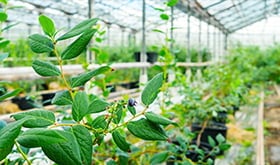
Blueberry cultivation in protected environment
Blueberries (Vaccinium spp.) are among the most important berry crops worldwide and are widely recognized for their nutritional value, particularly their high concentrations of anthocyanins and other bioactive compounds. Historically native to North America, blueberries have expanded rapidly across South America, Europe, Asia, Oceania, and Africa, driven by growing consumer demand and breeding efforts that have enabled adaptation to diverse climatic conditions.
The cultivated blueberry industry primarily consists of Northern Highbush (V. corymbosum), Southern Highbush hybrids, and Rabbiteye (V. virgatum syn. V. ashei). Breeding programs have incorporated genetic material from multiple Vaccinium species to improve adaptation to different chilling requirements, temperature regimes, and environmental conditions.
Blueberry Physiology and Root Characteristics
Blueberries posses a shallow, fibrous root system characterized by limited root-hair development. Compared with many other fruit crops, this root architecture results in relatively low efficiency for water and nutrient acquisition and contributes to the crop’s sensitivity to soil conditions and water availability (Lobos and Hancock, 2015).
Most active roots are concentrated within the upper soil profile, making blueberries particularly vulnerable to drought, temporary water deficits, and salinity stress. Water limitation can rapidly reduce stomatal conductance and photosynthetic activity, leading to reductions in plant growth, berry size, and yield (Ru et al., 2024). As a result, maintaining favorable root-zone conditions through proper pH management, irrigation, drainage, and adequate nutrition is essential for sustaining plant growth, productivity, and fruit quality.
Growing Conditions
Blueberries thrive under specific environmental and soil conditions:
- Temperature: Best growth occurs in temperate climates with cool winters and mild summers.
- Soil pH: Perform best under acidic conditions, with an optimal soil pH of 4.5–5.2 for Northern and Southern Highbush cultivars, and 5.0–5.5 for Rabbiteye blueberries.
- Soil type: Well‑drained soils with high organic matter are preferred.
- Water sensitivity: Highly sensitive to both drought and waterlogging.
- Salinity: Blueberries are among the most salt-sensitive horticultural crops. Excessive salinity can restrict root growth, reduce water and nutrient uptake, and negatively impact yield, making irrigation water quality and root-zone salinity management critical.
Global Production and Cultivation Systems
Blueberry production has experienced rapid global expansion across North and South America, Europe, and Asia, driven by a continuous rise in global consumer demand. While North America historically represented the cradle of commercial cultivation, global supply shares have significantly diversified.
The leading drivers of this global footprint include the United States and Canada in North America, Peru and Chile in South America, Spain and Poland in Europe, and China, which has rapidly risen to become the world’s largest individual producer by volume . This multi-regional expansion has transitioned the blueberry market from a seasonal crop into a truly year-round, globally supplied commodity (IBO, 2025).
Blueberries are grown today in a wide range of production systems, each designed to manage the crop’s sensitivity to soil pH, drainage, salinity, and oxygen availability in the root zone.. While traditional open-field soil cultivation remains common, rapid global expansion, especially into regions lacking naturally suitable soils has accelerated the adoption of advanced alternative systems, includingraised beds, container and substrate production, protected cultivation, evergreen production, and high-density planting systems (Fang et al., 2020).
Traditional open‑field soil production
This is the classic system used in long‑established blueberry -growing regions. Plants are grown in acidic, well‑drained soils, often amended with pine bark or organic matter materials to improve soil structure and favorable root-zone conditions. Raised beds are commonly used to enhance drainage and root aeration. This system generally requires lower initial investment but is best suited to regions with naturally favorable soil and climate conditions.
Amended raised beds
In many production regions, raised beds are constructed and amended with pine bark, peat, sawdust, or other organic materials to create a more suitable root environment. These amendments improve drainage, increase organic matter content, and help maintain the acidic conditions required for blueberry production. Raised beds are widely used where native soils require modification but complete soilless production is not necessary.
Container and substrate production
Container and substrate prodution systems have expanded rapidly worldwide, especially for Southern Highbush blueberries. Plants are grown in pots, grow bags, or troughs filled with soilless media such as peat, coir, pine bark, or substrate blends. These systems allow control of pH, moisture, and salinity while enabling production in areas with unsuitable soils. Containerized production is also compatible with high‑density plantings systems and evergreen management strategies. Drainage design, container configuration, and substrate aeration are critical for maintaining root health and preventing oxygen limitation in the root zone.Although these systems generally require higher initial investment, they often provide greater uniformity and improved management of water and nutrient supply.
Protected cultivation (tunnels, net houses, and greenhouses)
Protected cultivtion systems increasingly used to protect blueberries from rain, hail, frost, excessive solar radiation, and heat stress. Structures such as high tunnels, net houses, and greenhouses can advance fruit ripening, extend harvest windows, improve fruit quality, and reduce weather-related losses. These systems are often combine with container or substrate production to maximize control over the environment and extend harvest windows.
Evergreen production systems
In warm climates, Southern Highbush blueberries can be can be managed under evergreen production systems, reducing or bypassing the traditional dormancy period.. These systems focus maintaining a healthy leaf canopy throughout the year through efficient management of nutrition and irrigation.. Evergreen production allows growers to target early or extended harvest windows and is widely used in regions such asFlorida, Mexico, Peru, Australia, and parts of North Africa.
High‑density plantings
High-density planting configurations are frequently adopted to increase early production and improve labor efficiency. Although individual plant growth may be reduced under higher densities, yield per unit area often increases. These systems require careful attention to irrigation, nutrition, canopy management, and disease control due to increased competition between plants and reduced air circulation.
Common challenges across production systems
Regardless of the production system, successful blueberry cultivation depends on:
- Maintaining optimal soil or substrate pH
- Preventing salinity accumulation
- Ensuring uniform irrigation and drainage
- Avoiding nutrient deficiencies
- Managing heat and drought stress
Blueberry Usage and Quality
Blueberries are consumed fresh, frozen, dried, juiced, or processed into concentrates and nutraceuticals. Their popularity is largely driven by their nutritional value, appealing flavor, and high concentrations of bioactive compounds, particularly anthocyanins and other antioxidants.
Key quality parameters include:
- Berry size and firmness
- Skin color and anthocyanin development
- Soluble solids content (Brix)
- Acidity and flavor balance
- Bloom (natural surface wax)
- Shelf life and resistance of softening
Fruit quality is influenced by both genetics and crop management. Adequate nutrition is essential for producing high-quality fruit that meets market and consumer expectations.
Nutrient Requirements and Their Roles
Blueberries have distinct nutritional requirements due to their shallow, fibrous root system, limited root-hair development, and adaptation to acidic soils. This section summarize the functions of each nutrient in blueberry production and highlights their contribution to plant growth, yield, and fruit quality.
Nitrogen (N)
Nitrogen is the nutrient most frequently associated with vegetative growth, canopy development, and fruit production in blueberries. The crop preferentially utilizes ammonium-based N sources and generally exhibits superior growth when ammonium is supplied as the predominant N form. Nitrogen requirements vary with cultivar, plant age, yield potential, and production system, but are typically met through frequent split applications or fertigation to maximize uptake efficiency and minimize salinity risks. Excessive N can stimulate vegetative growth at the expense of fruit quality and may delay shoot hardening before dormancy.
Phosphorus (P)
Phosphorus plays an important role in root development, plant establishment, energy transfer, and early‑season growth. Uptake efficiency may be reduced in cold conditions, making P availability particularly important during plant establishment and early growth stages. Blueberries require relatively lower amounts of P, and fertilizer applications should be guided by soil and leaf analysis.
Potassium (K)
Potassium is fundamental for fruit development and is closefy associated with berry size, firmness, color, and sugar accumulation. Demand increases substantially during fruit expansion and ripening, when K supports cell turgor, carbohydrate transport, and overall fruit quality. Adequate K nutrition also contributes to improved tolerance to environmental stresses such as drought and heat.
Calcium (Ca)
Calcium is critical for cell wall strength, berry firmness, and postharvest shelf life. Because Ca has limited mobility within the plant, it must be supplied consistently throughout the growing season to ensure adequate movement into developing fruit. Deficiencies often result in softer berries and reduced storage potential, making Ca management a key component of premium fruit production.
Magnesium (Mg)
Magnesium is a central component of chlorophyll and is required for photosynthesis, energy transfer, and carbohydrate transport. Maintaining adequate Mg supports efficient carbon assimilation and the supply of photoassimilates to developing fruit.
Sulfur (S)
Sulfur is required for amino acid synthesis, protein formation, and N metabolism. Adequate S supply supports healthy vegetative development and efficient nutrient utilization throughout the growing season.
Micronutrients
Micronutrients, such as iron, manganese, zinc, boron, and copper, play essential roles in blueberry growth. Their availability is influenced by soil pH, organic matter content, moisture conditions, and interactions with other nutrients. Iron is critical for chlorophyll formation and photosynthetic electron transport. Manganese is involved in photosynthetic processes and enzyme activation, zinc plays an important role in enzyme activity and auxin synthesis, boron is essential for flowering and berry formation, and copper contributes to lignification and plant health. Regular monitoring through soil and leaf analysis is essential for maintaining high yield and fruit quality.
Blueberry Deficiency Symptoms
Nitrogen deficiency
- Pale green to yellow leaves, particularly on older foliage
- Reduced shoot growth
Phosphorus deficiency
- Dark green foliage
- Reduced growth and poor root development
Potassium deficiency
- Marginal chlorosis progressing to necrosis (“leaf‑edge burn”)
- Reduced berry size and yield
Calcium deficiency
- Soft fruit and reduced shelf life
- Tip dieback
Magnesium deficiency
- Interveinal chlorosis on older leaves
- Reduced plant growth
Sulfur deficiency
- Yellowing of young leaves
- Reduced growth
Iron deficiency
- Reduced leaf greenness
- Severe cases may result in nearly white young foliage
Boron deficiency
- Poor fruit set and misshapen berries
- Dieback of growing points
Manganese deficiency
- Interveinal chlorosis on young leaves
- Reduced photosynthesis
Conclusion
Blueberries are a high‑value crop with unique physiological and nutritional requirements driven by their shallow root system, adaptation to acidic soils, and sensitivity to root-zone conditions. As production continues to expand globally, growers have adopted a range of cultivation systems, including traditional field production, raised beds, containerized and substrate-based systems, protected cultivation, and evergreen production. Regardless of the production system, successful blueberry cultivation depends on maintaining optimal root-zone conditions through proper pH management, adequate drainage and aeration, high-quality irrigation water, and adequate nutrition. Regular soil and leaf tissue analyses are key tools for maintaining adequate nutrients availability, optimizing resource use efficiency, and supporting consistent yields of premium-quality fruit.
References
Ibo – International Blueberry Organization (IBO) (2023/2024). Global state of the blueberry industry report. IBO, 2025.
Fang, Y. et al. A Review for Southern Highbush Blueberry alternative production systems. Agronomy, 10, 1-15, 2020.
Lobos, G.A.; Hancock, J. Breeding blueberries for a changing global environment: a review. Frontiers in Plant Science, 6, 1-14, 2015.
Ru, S. et al. Review on blueberry drought tolerance from the perspective of cultivar improvement. Frontiers in Plant Science, 15, 1-15, 2024.
Blueberry Trials
Q&A
The questions that farmers frequently ask about blueberry cultivation
Blueberries make very limited use of nitrate‑nitrogen because the activity of the nitrate reductase enzyme in this crop is extremely low. Calcium nitrate is sometimes applied, but only as a source of calcium, not as a source of nitrogen.
If fertigation is used, the most effective method is to acidify the nutrient solution itself, typically with phosphoric acid or nitric acid. On plantations without fertigation, strongly acidifying fertilizers such as ammonium sulfate can be applied to lower the pH of the growing medium.
The best time to start fertigation is at the beginning of the growing season, but nitrogen should be applied just before the first leaves appear. This timing is extremely important in blueberry nutrition.
Explore Blueberry Solutions by Brand
Find the right solutions to improve crop quality and yield

Agrolution pHLow is your one-stop fruit and vegetable fertilizer solution
Brand details Agrolution pHLowThe groundbreaking total range of water-soluble straight fertilizers
Brand details NovaAgrolution pHLow is your one-stop fruit and vegetable fertilizer solution
Brand details Agrolution pHLowRecommended products
Agrolution pHLow

Agrolution pHLow

Nova

Nutrient & Unit Converter
Access calculators to improve nutrient management and boost productivity