Whatsapp
  X
X  Mail
Mail  Copy link
The four-in-one natural fertilizer
Brand details Polysulphate<sup>®</sup> Growing Cocoa
Crop Nutrition Advice
Everything you need to know about fertilizing cocoa, best practice, suitable products, field trials, and more.
Introduction
Cocoa (Theobroma cacao L.) is an understory tropical tree native to the humid forests of Central and South America. Today it supports the livelihoods of 40–50 million people, including 5.5 million smallholder farmers, and remains one of the most important perennial crops in the global South. Annual production is around 5 million tonnes, with over 70% coming from West Africa.
Despite strong demand, yields remain low in many regions due to aging plantations, declining soil fertility, pest and disease pressure, and limited access to improved planting material. These constraints often push farmers to expand into forested areas rather than rehabilitate existing plots. Achieving stable, sustainable yields requires good shade management, improved genetics, effective pest and disease control, and balanced nutrition throughout the life of the plantation.
Growing Conditions
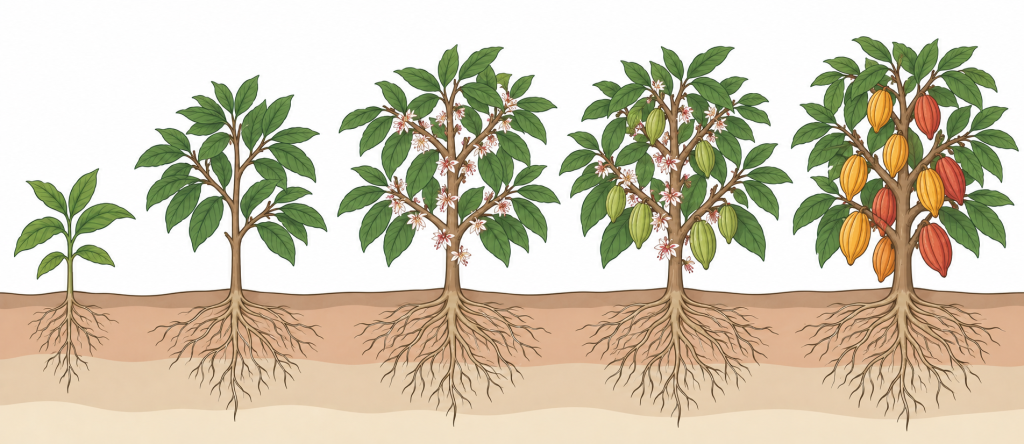
Cocoa is adapted to the humid lower storeys of tropical forests and performs best under:
- Temperature: 21–32 °C
- Rainfall: >1,250 mm per year, well distributed
- Humidity: consistently high
- Soils: deep, well‑drained, moderately acidic, rich in organic matter
Shade is particularly important during establishment and helps moderate temperature, reduce drought stress, and support soil fertility. Cocoa is sensitive to waterlogging, prolonged drought, and temperature extremes, making microclimate management essential. As climate change progresses, suitable cocoa zones are expected to shrink, increasing the importance of resilient agroforestry systems.
Global Production and Systems
Most cocoa is produced by smallholders in Côte d’Ivoire, Ghana, Nigeria, and Cameroon, with additional production in Latin America and Southeast Asia. The global cocoa area has expanded from 4.4 million hectares in the 1960s to nearly 12 million hectares in 2021, often at the expense of forests, particularly in West Africa.
Production systems range from traditional agroforestry, which provides shade and ecosystem services, to more intensive full‑sun monocultures. Across systems, common challenges include aging trees, low fertilizer use, nutrient‑depleted soils, poor pruning, and increasing pest and disease pressure. Modern cocoa agronomy focuses on rehabilitation, improved planting material, agroforestry, and targeted fertilization to raise yields while maintaining soil fertility and reducing pressure on remaining forests.
Cocoa Usage and Quality
Cocoa beans are fermented, dried, and processed into:
- cocoa liquor, butter, and powder
- chocolate and confectionery
- beverages and specialty products
Key quality parameters include bean size and uniformity, fermentation quality, fat content, flavor precursors, and absence of defects (mold, insect damage, off‑flavors). Nutrition influences yield and bean quality indirectly through tree vigor, pod set, and disease tolerance, and directly via the formation of carbohydrates, fats, and proteins in the beans.
Nutrient Requirements
Cocoa is a perennial crop with continuous nutrient demand. The most absorbed macronutrients are potassium (K), nitrogen (N), and phosphorus (P), followed by secondary nutrients such as calcium (Ca), magnesium (Mg), and sulfur (S).
- Nitrogen (N): supports vegetative growth, leaf area, and pod production
- Phosphorus (P): important for root development, flowering, and energy transfer
- Potassium (K): heavily exported in pods and husks; crucial for yield and bean filling
- Calcium (Ca), magnesium (Mg), sulfur (S): support cell structure, chlorophyll, and metabolic balance
Because significant amounts of K and other nutrients are removed with harvested pods and husks, regular fertilizer applications are needed on most soils to maintain yields and prevent long‑term depletion. Soil and leaf analyses are recommended annually or biannually to adjust nutrient supply.
Average Nutrient Uptake per 1 ton of Dry Cocoa Beans
| Nutrient | Approx. Uptake (per ton) | Notes |
|---|---|---|
| Nitrogen (N) | 64 kg/t | Needed for canopy + pod formation |
| Phosphorus (P) | 7.4 kg/t | Important for roots + energy transfer |
| Potassium (K) | 77.5 kg/t | Highest demand; most removed in husks |
Role of Nutrients in Cocoa Production
Nitrogen (N)
Nitrogen is essential for vegetative growth, leaf area expansion, and chlorophyll and protein synthesis. Adequate N supports canopy development, which is critical for photosynthesis and pod set. Excessive N without balanced K, however, can lead to overly vegetative trees and greater susceptibility to pests and diseases.
Phosphorus (P)
Phosphorus promotes root growth, early establishment, flowering, and pod development. It is central to energy transfer (ATP) and is particularly important in young plantations to build a strong root system capable of supporting long‑term production.
Potassium (K)
Potassium is the most heavily absorbed nutrient in cocoa and is critical for water regulation, carbohydrate transport, and bean filling. High K supply improves pod number, bean size, and resistance to drought and some diseases. Because large amounts of K are removed in pods and husks, K fertilization is often the key driver of yield response in cocoa.
Calcium (Ca)
Calcium contributes to cell wall strength, root growth, and overall plant structure. It supports pod and bean integrity and helps maintain soil structure when supplied as liming materials on acidic soils. Adequate Ca improves root exploration and nutrient uptake, especially in deeper soil layers.
Magnesium (Mg)
Magnesium is the central atom in chlorophyll and is essential for photosynthesis and enzyme activation. In cocoa, Mg supports leaf function and helps prevent premature leaf fall, which would otherwise reduce photosynthetic capacity and yield.
Sulfur (S)
Sulfur is involved in amino acid and protein synthesis and several enzyme systems. It supports vegetative growth and can enhance the efficiency of nitrogen use. In some soils, especially highly weathered tropical soils, S can become limiting and should be monitored through soil or leaf analysis.
Cocoa Deficiency Symptoms
(Descriptions are generalized; local diagnosis should be confirmed with leaf analysis.)
Nitrogen deficiency
- Pale, light‑green leaves, especially on older foliage
- Reduced shoot growth and smaller leaves
- Fewer flowers and pods, overall low vigor
Phosphorus deficiency
- Dark, dull green foliage with reduced growth
- Poor root development and delayed flowering
- In severe cases, reduced pod set and smaller pods
Potassium deficiency
- Symptoms first on older leaves: irregular yellow chlorosis from the margins towards the base
- Necrotic spots within yellow tissue; leaf tips and margins may scorch
- Dull, pale brown patches along veins; premature leaf fall and terminal dieback in severe cases
- Reduced pod number and bean size
Calcium deficiency
- Distorted young leaves and poor root growth
- Weak shoots and increased susceptibility to dieback
- In severe cases, poor pod development and higher fruit drop
Magnesium deficiency
- Interveinal chlorosis on older leaves, with veins remaining green
- Yellowing may progress to reddish or brownish tones in advanced stages
- Premature leaf fall, reducing canopy and yield
Sulfur deficiency
- General yellowing of younger leaves, sometimes resembling mild N deficiency
- Reduced growth and thin, weak shoots
- Lower overall vigor and yield potential
Because several deficiencies can produce similar visual symptoms, cocoa agronomy strongly recommends combining field observation with regular leaf and soil analyses to fine‑tune fertilization.
Conclusion
Cocoa is a high‑value perennial crop with a complex interaction between shade, planting density, pests, diseases, and nutrition. Yields remain low in many regions not because of genetic limitations, but because trees are under‑fertilized and grown on depleted soils. Balanced supply of N, P, K, Ca, Mg, and S, guided by soil and leaf analysis, supports healthy canopies, strong root systems, and consistent pod and bean production.
Investing in cocoa nutrition is therefore not just about short‑term yield increases; it is central to the long‑term sustainability and profitability of cocoa farms.
Cocoa Trials
Q&A
Cocoa benefits from regular, split applications throughout the year because it is a perennial crop with continuous nutrient demand. Most systems apply fertilizers 2–4 times per year, depending on rainfall, soil fertility, and tree age.
Cocoa has the highest demand for potassium (K), followed by nitrogen (N) and phosphorus (P). Potassium is especially critical because large amounts are removed in pods and husks, making it the main driver of yield response.
Yes. Young trees need more nitrogen and phosphorus to build canopy and root systems. Mature, bearing trees require higher potassium to support pod filling and bean development.
Fertilizer should only be applied when there is sufficient soil moisture. Applications during dry periods lead to poor uptake and potential losses. In dry regions, fertilization is often timed with the onset of rains.
Very. Cocoa performs best in soils rich in organic matter. Mulching with pod husks, leaves, or compost improves soil structure, moisture retention, and nutrient cycling, especially for potassium and magnesium.
Returning husks to the field as mulch helps recycle nutrients. However, husks from diseased pods should be composted or destroyed to avoid spreading pathogens.
Explore Cocoa Solutions by Brand
Find the right solutions to improve crop quality and yield
The four-in-one natural fertilizer
Brand details Polysulphate<sup>®</sup>Recommended products
Polysulphate®