Whatsapp
  X
X  Mail
Mail  Copy link
The four-in-one natural fertilizer
Brand details Polysulphate<sup>®</sup> Growing Garlic
Crop Nutrition Advice
Everything you need to know about garlic fertilization, best practice, field trials, and more.
Garlic Nutrition & Agronomic Guide
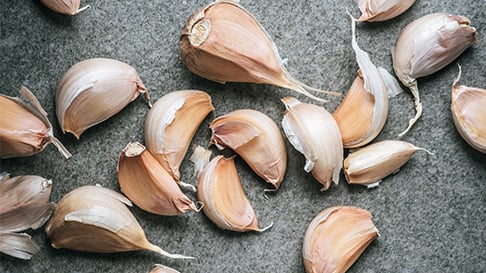
Garlic is propagated vegetatively from cloves.
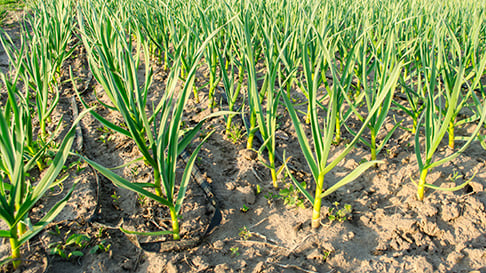
Garlic field during vegetative growth.
Introduction & Origin
Garlic (Allium sativum L.) is one of the oldest cultivated crops in the world, originating in Central Asia. From its center of origin, garlic spread throughout the Middle East, the Mediterranean region, and Asia, becoming an important crop for culinary, medicinal, and industrial uses. Nowadays, garlic is cultivated worldwide and is valued for its distinctive flavor, sulfur‑containing compounds, nutritional attributes, and economic importance.
Unlike many vegetable crops, garlic is propagated vegetatively through cloves. Consequently, the use of healthy, disease‑free planting material, together with appropriate crop and nutrient management, is essential for achieving high yields, uniform bulb development, and good postharvest quality.
Growing Conditions
Climate & Temperature
Garlic performs best under cool conditions during vegetative growth, followed by warm and relatively dry conditions during bulb development and maturation.
- Optimal temperature for vegetative growth: 12–24 °C.
- Vernalization (particularly important for hardneck cultivars): exposure of cloves to low temperature (0-10°C) for approximately 4–8 weeks, depending on the genotype and growing environmental.
- Bulb development and maturation: 20–30 °C under low humidity conditions.
Temperature and photoperiod interact to regulate bulb formation. Increasing day length and warmer temperatures generally promote bulb initiation and development.
Soil Requirements
Garlic grows best in well‑drained sandy loam to loam soils with good aeration.
- Preferred soil pH: 6.0–7.0.
- Moderate to high organic matter levels are beneficial. Good drainage is essential to promote root development and reduce disease pressure.
Because garlic has a relatively shallow and sparsely branched root system, soil physical quality is particularly important for optimal growth and nutrient uptake.
Water & Irrigation
- Garlic is sensitive to both drought stress and excessive soil moisture. Proper irrigation management is therefore essential for maximizing yield, bulb quality, and storage performance. Seasonal water requirements generally range from 400 to 850 mm, depending on climate, soil characteristics, cultivar, and crop duration.
- Critical stages for water supply include crop establishment, vegetative growth, bulb initiation, and bulb enlargement
- Excessive soil moisture or poor drainage may increase disease incidenc and reduce bulb quality.
- Irrigation should be gradually reduced and discontinued 5-20 days before harvest, depending on soil and weather conditions, to promote bulb curing and improve storage performance.
Global Production
Garlic is cultivated wordwide, with annual production exceeding 28 million tonnes. Production is concentrated primarily in Asia.
- China is the world’s largest garlic producer, accounting for more than 70% of global production .
- Other major producers include India, Egypt, Bangladesh, and South Korea.
Softneck cultivars dominate commercial production because of their longer storage life and broader adaptation to diverse production environments. Hardneck cultivars are generally better adapted toto colder climates and typically have greater vernalization requirements.
Garlic Growth Stages
- Establishment – root development and early shoot growth.
- Vernalization – cold exposure required by some cultivar for normal bulb development.
- Vegetative growth – rapid leaf production.
- Bulb initiation – triggered primarily by increasing day length and temperature.
- Bulb enlargement – rapid bulb accompanied by high water and nutrient demand.
- Maturation – bulb filling, wrapper skin development, and dry‑down before harvest.
Nutrient Requirements
Garlic has a relatively shallow and sparsely branched root system, limitind its ability to explore large soil volumes for nutrients and water. As a result, nutrient availability within the root zone is a major factor determining crop performance, bulb yield, and bulb quality.
Nitrogen (N)
Nitrogen plays a key role in vegetative growth, chlorophyll synthesis, and photosynthetic capacity. Adequate N supply during establishment and vegetative growth promotes vigorous plant development and supports subsequent bulb growth.. However, excessive N availability during the late stages of the crop cycle can delay maturity, reduce bulb dry matter accumulation, impair curing, and negatively affect storage quality. Therefore, N should be supplied through split applications or by using controlled-release fertilizer sources that gradually release N throughout the crop cycle.
Phosphorus (P)
Phosphorus supports root growth, energy transfer, and early crop establishment. Since garlic has a limited root system, adequate P availability at planting is particularly important for supportrapid root development and vigorous early growth In addition, due to its low mobility in the soil, P is generally utilized more efficiently when placed within the effective rooting zone.
Potassium (K)
Potassium is involved in enzyme activation, osmotic regulation, stomatal function, and carbohydrate transport. Potassium demand increases substantially during bulb enlargement, when photosynthates are actively translocated to developing cloves.. Adequate K nutrition contributes to increased bulb size, greater dry matter accumulation, enhanced stress tolerance, and improved storage quality storage quality. Potassium is commonly applied before planting and, where necessary, supplemented during the growing season.
Calcium (Ca)
Calcium (Ca) is essential for cell wall formation, membrane stability, and cell division. Adequate Ca nutrition promotes healthy root development, improves bulb firmness, enhances tissue integrity, and supports postharvest quality. Because Ca movement within the plant depends largely on transpiration, a continuous supply throughout the growing season is important.
Magnesium (Mg)
Magnesium (Mg) is the central element of the chlorophyll molecule and is therefore directly involved in photosynthesis. It also plays an important role in enzyme activation, energy metabolism, and carbohydrate transport. Adequate Mg nutrition supports photosynthetic efficiency and assists in the movement of carbohydrates from leaves to developing bulbs.
Sulfur (S)
In addition to its role in protein synthesis and enzyme activity, sulfur (S) is a structural component of cysteine, methionine, alliin, and other organosulfur compounds responsible for garlic’s characteristic flavor, aroma, pungency, and many of its bioactive properties. Because garlic has a particularly high requirement for S compared with other vegetable crops, an adequate supply throughout the growing season is essential for maximizing bulb yield, dry matter accumulation, storage quality, and flavor intensity
Micronutrients (Fe, Zn, B, Cu, Mn, Mo, Ni, Cl)
Although required in smaller quantities than macronutrients, micronutrients are fundamental for plant growth and development. For example, zinc (Zn) is involved in enzyme activation, boron (B) supports cell wall formation and bulb development, and iron (Fe) is critical for chlorophyll synthesis and photosynthetic function. Micronutrient deficiencies are more likely in alkaline soils, highly weathered soils, or soils with low organic matter levels.
Deficiency Symptoms
Nitrogen Deficiency
- Older leaves become pale green to yellow
- Reduced vegetative growth
- Thin stunted plants
- Small bulbs and reduced yield
Phosphorus Deficiency
- Stunted growth, and delayed development
- Dark green leaves, sometimes with reddish-purple pigmentation
- Reduced root and bulb development
Potassium Deficiency
- Chlorosis and necrosis along leaf margins on older leaves
- Reduced bulb size and dry matter accumulation
- Poor storage quality
Sulfur Deficiency
- Uniform chlorosis of young leaves
- Thin, weak plants
- Reduced pungency and lower bulb weight
Calcium Deficiency
- Necrosis of young leaf tips
- Reduced root growth, delayed bulb formation
- Reduced bulb firmness and storage quality
Magnesium Deficiency
- Interveinal chlorosis of older leaves
- Reduced photosynthetic activity and bulb growth
Boron Deficiency
- Distorted young leavesDeath of growing points under severe deficiency
- Cracked or malformed bulbs
Iron Deficiency
- Interveinal chlorosis of the young leaves while veins remain green
- Severe deficiency may result in leaf bleaching
Zinc Deficiency
- Interveinal chlorosis on young leaves accompanied by reduced leaf expansion
- Stunted growth and delayed bulb development
Deficiencies of manganese (Mn), copper (Cu), molybdenum (Mo), nickel (Ni), and chlorine (Cl) are less frequently observed in commercial garlic production and remain less thoroughly documented than deficiencies of B, Zn, Fe. The likelihood of deficiency varies among production systems and depends on soil characteristics such as parent material, texture, organic matter content, pH, and moisture regime, all of which influence nutrient availability and uptake by plants.
Fertilization Practices
An effective fertilization program begins with a comprehensive soil analysis, providing essential information on soil pH, nutrient availability, organic matter content, and potential fertility constraints that may limit crop performance. Therefore, fertilizer recommendations should be based on:
- Soil test results;
- Yield goals;
- Cultivar characteristics;
- Environmental conditions and;
- Local production practices
Due to its relatively shallow and sparsely branched root system, garlic depends heavily on nutrient availability within the upper soil layers, making both nutrient placement and timing critical for achieving high yields.
Key considerations for nutrient management include:
- Correcting soil fertility limitations before planting to support rapid establishment and early root development.
- Ensuring adequate nutrient availability within the active rooting zone throughout the growing season.
- Applying nitrogen in split applications or using controlled-release fertilizer sources to improve nutrient use efficiency and maintain adequate nutrient availability during vegetative growth.
- Avoiding excessive late-season N applications, as excessive N availability may delay maturity, reduce bulb dry matter accumulation, and negatively affect storage quality.
- Maintaining an adequate supply of K and S during bulb initiation and enlargement, when nutrient demand increases to support bulb growth, dry matter accumulation, and bulb quality.
- Using plant tissue analysis to complement soil testing and monitor crop nutritional status throughout the growing season, enabling nutrient deficiencies to be identified and corrected before visible symptoms develop.
Adjusting fertilization practices as needed to align nutrient supply with crop demand during the different growth stages.
Across production systems, nutrient management should follow the principles of 4R Nutrient Stewardship:
- Right Source – selecting the most appropriate nutrient source.
- Right Rate – applying nutrients according to crop demand and yield goals.
- Right Time – synchronizing nutrient applications with periods of greatest crop uptake.
- Right Place – positioning nutrients where they can be efficiently accessed by the root system.
Applying these principles helps improve nutrient use efficiency, support high yields, enhance bulb quality, and promote environmentally and economically sustainable garlic production.
Conclusion
Garlic is a high‑value crop whose productivity, bulb quality, and storage potential depend on the successful integration of effective agronomic practices. Achieving high yields and marketable bulbs requires not only favorable growing conditions, but also a fertilization strategy that matches nutrient supply with crop demand throughout crop development.
When guided by soil and tissue analyses and supported by the principles of 4R Nutrient Stewardship, nutrient management can improve nutrient use efficiency, enhance bulb quality and storage performance, and contribute to sustainable and profitable garlic production.
Related Trials
Guides & Articles
Q&A
Garlic has a relavively shallow and sparsely branched root system with limited capacity to explore large volumes of soil for water and nutrients. As a result, the crop depends on adequate nutrient availability within the active rooting zone throughout the growing cycle.
Although garlic requires nutrients throughout the growing cycle, nutrient demand is particularly high during establishment and early vegetative growth, as well as during bulb initiation and enlargement. Nutrient deficiencies during these stages can compromise bulb development, reducingyield, and bulb quality.
Excessive N availability after bulb initiation may delay maturity, reduce dry‑matter accumulation, and negatively affect bulb curing, storage quality, and overall marketability.
Sulfur is essential for the synthesis of sulfur-containing compounds, including alliin and related organosulfur metabolites responsible for garlic’s characteristic flavor, aroma, pungency, and many of its bioactive properties. Adequate S nutition throughout the growing season contributes to bulb quality, flavor intensity, market value, and overall crop performance.
Explore Garlic Solutions by Brand
Find the right solutions to improve crop quality and yield
The four-in-one natural fertilizer
Brand details Polysulphate<sup>®</sup>Recommended products
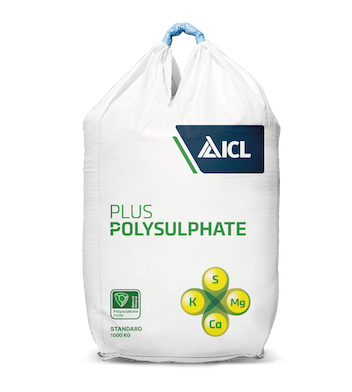
Polysulphate®
Digital Tools
Access calculators to improve nutrient management and boost productivity