Whatsapp
  X
X  Mail
Mail  Copy link
The four-in-one natural fertilizer
Brand details Polysulphate<sup>®</sup> Growing Pear
Crop Nutrition Advice
Everything you need to know about pear fertilization, best practice, suitable products, field trials and more.
Advice for growing Pear (Pyrus communis)
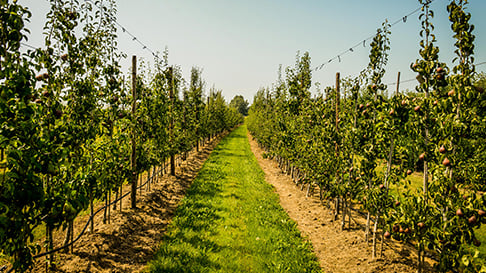
Intensively grown pear trees in an irrigated orchard.
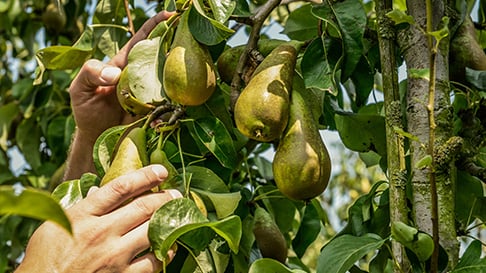
Conference pears before harvest.
Pears are among the world’s most important temperate fruit crops, valued for their long storage potential, delicate flavor, and high nutritional density. Commercially, they split between European pears (Pyrus communis) and Asian pears (Pyrus pyrifolia).
Modern pear cultivars trace their origins to wild Pyrus species native to a broad belt from Europe across the Caucasus into Western China, where early farmers selected the first edible forms more than 3,000 years ago.
Growing Conditions
Soil
While pears can tolerate heavier, more clay-dominant soils than stone fruits like peaches, optimal production relies on deep, fertile loams with a target pH of 6.2 to 6.7.
- Lime sensitivity: Pears are highly sensitive to active lime (CaCO3), especially on quince rootstocks. In European soils, chlorosis depends mainly on active lime (>5–7%) and irrigation water bicarbonates, not that much on pH.
- Moisture management: On quince rootstocks, pears are highly sensitive to poor drainage and root asphyxia. Prolonged standing water causes root asphyxiation and opens the door to Phytophthora root rot.
Climatic Requirements and Temperatures
Pears present a unique set of management challenges during early spring due to their early blooming habits and blossom biology:
- Chilling requirements: Trees require 600 to 1,000+ winter chilling hours, depending on cultivar (e.g. Abate, Conference, Williams). In European conditions, chilling is cultivar-specific and increasingly affected by mild winter.
- Frost risk: Pears bloom earlier in the spring than apples. Once the blossoms emerge, a drop below -2°C (28°F) can completely destroy the primary flowers, ruining the seasonal crop in a single night.
- Pollination challenges: Unlike other orchard fruits, pear blossom nectar is very low in sugar, making it highly unattractive to honeybees. Agronomists must plant dense pollenizer rows and often utilize foliar biostimulants and/or specialty fertilizers before bloom to ensure adequate pollen germination and fruit set.
- Fire bligth pressure: Pears are hyper-susceptible to fire blight (Erwinia amylovora). To reduce infection risk, vegetative growth on mature trees must be limited to 20–30 cm per year, primarily by restricting early-season nitrogen.
Irrigation and Water Management
High-density pear orchards require consistent water access to reach targeted pack-out sizes. While pear trees can survive periods of drought, moisture stress rapidly leads to small, woody, or astringent fruit.
Modern growers rely on precision drip irrigation or micro-sprinklers to manage soil moisture. Regulated Deficit Irrigation (RDI) may be applied cautionsly, mainly post-harvest, although is not widely used during fruit growth in EU systems due to the risk of reduced fruit size and yield. However, moisture must be kept uniform during the mid-to-late summer cell expansion phase; any sudden swings in soil water tension during this period mainly affect fruit growth and may induce internal physiological disorders.
Global Production
According to recent USDA and FAO statistical reviews, global pear production stabilizes at approximately 24 to 26 million metric tons annually.
The geographic distribution of production is highly concentrated: China is the undisputed global leader, controlling between 74% and 79% of the entire world output. The remaining commercial market is driven primarily by the European Union (led by Italy, the Netherlands, Belgium, and Spain), followed by the United States, Argentina, Turkey, and South Africa.
Defining and Measuring Fruit Quality
To an orchard manager, pear quality is evaluated through a strict set of post-harvest and physical metrics:
- Sugar-acid balance: Sugar accumulation is tracked via degrees Brix (soluble solids content). Premium fresh pears target a range of 11° to 14° Brix, balanced by low malic acid to ensure a sweet flavor profile.
- Firmness (pressure testing): Fruit maturity and harvest windows are determined using a penetrometer. Harvesting at the correct pressure (measured in pounds or kilograms per square inch) ensures the fruit can withstand long-term cold storage and ripen properly afterward without turning mealy.
- Skin finish and physiological disorders: The physical integrity of the skin dictates market value. Pears are highly susceptible to calcium-linked physiological disorders such as cork spot, black end, and alfalfa greening. Preventing these skin defects requires targeted foliar sprays because calcium moves poorly through the tree’s natural vascular system.
Nutrient Requirements and Roles
Nitrogen (N)
Essential for vegetative shoot vigor and leaf area expansion. However, over-application must be avoided; excessive nitrogen delays fruit maturation, degrades fruit storage potential, and heavily increases the tree’s vulnerability to fire blight infections.
Recommended N Fertilization Rates
| Tree age (years) | N rate (kg/ha) |
|---|---|
| Planting–5 | 17-28 |
| 6-7 | 28-39 |
| 8-10 | 39-56 |
Rates must be adjusted based on soil fertility, organic matter, yield level, and fertigation strategy.
Potassium (K)
Pear trees have an exceptionally high demand for potassium, requiring even greater amounts than apple trees. Potassium regulates cellular osmotic pressure, controls water-use efficiency through the leaves, and is heavily drawn into the fruit to maximize final sizing and sugar accumulation. Excess potassium can antagonize calcium uptake and increase the risk of physiological disorders and reduced storability.
Phosphorus (P)
Necessary for root architecture expansion, early seasonal energy transfer (ATP), and strong flower bud differentiation. Proper phosphorus levels ensure uniform spring budbreak and fruit set.
Calcium (Ca)
The most critical element for final pear quality. Calcium builds strong cell walls and maintains structural fruit firmness. Since calcium mobility is limited, foliar applications are necessary, but must be combined with:
- vigour control (avoid excess nitrogen)
- uniform irrigation
- balanced crop load
- appropriate rootstock choice
Magnesium (Mg)
Forms the central core of the chlorophyll molecule, powering photosynthesis. Adequate magnesium guarantees the canopy can produce the necessary carbohydrates to feed a heavy fruit load.
Boron (B) and Zinc (Zn)
Essential trace elements for spring reproductive development. Boron directly drives pollen viability and fruit set, while zinc regulates the growth hormones needed for leaf expansion. Applying post-harvest foliar sprays of boron and zinc in autumn helps store these nutrients directly in the wood for immediate use the following spring.
Nutrient Deficiency Symptoms
Nitrogen Deficiency
- Uniform, pale green to yellow chlorosis across the older, lower leaves first.
- Drastically shortened, thin shoot growth and premature leaf drop in autumn.
- Reduced fruit set and smaller fruit sizes.
Potassium Deficiency
- Marginal chlorosis (yellowing) starting on the outer leaf edges and progressing inward.
- Leaf margins curl upward and develop a scorched, necrotic brown appearance.
- Fruit remains small, lacks flavor, and fails to develop proper sugars.
Phosphorus Deficiency
- Leaves turn an unusually dark, dull green, sometimes developing a purplish tint on the veins and leaf stems.
- Delayed leaf budbreak and stunted shoot growth in the spring.
- Poor root development and a significant drop in flower production.
Calcium Deficiency
- Development of internal necrotic pocketing in the fruit flesh, known as cork spot.
- Blackening and dying back of the growing vegetative shoot tips.
- Increased rate of physiological disorders and soft fruit texture with short storage potential.
Magnesium Deficiency
- Interveinal chlorosis on older leaves, where tissue between the main veins turns yellow while the veins themselves remain dark green.
- Leaf margins may cup upward or turn brown in severe cases.
- Premature leaf drop in late summer, exposing fruit directly to sunscald.
Iron Deficiency
- Severe yellowing or bleaching of the youngest leaves at the shoot tips first.
- The entire leaf blade turns pale yellow or ivory, while the main veins remain sharply green.
- Commonly found in high-pH or waterlogged soils where iron becomes chemically locked up.
Zinc Deficiency
- Forming of “little leaf” syndrome, where leaves remain small, narrow, and clustered tightly together.
- Shortened internodes along the branches, creating a bunched, rosette-like appearance.
- Small, misshapen, and unevenly sized fruit.
Boron Deficiency
- Poor pollen tube growth resulting in massive flower drop and failed fruit set.
- Developing pitting, cracking, and internal corky lesions inside the ripening fruit.
- Dieback of terminal shoot buds, causing lower buds to grow out into a bushy shape.
Conclusion
Pears are a high-value, management-intensive perennial crop where profitability depends on balancing vegetative vigor, disease pressure, and fruit quality. Success hinges on:
- precise nitrogen control
- high potassium availability
- targeted calcium delivery
- micronutrient support for flowering and fruit set
- stable soil moisture during fruit expansion
With optimized nutrition programs and modern irrigation strategies, growers can achieve consistent pack-out quality, long storage life, and strong market returns year after year.
Literature:
Jackson, J. E. (2003). Biology of Apples and Pears. Cambridge University Press
Oregon State University Extension. Pear Fertilizer Guide (FG 59).
Glozer, K. & Mitcham, E. J. (UC Davis). Optimizing Pear Fertilizer Practices Based on Seasonal Demand.
Related Trials
Guides & Articles
Q&A
Commercial production is dominated by European pears (Pyrus communis) and Asian pears (Pyrus pyrifolia).
Target pH 6.2–6.7. In European conditions, special attention should be paid to active lime content (>5–7%) and irrigation water bicarbonates, which are the primary drivers of iron chlorosis, especially on quince rootstocks.
Potassium (high demand for fruit size and sugars), calcium (prevents cork spot and internal disorders via foliar applications), and balanced nitrogen (enough for growth but limited early to reduce fire blight risk).
Pears need 600–1,000+ chilling hours below 7.2°C; blossoms are vulnerable, temperatures below −2°C (28°F) after bloom can destroy primary flowers and wipe out the crop.
Explore Pear Solutions by Brand
Find the right solutions to improve crop quality and yield
The four-in-one natural fertilizer
Brand details Polysulphate<sup>®</sup>Recommended products
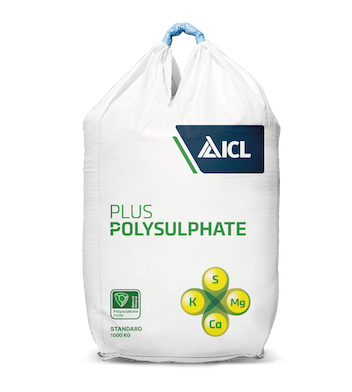
Polysulphate®
Digital Tools
Access calculators to improve nutrient management and boost productivity