


 Whatsapp
  X
X  Mail
Mail  Copy link
The four-in-one natural fertilizer
Brand details Polysulphate<sup>®</sup>Growing Pineapple crop nutrition advice
Everything you need to know about Pineapple fertilization, best practice, field trials, and more.
Pineapple requires precise management of nitrogen, potassium, calcium, magnesium, and micronutrients to support growth, fruit quality, and yield. Key nutritional risks include imbalance, leaching in sandy soils, and deficiencies that reduce fruit size, sweetness, and shelf life. This guide supports fertilizer selection, timing, and rate decisions across growth stages to improve productivity and sustainability.
Introduction
Pineapple (Ananas comosus) is a perennial tropical fruit crop belonging to the family Bromeliaceae. It originated in South America (probably Brazil–Paraguay region) and is cultivated extensively in tropical and subtropical regions for fresh consumption and processing.
In 2023, global production reached ~28–29 Mt (FAOSTAT), continuing a decade-long growth trend driven by Central America and Southeast Asia led by Costa Rica, the Philippines, Thailand, Indonesia, and India.
Commercial yields typically range from 40–70 t/ha under rainfed open-field conditions and 80–100 t/ha under irrigated or fertigated management.
The crop is highly responsive to nutrient management, particularly potassium and nitrogen, which directly affect yield, fruit size, and sweetness. Challenges include soil acidification, magnesium and calcium deficiency, and nutrient leaching in sandy soils. Proper fertilization improves fruit firmness, sugar-acid balance, and shelf life.
Plant Growth Environment
Soil:
Pineapple thrives on well-drained sandy loams with pH 4.5–6.5. It tolerates acidic soils but requires adequate Ca and Mg supplementation.
Avoid heavy clays and poorly drained soils to prevent root rot (Phytophthora spp.). Salinity tolerance is moderate (ECe < 1.5 dS/m).
Climate:
Optimal temperature range is 24–30°C. Growth slows below 18°C and ceases below 10°C.
Pineapple grows year-round in humid tropics with annual rainfall of 1,200–1,800 mm. Flowering can be synchronized by ethephon or calcium carbide induction.
Water management:
Water requirement averages 800–1,200 mm per crop cycle (18–22 months). Irrigation is essential for uniform fruiting.
Avoid waterlogging as it reduces root aeration and nutrient uptake efficiency.
Nutrient Roles, Deficiency and Excess Symptoms
This table describes the physiological role of each essential nutrient in pineapple plants and the typical visual symptoms that appear when nutrients are deficient or applied in excess.| Nutrient | Role in Plant | Deficiency Symptoms | Excess Effects |
|---|---|---|---|
| Nitrogen (N) | Promotes vegetative growth and leaf area expansion | Pale, narrow leaves; stunted growth | Excess causes large but watery fruits and delays flowering |
| Phosphorus (P₂O₅) | Root growth and reproductive development | Purpling of leaves and weak flowering | High P may reduce Zn and Fe uptake |
| Potassium (K₂O) | Sugar transport, firmness, and fruit sweetness | Leaf tip necrosis, low sugar, and acid imbalance | High K suppresses Mg and Ca uptake |
| Calcium (CaO) | Cell wall integrity, fruit firmness, blackheart resistance | Internal browning, soft fruit | High Ca can antagonize Mg uptake |
| Magnesium (MgO) | Chlorophyll synthesis and enzyme activation | Interveinal chlorosis on older leaves | Rare toxicity; imbalance with Ca possible |
| Sulfur (SO₃) | Protein and amino acid synthesis | Uniform leaf yellowing similar to N deficiency | Rare toxicity |
| Boron (B) | Flower fertility and fruit formation | Malformed fruitlets, fruit cracking | Toxic >100 ppm tissue |
| Zinc (Zn) | Auxin metabolism, leaf expansion | Shortened internodes, narrow leaves | Toxic >200 ppm |
| Iron (Fe) | Chlorophyll formation | Interveinal chlorosis on young leaves | Rare toxicity under low pH |
| Manganese (Mn) | Photosynthesis enzymes | Grey spots, necrosis | Toxic at pH <4.0 |
Key takeaways:
Nitrogen strongly affects vegetative growth, but excess N can delay fruit maturity and reduce quality.
Potassium is critical for fruit size, sugar accumulation, and stress tolerance.
Calcium and magnesium imbalances often occur in acidic or leached soils and affect plant stability and fruit firmness.
Nutrient–Quality Interactions:
This table explains how specific nutrients influence pineapple fruit quality parameters such as size, sweetness, acidity, firmness, and shelf life.| Nutrient | Quality Effect | Mechanism | Risk of Excess |
|---|---|---|---|
| N | Improves fruit size but reduces sugar content | Increases vegetative vigor and dilution effect | Soft fruit, delayed maturity |
| K | Increases sweetness and acidity balance | Enhances sugar transport | Suppresses Mg and Ca uptake |
| Ca | Improves firmness and storage life | Reinforces cell wall structure | Limited leaf mobility |
| B | Improves fruit set and uniformity | Enhances pollen tube growth | Toxic >100 ppm tissue |
| Zn | Improves symmetry and crown development | Stimulates auxin production | Foliar toxicity if overapplied |
Key takeaways:
Potassium has the strongest positive impact on fruit size, sugar content, and post-harvest quality.
Balanced nitrogen nutrition is essential to maintain yield without compromising sweetness or firmness.
Calcium and micronutrients play a key role in improving fruit texture and storage performance.
Growth Stages and Nutritional Needs
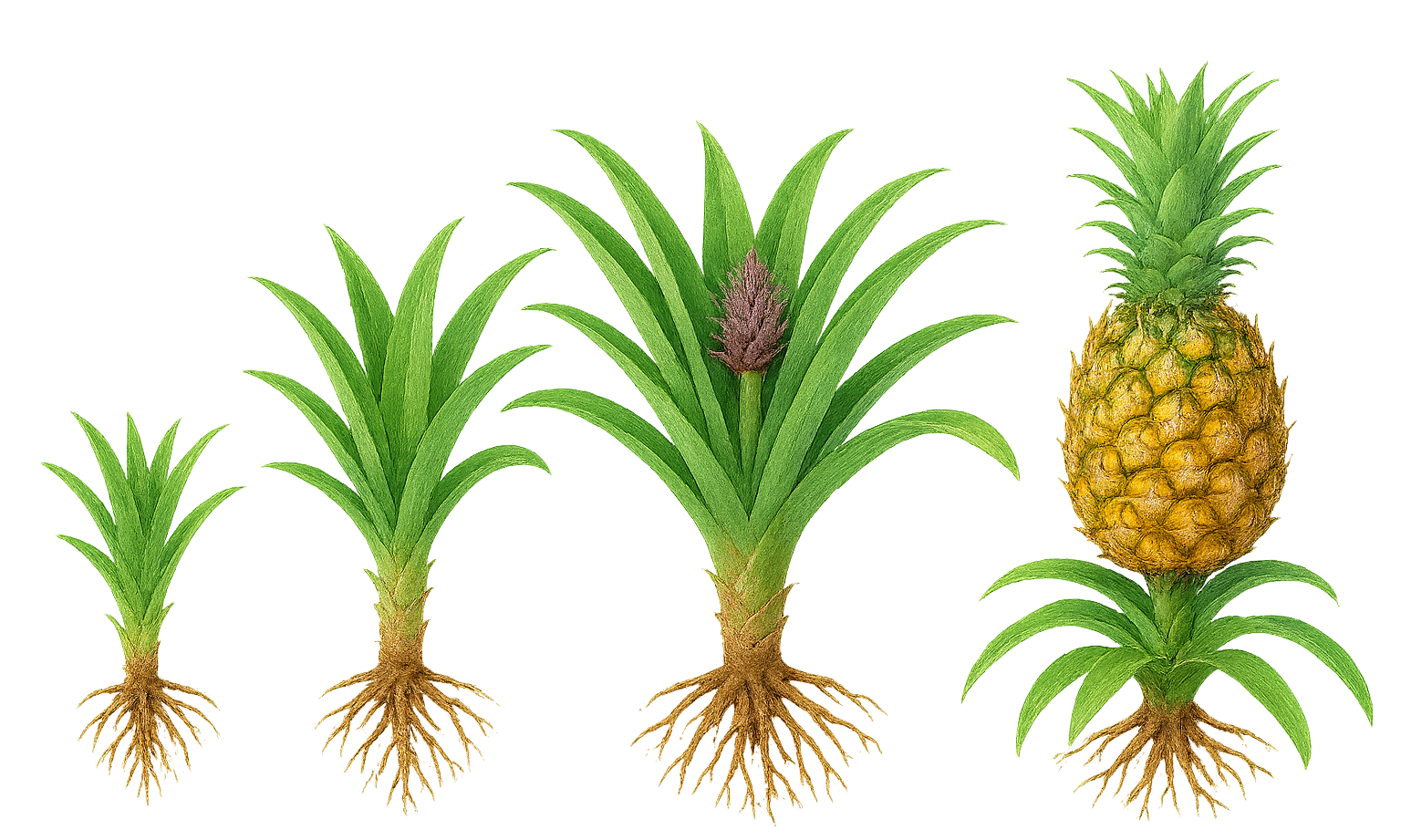
The pineapple crop cycle spans 18–22 months and includes four main stages: establishment, vegetative growth, flowering induction, and fruit development.
Fertilization should be adjusted according to growth stage and soil analysis results.
This table links pineapple growth stages with their dominant nutritional requirements, supporting stage-specific fertilizer planning.
| Stage | Months After Planting | Main Nutrients | Recommended Rate (kg/ha) | Objective |
|---|---|---|---|---|
| Establishment | 0–3 | N, P₂O₅, CaO | 50 N, 60 P₂O₅, 40 CaO | Root initiation and early leaf growth |
| Vegetative Growth | 3–8 | N, K₂O, MgO, B | 200 N, 250 K₂O, 40 MgO, 0.5 B | Canopy expansion and sugar accumulation |
| Flower Induction | 8–12 | P₂O₅, K₂O, CaO | 40 P₂O₅, 200 K₂O, 50 CaO | Uniform flower induction and fruit initiation |
| Fruit Development | 12–18 | K₂O, CaO, MgO, B, Zn | 150 K₂O, 60 CaO, 40 MgO, 0.3 B, 0.2 Zn | Enhance fruit size, sweetness, and firmness |
| Post-Harvest / Ratoon | 18–22 | P₂O₅, K₂O, CaO | 60 P₂O₅, 200 K₂O, 50 CaO | Replenish reserves for ratoon crop |
Micronutrients are best applied by foliar sprays during vegetative and fruiting stages.
Key takeaways:
Early growth stages require sufficient nitrogen and phosphorus to establish canopy and roots.
Potassium demand increases significantly during fruit development and maturation.
Matching nutrient supply to growth stage improves nutrient use efficiency and crop performance.
Sustainable and Precision Nutrition Practices
- Apply 4R Nutrient Stewardship (Right source, rate, time, place).
- Use soil and D-leaf tissue testing for nutrient monitoring.
- Incorporate 10–15 t/ha organic compost to improve structure and reduce acidity.
- Adopt fertigation to minimize nutrient losses and enhance uptake efficiency (>85%).
- Maintain target leaf nutrient ranges: N 1.8–2.2%, P 0.2–0.3%, K 2.5–3.5%, Ca 0.4–0.7%, Mg 0.25–0.40%, Fe 100–150 ppm, B 30–60 ppm.
Climate Change Impacts on Crop Nutrition
Extreme rainfall events can leach nitrate and potassium from sandy soils, while prolonged drought reduces nutrient mobility.
Heat stress can lead to unbalanced N:K ratios and lower fruit acidity. Adaptation strategies include mulching, drip irrigation, use of controlled-release fertilizers, and organic matter enrichment to buffer soil moisture and nutrient retention.
Elevated CO₂ may increase vegetative growth and dilute tissue nutrient concentrations, reinforcing the need to manage N:K ratios and Ca supply under warming scenarios.
References
- (2023). FAOSTAT statistical database. Food and Agriculture Organization of the United Nations.
- (2024): a technical guide for pineapple producers and exporters
- University of Hawaii: Pineapple Cultivation
- Silva and R. Uchida (2000): Recommended Plant Tissue Nutrient Levels for Some Vegetable, Fruit, and Ornamental Foliage and Flowering Plants in Hawaii
Other intersting trials
Q&A
Here are some frequently asked questions we received from farmers regarding growing Pineapple
Conduct D-leaf tissue analysis at 6–8 months. Deficiency thresholds: N <1.7%, K <2.2%, Mg <0.25%.
Low Ca and B, combined with rapid fruit growth or excess N.
Apply 2–3 weeks before ethephon induction to ensure adequate nutrient reserves.
Yes, particularly for Ca, B, Zn, and Mg during rapid fruit expansion.
Up to 30–40% of total nutrient requirement can be replaced with compost or manure in integrated systems.
Explore Pineapple Solutions by Brand
Find the right solutions to improve crop quality and yield

Master your crop nutrition in any condition
Brand details Agromaster<sup>®</sup>
Unlock the potential of your crops with Bioz®
Brand details Bioz<sup>®</sup>
Elevate your crops with ICL BEOZ®
Brand details BEOZ<sup>®</sup>The four-in-one natural fertilizer
Brand details Polysulphate<sup>®</sup>Master your crop nutrition in any condition
Brand details Agromaster<sup>®</sup>Unlock the potential of your crops with Bioz®
Brand details Bioz<sup>®</sup>Elevate your crops with ICL BEOZ®
Brand details BEOZ<sup>®</sup>Discover Our Solutions for Growing Pineapple
Pineapple Solutions: Increase Your Harvest


Nutrient & Unit Converter
Access calculators to improve nutrient management and boost productivity


