Whatsapp
  X
X  Mail
Mail  Copy link
Precision formulas tailored to your needs
Brand details Combifert<sup>®</sup> Growing Pomegranate
Crop Nutrition Advice
Everything you need to know about pomegranate fertilization, best practice, field trials, and more.
Advice for growing pomegranate (Punica granatum)
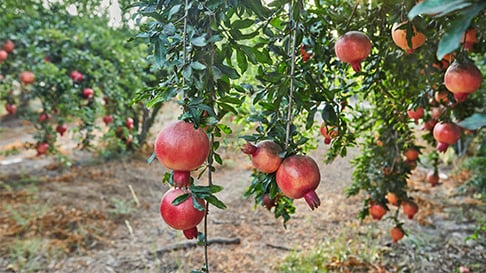
Pomegranate orchard before harvest.
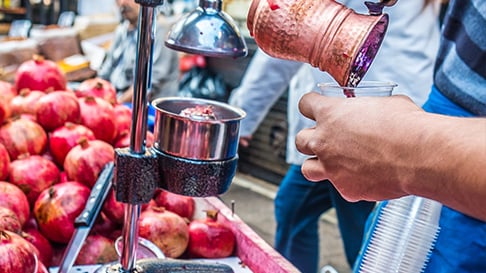
Freshly pressed pomegranate juice is a favourite street drink.
Introduction
Pomegranate (Punica granatum) is a long‑lived woody perennial fruit crop known for its adaptability to diverse growing environments, relative tolerance to drought, and production of nutritious, high-value fruits. The crop is cultivated for fresh consumption as well as for juice, and various processed products. In recent decades, global interest in pomegranate has increased due to its nutritional value, bioactive compounds, and expanding market demand. Under appropriate management, commercial orchards can remain highly productive for 15–20 years or longer.
Pomegranate is one of the oldest cultivated crops in the world and is believed to have originated in the region of present-day Iran and neighboring areas of Central Asia. From its center of origin, cultivation spread eastward to India and China and westward throughout the Mediterranean Basin.
Growing Conditions
Climate
Pomegranate is adapted to a wide range of climate conditions, and is currently grown in tropical and subtropical regions worldwide. The species exhibits remarkable adaptability and can also be grown in warm temperate areas under suitable conditions. It is particularly well suited to arid and semi-arid environments due to its tolerance to drought.
Excessive rainfall, prolonged periods of high humidity, or sudden fluctuations in soil moisture during fruit development can increase the incidence of diseases and physiological disorders such as fruit cracking. Consequently, regions characterized by hot, dry conditions during fruit maturation generally favor fruit quality and commercial production.
The highest crop growth, yield, and quality can be achieved in areas with hot and long summers. One of the most critical limitations of pomegranate cultivation is its sensitivity to low freezing temperatures. The trees can be damaged at temperatures below -10 °C (Sarkhosh et al., 2021).
Soil
Pomegranate can be grows in a wide range of soil types. However, tree growth and fruit quality are negatively affected by poor drainag, making well-drained soils essential for successful cultivation. The best conditions for pomegranate production are deep sand-clay soils (Sarkhosh et al., 2021).
Although the crop can tolerate moderate salinity and alkalinity, optimal commercial production is generally achieved in soils with a pH between 5.5 and 7.2.
Irrigation
While known for drought tolerance, pomegranate requires adequate irrigation to achieve high yields and good fruit quality. Young orchards need regular watering to establish a strong root system, while bearing trees benefit from steady moisture during flowering, fruit set, and fruit sizing. Drip irrigation is preferred because it improves water-use efficiency and helps maintain stable soil moisture conditions, reducing the risk of fruit cracking associated with sudden fluctuations in water availability. . In some regions, controlled deficit irrigation is used during the later stages of fruit development to enhance fruit color and sweetness without significantly compromising yield.
Global Production
The top countries for the production of pomegranate are India, Iran, Turkey, China, United States of America, Israel, Egypt, Spain, Afghanistan, Tunisia, Azerbaijan, Morocco, Argentina, Brazil, Chile, Peru, South Africa, Australia and Italy. However, due to the rapid increase in the production, it is highly difficult to calculate the total production worldwide.Estimated global pomegranate production was around 3.8 million metric t in 2017, with India being the largest producer with a production of 2.84 million metric t (Kahramanoglu, 2019).
Usage and Quality Requirements
Pomegranates are consumed fresh, as arils, or processed into juice, concentrates, and nutraceutical products. Key quality parameters include:
- Attractive fruit size, shape, and external appearance;
- Uniforme and intense aril coloration;
- High juice content and desirable balance between sugars and acidity;
- Firm rind capable of withstanding handling and transport;
- Low incidence of fruit cracking, sunburn, and other physiological disorders.
Adequate nutrition and regulated irrigation are essential for achieving commercial quality standards.
Growth Stages
Pomegranate growth follows a cycle of:
Bud break and vegetative growth
- Dormant buds resume growth;
- New shoots and leaves develop rapidly;
- Root activity increases and nutrient demand rises;
- Canopy development during this phase influences future flowering and fruiting.
Flowering and fruit set
- Development of male and hermaphrodite flowers;
- Pollination and fertilization determine fruit set;
- Environmental stress during this stage may reduce fruit retention.
Fruit development and enlargement
- Rapid fruit growth and aril development;
- Accumulation of juice and increase in fruit size;
- Adequate soil moisture is essential to minimize fruit cracking.
Ripening and harvest
- Development of characteristic rind and aril coloration;
- Accumulation of sugars, acids, and bioactive compounds;
- Fruits reach commercial maturity and are harvested for fresh or processing markets.
Nutrient Roles in Pomegranate Production
Nitrogen (N)
Nitrogen supports shoot growth, leafdevelopment, and canopy formation, which is essential for photosynthesis and carbohydrate production. Adequate N nutrition promotes vegetative growth, flowering, fruit set, and yield. On the other and, excessive N availability may stimulate excessive vegetative trees, delay fruit coloring, and maturity, and increase the susceptibility to physiological disorders such as fruit cracking. Therefore, N should be supplied according to crop demand to support productive growth and high yields.
Phosphorus (P)
Phosphorus (P) plays a central role in energy transfer and metabolism, supporting processes such as photosynthesis. Adequate P nutrition promotes efficient water and nutrient uptake, supports reproductive growth, and contributes to overall tree productivity. Its importance is particularly evident during periods of active growth and fruit development, when energy demand is high.
Potassium (K)
Potassium (K) is one of the most important nutrient influencing pomegranate fruit quality. It plays a key role in sugar transport and accumulation, fruit coloration, water regulation, ans stress tolerance. Potassium demand increases during fruit development and ripening. Adequate K supply may help reduce the incidence of fruit cracking and contribute to improved fruit quality and post‑harvest performance.
Calcium (Ca)
Calcium (Ca) is fundamental for cell wall formation and membrane stability, contributing to fruit firmness and structural integrity. In pomegranate, adequate Ca nutrition helps maintain rind strength and may reduce fruit cracking, especially under conditions of fluctuating soil moisture or high temperatures.
Magnesium (Mg)
Magnesium (Mg) is the central component of the chlorophyll molecule and is therefore essential for photosynthesis and carbohydrate production. Adequate Mg nutrition supports energy production, and the transport of photosynthates to developing fruits.
Sulfur (S)
Sulfur (S) is fundamental for amino acid and protein synthesis and is closely linked to N metabolism. Adequate S supply contributes to vegetative growth, canopy development, and overall orchard productivity.
Boron (B)
Boron (B) plays a key role in flowering, pollen viability, and pollen tube growth. Its availability is therefore critical for successful pollination and reproductive development, directly influencing fruit set and overall yield in pomegranate production.
Zinc (Zn)
Zinc (Zn) is involved in hormone synthesis, enzyme activation, and the development of new tissues. It plays an important role in shoot elongation, leaf expansion, and canopy development.
Other micronutrients
Although deficiencies in iron (Fe), manganese (Mn), copper (Cu), molybdenum (Mo), and chlorine (Cl) are less frequently observed in pomegranates compared to B and Zn, these micronutrients remain essential for photosynthesis, plant metabolism, and overall development. Deficiencies are most likely to occur under soil conditions characterized by high pH or excessive liming (particularly for cationic micronutrients), or in soils derived from low-nutrient parent materials.
Deficiency Symptoms
Nitrogen Deficiency
- Chlorosis (yellowing) of older leaves;
- Reduced shoot growth and canopy development;
Phosphorus Deficiency
- Reduced root and shoot growth;
- Dark green foliage, occasionally with reddish‑purple discoloration;
- Reduced flowering and fruit set (P strongly influences the uptake of nutrients;
Potassium Deficiency
- Marginal chlorosis and necrosis of older leaves;
- Reduced fruit size, weight, and overall quality;
- Increased incidence of fruit cracking (a major K‑related physiological disorder) and shorter post‑harvest shelf life;
Calcium Deficiency
- Increased fruit cracking, especially under fluctuating irrigation regimes;
- Reduced leaf size and chlorosis; young leaves become distorted;
- Poor rind firmness and reduced post-harvest storage potential due to impaired cell wall development;
Boron Deficiency
- Chlorosis and necrosis of young leaf tips and margins, followed by leaf drop;
- Dieback of shoot tips and growing points in severe cases
- Poor pollen viability and pollen tube growth, leading to reduced fruit set;
- Increased fruit deformation and internal tissue disorders;
Zinc Deficiency
- Small, narrow, pointed leaves (“little leaf”) and shortened internodes, resulting in a rosette appearance;
- Interveinal chlorosis or mottled chlorosis on young leaves;
- Restricted shoot growth and reduced canopy development.
Conclusion
Pomegranate is a resilient, high-value fruit crop that is well adapted to a wide range of growing environments. Although it exhibits a degree of tolerance to drought, achieving high yields and fruit quality depends on suitable climate conditions, adequate irrigation, and proper orchard management. Favorable growing conditions and appropriate nutrient management are particularly important for minimizing physiological disorders such as fruit cracking and for maximizing yield and fruit marketability.
References
Kahramanoglu, I. 2019. Trends in pomegranate sector: production, postharvest handling and marketing. International Journal of Agriculture, Forestry and Life Sciences, 3, 239-246.
Sarkhosh, A. et al. 2021. The pomegranate: botany, production and uses. CABI: USA.
Related Trials
Guides & Articles
Q&A
Fruit cracking is primarily associated with fluctuations in soil moisture,particularly when drought periods are followed by heavy irrigation or rainfall during fruit development. Nutritional factors, especially inadequate calcium and potassium supply, may increase susceptibility to cracking. Maintaining uniform soil moisture through proper irrigation management and ensuring adequate nutrient supply can reduce cracking.
Pomegranate performs best in subtropical to tropical climates with temperatures of 25–35 °C. Excess rainfall and high humidity can increase disease pressure and the incidence of fruit cracking. Although mature trees tolerate moderate drought, pomegranate is sensitive to severe frost, and temperatures below −10 °C can cause significant damage.
The crop can be grown in a wide range of soil types but performs best in deep, well-drained sandy-loam to loam soils. The crop tolerates moderate salinity and alkalinity; however, optimal growth and fruit production are generally achieved in soils with a pH between 5.5 and 7.2. Good drainage is essential, as prolonged waterlogging can restrict root growth and increase the risk of diseases.
Water requirements vary depending on soil type, climatic conditions, tree age, and crop stage. Young orchards generally require more frequent irrigation to establish a healthy root system, while bearing trees benefit from maintaining adequate soil moisture during flowering, fruit set, and fruit development. Drip irrigation is the preferred method because it improves water-use efficiency and helps reduce the risk of fruit cracking associated with fluctuations in soil moisture.
Commercial pomegranate orchards are typically established using vegetative propagation methods, particularly hardwood cuttings, which ensure genetic uniformity and earlier production. Healthy, disease-free planting material should be selected.
Explore Pomegranate Solutions by Brand
Find the right solutions to improve crop quality and yield
Precision formulas tailored to your needs
Brand details Combifert<sup>®</sup>Recommended products
Combifert®

Digital Tools
Improve your fertilization and increase your yield with our handy calculation tools