


 Whatsapp
  X
X  Mail
Mail  Copy link

Master your crop nutrition in any condition
Brand details Agromaster<sup>®</sup> Growing Rice
Crop Nutrition Advice
Everything you need to know about rice fertilization, best practice, field trials, and more.
Rice Nutrition & Agronomic Guide
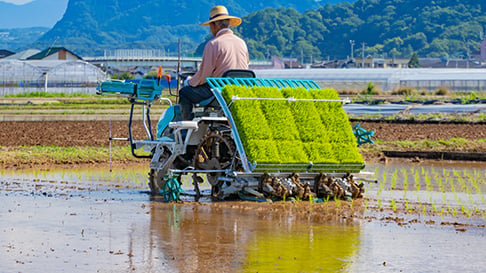
Mechanized planting of rice seedlings.
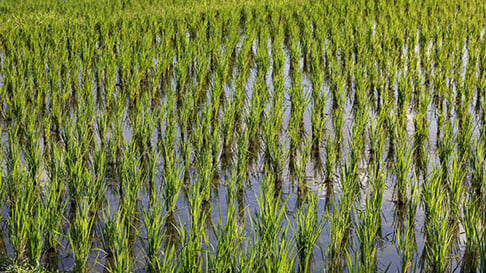
Rice plants in a typical paddy field.
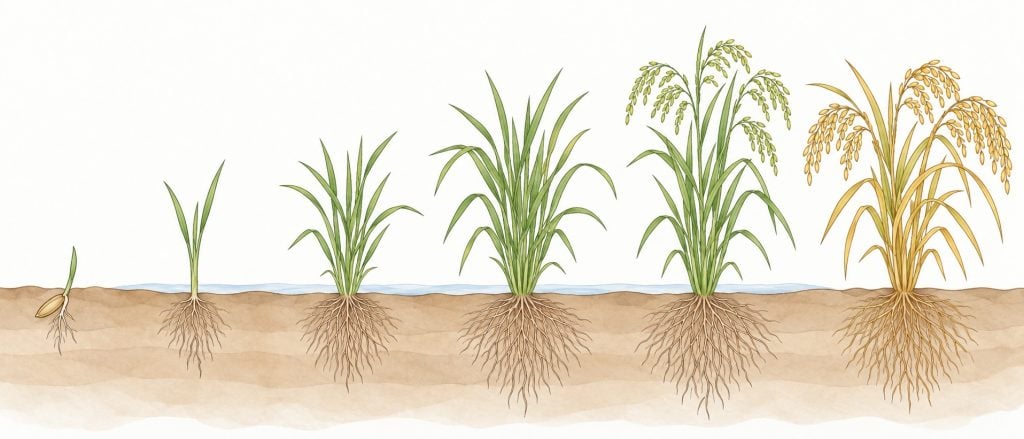
Rice (Oryza sativa L. and Oryza glaberrima Steud.) is a foundational global food crop that supports the caloric needs of over 3.5 billion people. As an annual warm-season grass, it is characterized by round culms, flat leaves, and terminal panicles. Production is primarily categorized into irrigated lowland systems, which account for three-quarters of total production and offer the highest yields due to stable water and nutrient dynamics, and upland systems, which are essential in Africa and Latin America but face challenges like drought and soil acidity. Agronomically, rice growth follows distinct vegetative, reproductive, and ripening phases, with a duration that varies by variety.
Global Production and Use
Global rice production is a massive enterprise, with a harvested area of approximately 170 million hectares producing roughly 520 million metric tons (FAOSTAT 2023). Asia is the dominant production hub, accounting for more than 90% of the world’s supply.
- Leading Producers: China and India are the world’s largest producers, with China producing nearly 200 million metric tons and India close to 150 million metric tons. Other significant producers include Bangladesh, Indonesia, Vietnam, and Thailand.
- Utilization: While primarily consumed directly as a grain, rice is also processed into flour, noodles, snacks, and beverages. By-products such as rice bran oil, broken rice, and straw provide significant economic value for the manufacturing and livestock sectors.
Nutritional Value, Production Challenges, Market Requirements
Rice is a primary source of carbohydrates and energy for nearly half the global population. However, its production is fraught with diverse ecological and biological challenges:
- Production Constraints: Irrigated systems frequently face zinc deficiency, iron toxicity, and salinity, while upland systems are limited by phosphorus fixation, aluminum toxicity, and erratic rainfall.
- Pest and Disease Pressure: Key pests include stem borers, leaf folders, and plant hoppers. Diseases such as rice blast, sheath blight, and bacterial leaf streak can cause significant yield losses.
- Market and Quality Requirements: Market value is driven by grain quality, including protein content and milling performance. Nutrient management plays a critical role here; for instance, adequate potassium reduces “chalkiness” and improves grain filling, while silicon increases grain hardness and disease resistance.
Plant Growth Environment
Optimal rice production requires a careful balance of anaerobic and aerobic soil conditions, depending on the system, along with precise temperature and water management.
Soil Characteristics and Nutrient Availability
Flooded lowland systems create anaerobic conditions that profoundly change nutrient dynamics: ammonium becomes the dominant nitrogen form, and phosphorus availability typically increases. Conversely, zinc availability decreases in these flooded soils due to the formation of insoluble complexes.
Upland rice is grown in aerobic, often acidic soils (pH 4.5–6.0) where phosphorus fixation is a major hurdle.
pH and Salinity
The ideal pH for rice is generally between 5.5 and 6.5, though some sources indicate a broader adequate range up to 8.5 depending on the system. Rice is sensitive to salinity, with yield declines beginning at an EC of 3 dS/m in sensitive varieties.
Temperature and Water Management
Rice thrives at temperatures between 25°C and 35°C. It is extremely sensitive to heat during flowering, where temperatures above 35°C can cause spikelet sterility. Water requirements are high, ranging from 1,000 to 1,500 mm for irrigated systems to roughly 1,000 mm for well-distributed rainfall upland environments.
Nutrient Roles and Requirements
Rice has a very high demand for nutrients, particularly potassium, which is taken up in quantities even greater than nitrogen during certain growth stages. The uptake of these two most important nutrients increases rapidly between tillering and flowering.
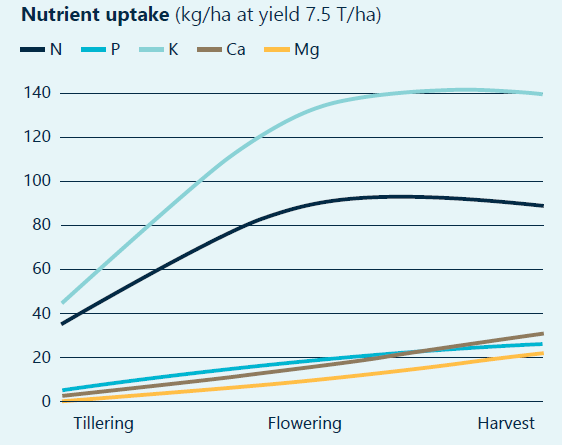
Adapted from Hirzel and Undurraga, 2013
For every 1 metric ton of rough rice (grain + straw) produced, the crop removes approximately:
- Nitrogen (N): 18 – 22 kg
- Phosphorus (P₂O₅): 6 – 9 kg
- Potassium (K₂O): 20 – 28 kg
- Calcium (CaO): 4 – 6 kg
- Magnesium (MgO): 4 – 5 kg
- Sulfur (SO₃): 3 – 4 kg
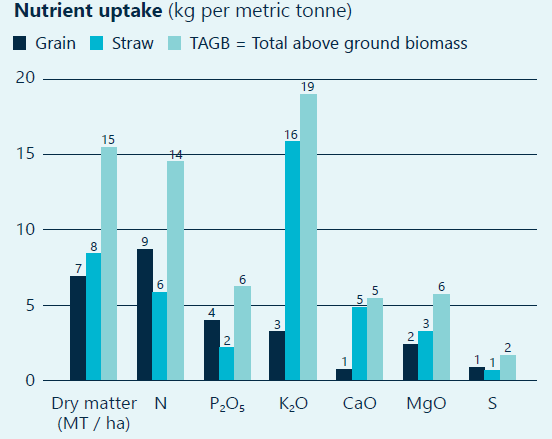
Adapted from Buresh, R.J, 2010
Nitrogen (N)
Nitrogen is the most vital nutrient in rice cultivation, acting as the primary engine for high-yield production. During the early stages, it stimulates vigorous tillering and ensures lush vegetative growth, which establishes the architectural foundation of the plant. As the rice transitions to its reproductive phase, nitrogen becomes essential for panicle initiation and grain filling. Its most critical function, however, lies in the synthesis of proteins and chlorophyll; by optimizing the plant’s photosynthetic capacity and structural development, nitrogen directly dictates both the quality and the final weight of the harvest.
Phosphorus (P)
Phosphorus acts as the foundational energy broker for rice, primarily known for its ability to promote robust root systems that allow the plant to anchor effectively and access deep-soil nutrients. As a vital driver of cell division, it is a fundamental prerequisite for flowering; without sufficient phosphorus, the plant cannot develop the reproductive structures necessary to maximize the number of grains per panicle. Furthermore, it is indispensable for energy management within the plant, serving as a core component of ATP (adenosine triphosphate) to fuel every metabolic process from seedling emergence to maturity..
Potassium (K)
Potassium functions as a vital regulator, activating the enzymes necessary for various metabolic reactions. It is particularly important during the grain-filling stage, as it enhances the transport of carbohydrates from the leaves to the ripening grains. Furthermore, potassium manages the plant’s water use by controlling stomatal aperture, which helps maintain turgor and improves resilience against environmental stress.
Calcium (Ca)
Calcium is essential for maintaining cell-wall stability, which provides the mechanical strength necessary for a resilient plant architecture. This structural integrity is critical for preventing lodging during heavy rainfall or high winds and serves as a primary defense mechanism by enhancing disease resistance. In rice cultivation, a robust calcium supply ensures the plant can physically support the weight of the panicles as they mature.
Magnesium (Mg)
As the central atom of the chlorophyll molecule, magnesium is indispensable for the plant’s photosynthetic capacity. Beyond its role in light harvesting, it acts as a structural component and activator for numerous enzymes, specifically facilitating the utilization of iron (Fe). Magnesium also serves as a vital carrier of phosphorus throughout the plant, ensuring that energy-rich compounds are distributed where they are most needed for growth and grain development.
Sulphur (S)
Sulphur functions as a fundamental structural component of proteins and various enzymes, playing a decisive role in the conversion of inorganic nitrogen into organic protein. It acts as a necessary catalyst in chlorophyll production and is heavily involved in the synthesis of oils and proteins. By bridging the gap between nitrogen uptake and protein formation, sulphur directly influences both the nutritional quality and the overall biomass of the rice crop.
Micronutrients
- Iron (Fe) is essential for chlorophyll and protein synthesis, serving as a critical component in the plant’s energy and respiratory enzyme systems.
- Manganese (Mn) complements this by driving photosynthesis, specifically the “Hill reaction” for water splitting, and aiding in CO2 assimilation and the formation of vitamins like ascorbic acid and carotene.
- Boron (B) is vital for reproductive success, facilitating pollination, seed production, and the translocation of sugars, while also regulating cell wall formation and calcium uptake.
- Zinc (Zn) acts as a catalyst for growth, promoting the production of the hormone auxin and supporting starch formation, root development, and the synthesis of proteins and chlorophyll.
- Copper (Cu) functions as a metabolic catalyst, assisting in nitrogen and carbohydrate processing and the enzymatic transition of amino acids into proteins.
- Molybdenum (Mo) is specifically required for nitrate reductase activity, allowing the plant to convert nitrates into amino acids and inorganic phosphorus into organic, usable forms.
Silicon (Si)
While often classified as a beneficial element, silicon is crucial for rice. It deposits in the epidermal layers to provide mechanical strength, significantly reducing lodging and enhancing resistance to pests and fungal diseases. By keeping leaves more erect, it also improves light interception and photosynthetic efficiency.
Deficiency Symptoms
Nitrogen Deficiency
- Pale leaves
- Poor tillering
- Reduced canopy
Phosphorus Deficiency
- Stunted growth
- Dark-green leaves
- Purpling
Potassium Deficiency
- Bronzing of leaves
- Weak stems
- Increased grain chalkiness
Zinc Deficiency
- Bronzing and stunting
- Reduced tillering
Sulfur Deficiency
- Yellowing of young leaves
Fertilization Methods
- Basal application: phosphorus, zinc, sulfur, and a portion of nitrogen should be applied at planting to support root establishment and early vigor.
- Split topdressing: nitrogen and potassium are typically split-applied during the tillering and panicle initiation stages to optimize canopy expansion and spikelet formation.
- Deep placement: in irrigated systems, deep placement of nitrogen fertilizers significantly improves use efficiency and reduces environmental losses.
- Foliar nutrition: foliar sprays are highly beneficial for delivering micronutrients like zinc, boron, and iron, especially under soil constraints or drought conditions.
Conclusion
Rice is a complex and globally vital crop that demands high-precision nutrient management to reach its yield potential. By understanding the unique anaerobic dynamics of lowland systems versus the acidic constraints of upland environments, growers can implement balanced fertilization programs. Prioritizing nitrogen and phosphorus for early establishment, followed by strategic potassium and silicon applications for grain quality, ensures a productive and sustainable harvest that meets the world’s growing food demands.
References
De Datta, S. K. (1981). Principles and Practices of Rice Production. Wiley.
Dobermann, A., & Fairhurst, T. (2000). Rice: Nutrient Disorders & Nutrient Management. IRRI.
Dobermann, A., Witt, C., Dawe, D., et al. (2002). Site-specific nutrient management for intensive rice cropping systems in Asia. Field Crops Research
FAO. (2023). FAOSTAT Statistical Database. Food and Agriculture Organization of the United Nations.
Fageria, N.K., Baligar, V.C., & Jones, C.A. (2011). Growth and Mineral Nutrition of Field Crops, 3rd ed. CRC Press.
Fageria, N. K. (2014). Nitrogen management in crop production. CRC Press.
IRRI (2024). Rice Knowledge Bank. International Rice Research Institute.
Neue, H.U. & Mamaril, C.P. (1985). Zinc, sulfur, and other micronutrients in wetland soils. In Wetland Soils: Characterization, Classification, and Utilization. IRRI.
Savant, N.K., Snyder, G.H., & Datnoff, L.E. (1997). Silicon management and sustainable rice production. Advances in Agronomy
Yoshida, S. (1981). Fundamentals of Rice Crop Science. IRRI.
Rice Trials
Guides & Articles
Q&A
Early-season diagnosis relies on a combination of real-time monitoring and analytical testing. SPAD meters and Leaf Color Charts (LCC) quantify chlorophyll status, while remote sensing (NDVI) provides spatial insights into canopy vigor. For precise nutrient concentrations, plant tissue analysis performed at the panicle initiation stage serves as the definitive standard.
Foliar application is most effective for delivering micronutrients like zinc (Zn), boron (B), and iron (Fe). It is particularly beneficial when soil conditions (such as high pH or salinity) limit nutrient availability, during periods of moisture stress, or when root activity is compromised, as it bypasses soil-related immobilization and root-uptake barriers.
High levels of bicarbonate HCO₃⁻ can significantly hinder uptake by causing the precipitation of zinc and iron in the rhizosphere. To mitigate this, agronomists should prioritize acidified fertilizers to lower localized pH or utilize foliar-applied micronutrients to ensure direct absorption into the leaf tissue.
Beyond genetic selection, lodging resistance is improved by balancing nitrogen (to avoid succulent, weak growth) with adequate potassium and silicon. These elements thicken the culm (stalk) walls and enhance mechanical strength, allowing the plant to support heavier grain loads and resist wind pressure.
Explore Rice Solutions by Brand
Find the right solutions to improve crop quality and yield

The four-in-one natural fertilizer
Brand details Polysulphate<sup>®</sup>Master your crop nutrition in any condition
Brand details Agromaster<sup>®</sup>The four-in-one natural fertilizer
Brand details Polysulphate<sup>®</sup>Recommended products
Polysulphate®
Agromaster®

Digital tools
Improve your fertilization and increase your yield with our handy calculation tools


