Whatsapp
  X
X  Mail
Mail  Copy link
 Agrolution pHLow: 4.4x More Efficient Than Conventional Fertilizer?
Field data from maize, potatoes, soybeans, and pears show how precision pH management can dramatically improve phosphorus efficiency while reducing environmental impact.

On this page:
In a series of field trials, ICL’s pH-focused water-soluble fertilizers delivered up to 4.4× greater phosphorus efficiency compared to conventional 10-34-0. The result: higher yields, lower P2O5 application rates, reduced input costs, and measurable environmental gains.
A substantial increase in nutrient use efficiency (up to 4.4 times higher) when using ICL low pH water soluble fertilizers was a recurring theme in a recent webinar featuring Christi Falen, Product Lead, Biostimulants and Specialty Foliar Products, ICL North America. This article we aim to summarize some of the key data obtained from a number of different crop trials.
What Does 4.4× More Efficient Actually Mean?
In maize trials, ICL’s Agrolution pHLow 11-45-11 delivered 4.4 times greater phosphorus use efficiency compared to standard 10-34-0 liquid ammonium polyphosphate. That efficiency is calculated based on the yield per unit of P2O5 applied.
Instead of applying higher phosphorus rates to drive performance, the trials demonstrated that growers can instead user lower P2O5 inputs, precisely placed starter applications, and a rhizosphere-focused pH management to produce equal, or superior, yields while dramatically reducing nutrient load.
It’s clear that this is not simply a yield story… it is an efficiency story.
How Much Can Phosphorus Application Be Reduced?
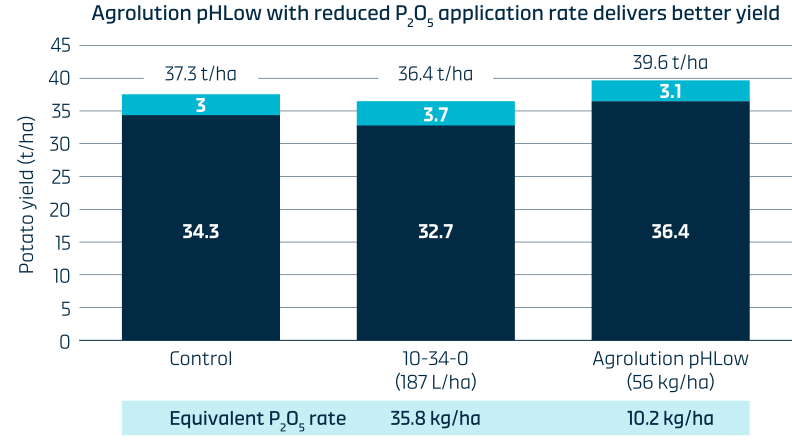
One of the more striking examples in the webinar comes from a set of Michigan potato trials.
With conventional 10-34-0, growers would typically apply:
- 79 units of P2O5 and achieve a yield of 36.4 t/ha (325 cwt/A)
Using Agrolution pHLow, the same system required only:
- 22.5 units of P2O5 to achieve a yield of 39.6 t/ha (353 cwt/A)
That represents 3.5× less phosphorus applied, while maintaining, and even improving, yield.
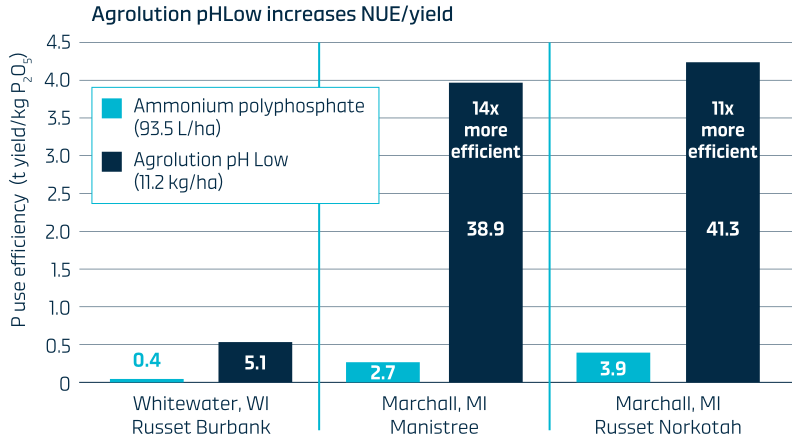
Another set of potato trials in Wisconsin and Michigan also demonstrate the increase in NUE when using Agrolution pHLow compared to the control using ammonium polyphosphate. After adjusting for baseline soil fertility levels, the trials showed 11–14 times greater phosphorus efficiency using Agrolution pHLow, compared to potatoes produced with conventional programs.
Christi Falen describes this in more detail in the webinar at 22’30”.
From both an agronomic and environmental standpoint, this is a significant shift.
So Why Does Lowering pH in the Rhizosphere Improve Efficiency?
The answer lies in nutrient chemistry.
High soil pH, especially in calcareous or carbonate-rich soils, restricts phosphorus availability. Instead of trying to change the pH of the entire field, which is costly and impractical, ICL’s approach here focuses on:
- Temporarily acidifying the root zone (rhizosphere)
- Enhancing nutrient solubility where uptake occurs
- Unlocking soil-bound nutrient reserves
By improving solubility and diffusion near roots, plants access both applied phosphorus and native soil phosphorus more effectively.
This is why reduced rates can still deliver stronger performance.
Do We Only See This Benefit in Potatoes?
No, ICL’s field trials clearly demonstrate that careful pH management delivers efficiency gains across many different crops.
Maize
With maize, a trial in Wisconsin demonstrated how optimized WSF can provide greater P use efficient (watch at 14’30”).
- 4× greater P efficiency with Agrolution pHLow vs. 10-34-0
- Yield increases over untreated controls
- Reduced total phosphorus applied
Soybeans
Using Nova PeKacid as a starter fertilizer in soybean trials in Louisiana delivered increased yield (watch at 15’52”):
- Only 6.7 kg/ha of Nova PeKacid applied
- 13% yield increase
- Increase of 0.54 t/ha (8 bushels per acre) over the standard grower practice
Pears
As part of a 2-year fertigation study on a commercial pear orchard in Oregon, nine precise fertigation applications were made. You can watch the full explanation at 16’20” in the webinar, but in summary, this resulted in:
- Soil phosphorus increasing from 56 ppm to 98 ppm
- Potassium increasing from 242 ppm to 433 ppm
- Reduced calcium levels in the soil, making the nutrients much more available
- Nearly doubled yield from the control of 11 t/ha to 21.45 t/ha when Agrolution pHLow is used in this commercial orchard
- As an additional benefit, the fruit quality improved with increased fruit firmness
Importantly, these results were achieved with a total of only 40.35 kg/ha of P2O5 from the 9 Agrolution pHLow applications.
What Is the Economic Impact for Growers?
The trials demonstrated clear advantages across three dimensions:
Economic
- Lower fertilizer input cost per hectare
- Higher marketable yield
- Improved return on investment
Agronomic
- Faster early-season crop establishment
- Improved nutrient uptake
- Stronger root zone performance
Environmental
- Significantly reduced phosphorus application
- Lower risk of runoff and nutrient loss
- Improved nutrient use efficiency (NUE)
As Christi Falen noted during the webinar:
Not only are we seeing an economic benefit, we’re also having an environmental benefit [by] utilizing less phosphorus and producing more than what we had with the conventional product
This dual outcome is increasingly important in today’s regulatory and sustainability-driven agricultural landscape.
Is This Just a Specialty Crop Solution?
While water-soluble fertilizers have historically been associated with high-value specialty crops and fertigation systems, the data show strong potential in:
- Row crops as part of the starter package
- Precision banding systems
- Drip irrigation applications
- Alkaline and calcareous soil regions
We are seeing a shift from “high-value crop only” to high-efficiency systems across many crop types.
What Does This Mean for Water-Soluble Fertilizers?
This data from maize, potatoes, soybeans, and pears reinforces a broader trend: Water-soluble fertilizers are developing from simple nutrient carriers into precision tools for efficiency and sustainability.
By integrating targeted pH management, enhanced compatibility, rhizosphere-focused application, and complementary biostimulant technologies, growers can produce more with less nutrient input.
The takeaway from this webinar is clear: Growing more does not always mean applying more.
With the right chemistry in the right place, efficiency becomes the primary driver of profitability and sustainability.
We encourage you to watch the Beyond Nutrition: Why pH Is the Key to Fertilizer Performance webinar to see hear first-hand the benefits of pH-focused water-soluble fertilizers, and how they could fit your system.