


 Whatsapp
  X
X  Mail
Mail  Copy link
 Beyond MAP: Getting More from Your Granular Phosphorus Program

On this page:
Every spring, phosphorus is a familiar part of the fertility plan. For many growers, that means 10-34-0 or another liquid starter near the row, along with granular MAP (11-52-0) or DAP supplemented by other nutrients in a dry blend.
The goal is straightforward: supply the phosphorus needed for early growth while building a balanced nutrition program for the season ahead.
It works. Especially in cold soil, where early phosphorus availability helps support emergence and vigor. But with tighter margins, compressed application windows and growing pressure to maximize nutrient efficiency, it is worth taking a closer look at fertilizer sources and asking how we can get more from our inputs.
ICL PKpluS® offers us an opportunity to rethink how we approach spring fertility. This co-granulated phosphorus fertilizer combines superphosphates with polyhalite (potassium, sulfur, calcium and magnesium) in one low-salt, low-chloride granule. That means five nutrients in every granule, fewer fertilizer components to blend and store, and the flexibility to manage nitrogen separately.
Why Phosphorus Source Matters
MAP and DAP are proven, high-analysis phosphorus fertilizers. But P₂O₅ concentration isn’t the only consideration. What comes with the P, how it fits into the blend and where it can be placed matter, too.
- Simplifying the blend. MAP or DAP is frequently blended with potassium and sulfur sources to build a complete dry fertility program. Physical blends work, but multiple fertilizer materials need to be sourced, stored, blended and handled. A multi-nutrient granule offers another way to deliver several of those nutrients together.
- Managing nitrogen separately. MAP, DAP and APP also contribute ammonium-N that needs to be accounted for in the overall nitrogen program and potentially vulnerable to environmental loss. A phosphorus source without N leaves growers free to manage nitrogen source, rate, timing and placement separately.
- Considering placement and seed safety. As fertilizer moves closer to the seed, salt, chloride, ammonia potential, rate, crop sensitivity and soil conditions become increasingly important. A low-salt, low-chloride fertilizer can provide useful flexibility for in-furrow and near-row applications.
How Do Granular Phosphorus Sources Compare?
P₂O₅ analysis tells us how concentrated a phosphorus fertilizer is, but not the whole story. What comes with that phosphorus—and how the product behaves around the seed—can be just as important when choosing the right source.
| Phosphorus Source | Typical Analysis | Additional Nutrients | Salt, Chloride & Placement Considerations |
|---|---|---|---|
| MAP | 11-52-0 | Ammonium-N | Contains ammonium-N; salt and ammonia effects should be considered when determining seed-row rates |
| DAP | 18-46-0 | Ammonium-N | Ammonia-related seedling risk makes direct seed contact an important consideration |
| TSP | 0-46-0 | Ca | No ammonium-N; placement rate still needs to account for fertilizer salt and crop sensitivity |
| ICL PKpluS | 0-24-6 + 15.4 Ca + 1.8 Mg + 9.1 S | K, S, Ca and Mg | Low salt and low chloride; suitable for in-furrow, near-row banding or broadcast at appropriate agronomic rates; no blending required. |
MAP, DAP and TSP deliver more concentrated P₂O₅ but PKpluS takes a different approach: use the phosphorus application to deliver a broader package of nutrients in every granule and leverage seed row safe, balanced nutrition to improve nutrient use efficiency across the board.
What Is ICL PKpluS?
PKpluS is more than just a phosphorus source. PKpluS combines superphosphates with the natural mineral polyhalite, the foundation of Polysulphate®, to supply P, K, S, Ca and Mg. All five nutrients are soluble and available to the crop, with no nitrogen in the analysis.
That distinction matters. A field rarely needs phosphorus in isolation. Depending on the crop and soil test, potassium, sulfur and secondary nutrients are an important part of a fertility plan.
With PKpluS, growers get:
- 24% P₂O₅: A meaningful granular phosphorus source, not simply a sulfur product with P included.
- Five nutrients in every granule: P, K, S, Ca and Mg together rather than relying on multiple fertilizer ingredients to build the nutrient package. PKpluS 0-24-6 +15.4Ca +1.8Mg +9.1S is the analysis available in North America, for example.
- Nitrogen flexibility: N source, rate, timing and placement remain independent of the phosphorus application.
- Placement flexibility: Low-salt and low-chloride characteristics support in-furrow, near-row banding and broadcast applications at appropriate agronomic rates.
- Simpler handling: Fewer individual fertilizer components to source, store, blend and handle, with compatibility across common dry-fertilizer equipment.
The polyhalite component provides gradual-release, plant-available K, S, Ca and Mg alongside phosphorus from the superphosphate component.
What Cropping Systems Does PKpluS Fit?
PKpluS can fit a range of North American fertility programs, including corn, canola, wheat, pulses, soybean, forages, and specialty crops particularly where the soil test and crop requirements call for phosphorus along with potassium, sulfur or secondary nutrients.
It can be a particularly good fit for:
- High-sulfur-demand crops: Crops such as canola have significant sulfur requirements, making a P source that also supplies sulfate sulfur a natural fit.
- Protein and oil production: Sulfur plays an important role in nitrogen utilization and the formation of amino acids, while K, Ca and Mg support other key crop functions.
- Production of leguminous crops: Both sulfur and calcium are important in the formation of root nodules, where symbiotic bacteria convert atmospheric nitrogen into usable ammonia.
- Flexible nitrogen programs: With no N in the analysis, PKpluS fits programs where nitrogen source, rate, timing and placement are managed separately, like operations using anhydrous ammonia, urea, UAN or other N sources.
- Different placement strategies: In-furrow with the seed, banded near the seed row or broadcast, and suitable for both fall and spring applications.
A conventional dry program may start with MAP or DAP for phosphorus, then add potash for potassium and ammonium sulfate or elemental sulfur to complete the blend.
PKpluS approaches that same fertility decision differently with multiple sulfate-based nutrients already present in every granule.
Placement, Rates and Equipment
How Should PKpluS Be Applied?
- Placement: In-furrow with the seed, banded near the seed row or broadcast.
- Typical starting rate: 100–150 lb/acre, adjusted for soil-test levels, crop requirements, yield goals and placement. PKpluS isn’t a pound-for-pound replacement for MAP, potash and sulfur. The right rate still starts with the soil test, crop requirements, yield goal, placement and nutrient source. But since PKpluS is a multi-nutrient source, it is designed to leverage nutrient synergies to help improve nutrient use efficiency.
- Equipment: Compatible with air seeders, planters and broadcast spreaders.
As with any fertilizer applied with or near the seed, rate should account for crop sensitivity, row spacing, soil conditions and moisture. Work with your agronomist to match rate and placement to the field.
Improving Nutrient Uptake and Nutrient Use Efficiency
What if improving nutrient efficiency starts with changing the source? Polyhalite (Polysulphate) makes up a significant proportion of PKpluS. Across several cropping systems, ICL research has observed improvements in root growth, nutrient uptake and nutrient use efficiency following Polysulphate applications.
Part of the difference may lie in the natural mineral itself. In polyhalite, sulfate-based nutrients are held within the same naturally formed mineral. As it gradually dissolves, all nutrients are released together, providing a balanced nutrient supply rather than relying on separate sources with different dissolution and release patterns.
The release pattern, together with Polysulphate’s low-salt, low-chloride characteristics, may contribute to the crop and soil responses observed in our research.
- Improved microbial diversity: Emerging research shows Polysulphate increased soil microbial diversity, which can help support nutrient cycling and a more active soil environment.
- Better root development: Across multiple crops, like peas and soybeans, denser, longer root mass and higher yields were observed.
- Nutrient Uptake: In a period of two years, Polysulphate was tested in several winter barley trials. Polysulphate increased nutrient uptake compared with the control across six sites in northeast England in year one and 23 sites spanning northern to southern England in year two:
- Phosphorus: phosphate uptake increased by 41% in year one and 34% in year 2 (ICL, UK, 2021).
- Nitrogen: nitrogen uptake increased by 28% in year one 36% in year two (ICL, UK, 2021).
- Potassium & Sulfur: 21% improvement in both potassium and sulfur uptake (ICL, UK, 2021).
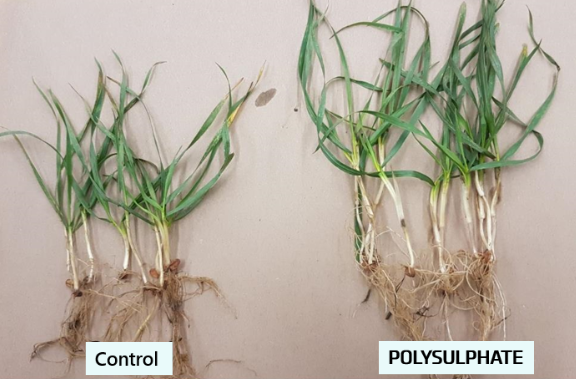
Polysulphate improved N & P uptake compared to control in trial, UK, 2021
Across a broader meta-analysis covering different countries, crops and cropping systems, Polysulphate was associated with an 8% increase in yield and a 10% improvement in nitrogen use efficiency compared with growers’ practice.
Sometimes, changing the source of your nutrients can change what your crop—and your soil—can do with them.
What Else Can Your Phosphorus Source Do?
10-34-0, MAP, DAP and TSP will continue to be important phosphorus fertilizers. But they aren’t the only way to build an early season phosphorus program.
ICL PKpluS offers another option: five nutrients in every granule, fewer fertilizer components to manage, flexible placement and the freedom to build nitrogen around the needs of the crop and operation.
For decades, phosphorus decisions have often started with analysis alone. But when every fertilizer dollar has to work harder, it may be worth taking a fresh look at what your phosphorus source can deliver beyond P₂O₅.
Ready to take another look at your fertility program for 2027? Connect with an ICL expert or explore ICL PKpluS® to see how it fits your acres.
ICL PKpluS FAQ
Is PKpluS a replacement for MAP?
It can replace MAP but not on a pound-for-pound basis. PKpluS has a different nutrient analysis and supplies P, K, S, Ca and Mg, so rates should be based on soil tests, crop requirements, yield goals and placement.
Does PKpluS contain nitrogen?
No. ICL PKpluS contains no nitrogen, allowing nitrogen source, rate, timing and placement to be managed separately.
Can PKpluS be applied in-furrow?
PKpluS is a low-salt, low-chloride fertilizer suitable for in-furrow, banded, air-seeded, or broadcast applications at appropriate agronomic rates.
What nutrients are in PKpluS?
The ICL PKpluS portfolio has various formulations. The product analysis in the US is 0-24-6 + 15.4 Ca + 1.8 Mg + 9.1 S, supplying phosphorus, potassium, sulfur, calcium and magnesium.
Sources:
ICL agronomy team, third party trials and research
Margenot, A. J., & Lee, J. (2023). The fate of nitrogen of ammonium phosphate fertilizers: A blind spot. Agricultural & Environmental Letters, 8, e20116. https://doi.org/10.1002/ael2.20116
Kaiser, D. (2025, April 14). Is “fixed” P lost? 4 things to consider. Minnesota Crop News, University of Minnesota Extension. https://blog-crop-news.extension.umn.edu/2025/04/is-fixed-p-lost-4-things-to-consider.html


Related Crops


