


 Whatsapp
 X
 Mail
 Copy link
Controlled-Release vs Slow-Release Fertilizers: What You Need to Know
It is not always easy to make the difference between controlled release and slow release fertilizers, but these two fertilizer technologies work very differently. Understanding their release mechanisms, agronomic behavior, and practical benefits helps match the right product to the crop, soil, and production system.
On this page:
What Are the Main Characteristics of CRFs and SRFs
Controlled‑Release Fertilizers (CRFs) are fertilizers engineered to release nutrients in a predictable, measurable pattern. In CRFs, a coating acting as a physical barrier regulates nutrient release based solely on soil temperature. Each product has a defined release longevity (e.g., 2–3 months, 5–6 months), allowing precise nutrient planning.
Slow‑Release Fertilizers (SRFs) release nutrients gradually, but the release pattern is not controlled. They rely on chemical structure (e.g. ureaform) or low solubility materials that break down through microbial activity, soil moisture, pH, and temperature. Their release curve is also slower but not predictable.
Why Predictability Matters
The key difference between the two technologies is predictability. With CRFs, you can determine nutrient release for a specific location in advance and adjust it to the crop’s uptake requirements. SRFs also release nutrients slowly but the curve may fluctuate depending on environmental conditions. For high‑value crops or systems where the risk of nutrient losses is high, the reliability of CRF nutrition often translates into better nutrient‑use efficiency and more uniform growth. SRFs, on the other hand, can be suitable in situations where a more variable feeding is acceptable and growing conditions are stable.
Release Curve Comparison
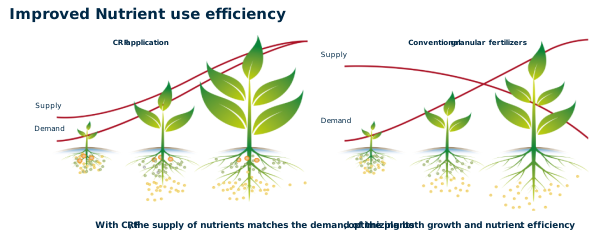
The graphic below clearly shows the advantage of using CRFs.
Agronomic Implications of CRFs
As controlled‑release fertilizers (CRFs) provide nutrients exactly when the crops need them, the nutrient‑use efficiency is improved and losses through leaching or volatilization are reduced. Thanks to their engineered release, CRFs require fewer applications and maintain reliable performance even in challenging conditions such as sandy soils or periods of high rainfall or drought.
What is the Environmental Impact of CRFs
Controlled‑release fertilizers (CRFs) bring several clear advantages for the environment:
- improving nutrient use efficiency (NUE) by up to 80% thanks to the temperature-controlled nutrient release,
- reducing the environmental impact by reducing nutrient losses by up to 50%,
- delivering higher or similar yields with lower fertilizer application rates
- reducing the number of fertilizer applications required, thanks to the coating managing the timing of delivery, rather than having to rely on multiple passes through the field, reducing time and fuel consumption.
CRF vs SRF Comparison Table
| Feature | Controlled Release (CRF) | Slow Release (SRF) |
|---|---|---|
| Release mechanism | Nutrient diffusion based on soil temperature | Chemical/microbial breakdown |
| Predictability | High | Medium–low |
| Release curve | Controlled | Irregular |
| Environmental dependency | Targeted | High |
| Nutrient use efficiency | High | Non predictable |
| Best for | Variable growth conditions | Stable growth conditions |



Related Crops


-
 An Introduction to Controlled-Release Fertilizers
- How Controlled-Release Fertilizers Help Reduce Nitrogen Losses
- Is there a Connection Between Controlled Release Fertilizers and Soil Health?
- Webinar: Enhanced Nutrient Use Efficiency with Controlled Release Fertilizers: a Solution for European Agriculture
- It’s a Coating Matter: Controlled-Release Fertilizers in Agriculture
