Whatsapp
  X
X  Mail
Mail  Copy link
 How Can EEFs Improve Nutrient Use and Reduce Losses?

On this page:
Enhanced efficiency fertilizers (EEFs) help crops use nutrients more effectively while reducing environmental losses. By combining technologies such as controlled-release fertilizers (CRFs), stabilized nitrogen, and biodegradable innovations, growers can improve nutrient uptake, reduce emissions, and maintain or increase yields, especially under increasing regulatory pressure.
Enhanced efficiency fertilizers are becoming an essential tool for modern agriculture. As growers face the dual challenge of improving productivity while reducing environmental impact, traditional fertilization approaches are no longer sufficient on their own. New technologies are enabling a more precise and efficient use of nutrients, helping to align crop demand with nutrient supply, while minimizing losses and supporting long-term soil and environmental health.
Why Is Nitrogen Use Efficiency Still a Major Challenge in Agriculture?
Nitrogen is essential for crop growth, yet it remains one of the least efficiently used nutrients in modern agriculture. Typically, only 40–60% of applied nitrogen is taken up by crops. The remainder is lost through volatilization, leaching, run-off, and denitrification.
These losses are not only costly for growers but also contribute significantly to environmental issues, including greenhouse gas emissions and water contamination.
At the same time, agriculture is under increasing pressure to produce more with fewer inputs. Regulatory frameworks, particularly in Europe, are targeting substantial reductions in nutrient losses and emissions, without lowering yield expectations.
As Ronald Clemens, Global Portfolio Manager at ICL, explains:
“ICL’s approach is to make nutrients work harder, aligning nutrient release with crop demand, improving uptake inside the plant, and reducing losses to air, soil and water.”
What Are Enhanced Efficiency Fertilizers (EEFs)?
Enhanced efficiency fertilizers are designed to improve nutrient availability to crops while minimizing losses to the environment. Rather than relying on a single solution, they are best used as part of a broader nutrient management strategy.
EEF technologies generally fall into two main categories:
- Stabilized fertilizers, which slow nitrogen transformations in the soil using inhibitors
- Controlled-release fertilizers (CRFs), which regulate nutrient release through physical coatings
Each addresses different types of nutrient loss, making them complementary rather than interchangeable.
Why Is a ‘Toolbox Approach’ Important for Nutrient Management?
No single fertilizer technology can address all agronomic conditions. Soil type, crop species, climate, and management practices all influence nutrient dynamics.
For this reason, a ‘toolbox approach’, combining multiple EEF technologies, is often the most effective strategy.
Stabilized fertilizers reduce rapid nitrogen conversion, helping to limit volatilization and leaching. CRFs, by contrast, provide a more predictable nutrient release pattern, aligning closely with crop demand over time.
“There is no single solution,” says Ronald Clemens. “But by using the right tools, in the right place, at the right time, nutrients can work harder, for crops, for farmers, and for the environment.”
How Do Controlled-Release Fertilizers Improve Nutrient Efficiency?
Controlled-release fertilizers physically encapsulate nutrients within a coating that regulates their release. Moisture penetrates the coating, dissolves the nutrients, and allows them to diffuse gradually into the soil.
This mechanism offers several key advantages:
- Improved synchronization between nutrient release and crop uptake
- Reduced nitrogen losses across multiple pathways
- Fewer applications required during the growing season
“By using a membrane around the granule, you can clearly improve efficiency,” Ronald explains. “Nutrients that the crop cannot take up are not lost to the environment.”
CRFs are particularly well suited to crops with longer growing cycles, such as maize, rice, potatoes, onions, and forestry systems.
Research consistently supports the performance of controlled release fertilizers, showing that CRFs can reduce nitrogen losses significantly, by up to 80% in some cases, while maintaining or improving yields across a wide range of crops.
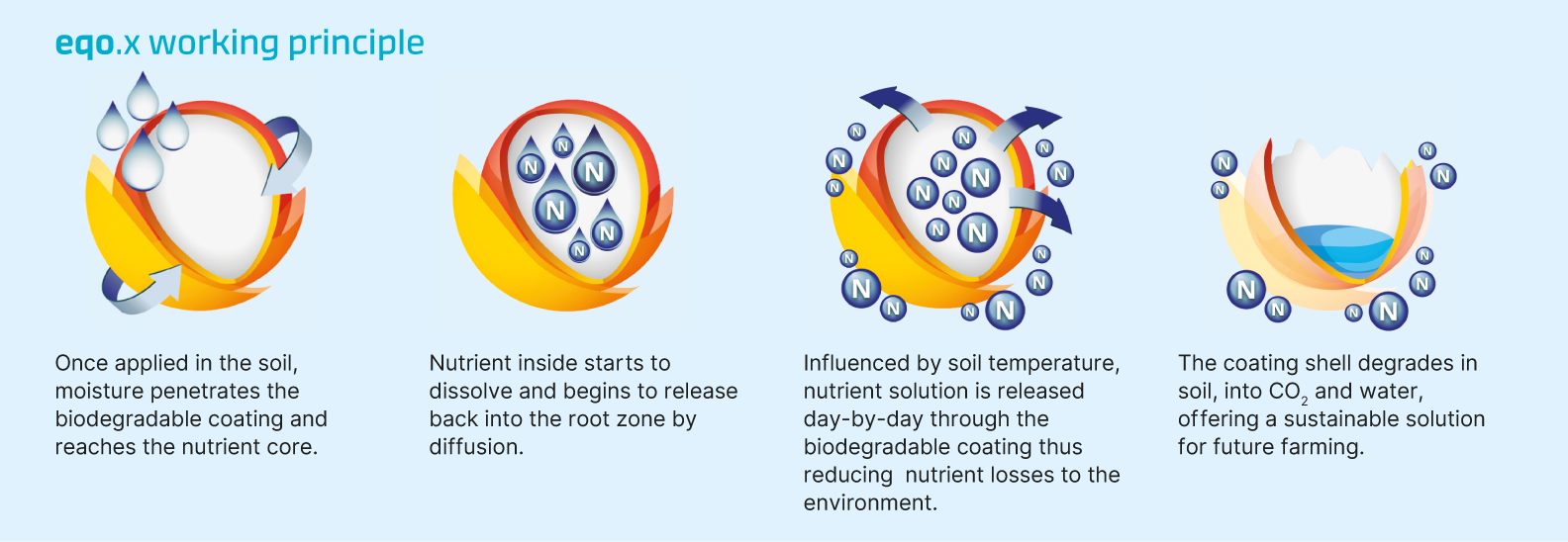
How do eqo.x Controlled Release Fertilizers Work?
How Are Biodegradable Coatings Changing Fertilizer Technology?
Sustainability requirements are now shaping the next generation of fertilizer technologies. Upcoming European regulations will require controlled-release coatings to be biodegradable in soil and water.
In response, new coating technologies are being developed to meet these standards without compromising performance.
ICL’s eqo.x Release Technology represents an important step forward. It combines controlled nutrient release with biodegradable materials designed to break down naturally, and completely, after use.
“Once certified, these coatings set a new benchmark for sustainable nutrient delivery, and eqo.x is the first to achieve this in the EU” says Ronald Clemens.
Can Enhanced Efficiency Fertilizers Help Reduce Carbon Emissions?
Improving nutrient efficiency has a direct impact on agricultural emissions.
By reducing nitrogen losses and minimizing the need for repeated applications, EEFs can significantly lower greenhouse gas emissions related to fertilizer use.
Field data shows that:
- Nitrogen leaching can be reduced by up to 55%
- Emissions per kilogram of grain can decrease substantially
- Measurable reductions in CO₂-equivalent emissions can be achieved across different cropping systems
As carbon accounting becomes more integrated into agricultural supply chains, these reductions are increasingly relevant for both compliance and potential financial incentives.
What Innovations Are Improving Micronutrient Efficiency?
Innovation in fertilizer technology is extending beyond macronutrients.
Traditional chelates, which bond with micronutrients to keep them available to the plants, are effective but often persistent in the environment. In many cases, only a small proportion of the product contributes directly to plant nutrition.
New biodegradable chelate technologies are addressing these limitations. Based on peptide structures and organic acids, they act not only as nutrient carriers but also as biostimulants.
These innovations can:
- Accelerate nutrient uptake within the plant
- Improve nutrient mobility and remobilization
- Enhance plant resilience to stress
Advanced imaging techniques have shown that micronutrient uptake can occur significantly faster with these new formulations, supporting more responsive and efficient crop nutrition.
Moving Toward More Efficient and Sustainable Fertilization
Fertilization is evolving from a focus on application rates to a broader, more integrated approach that considers plant physiology, soil biology, and environmental impact.
Enhanced efficiency fertilizers are here to support this transition. By combining technologies and tailoring strategies to specific conditions, growers can improve nutrient use efficiency while meeting both productivity and sustainability goals.
As Ronald Clemens summarizes:
“Fertilization is no longer just about feeding the soil per applied kilograms, it is about managing plant physiology, soil biology and environmental impact.”