Whatsapp
  X
X  Mail
Mail  Copy link
 How Can We Minimize Nutrient Leaching in Asparagus Production?
How controlled-release fertilization reduces leaching and improves nutrient efficiency in asparagus
On this page:
Controlled-release fertilizers (CRFs), such as Agromaster®, can help asparagus growers reduce application rates by up to 30% while minimizing nutrient leaching. By aligning nutrient release with crop demand, this approach improves efficiency while supporting soil and water protection.
Asparagus growers often face a persistent challenge: high nutrient losses, particularly in light, sandy soils where nutrient retention is limited. This can lead to inefficient fertilizer use, rising input costs, and increased environmental pressure.
Asparagus is a unique permanent crop, typically cultivated in soils with low nutrient-holding capacity. In major production regions such as Germany, where asparagus covers more than 22,000 hectares, managing nitrogen losses and mineral leaching is a key concern for both productivity and regulatory compliance. The combination of shallow root systems, seasonal nutrient demand, and porous soil conditions makes asparagus especially vulnerable to nutrient loss.
What Are the Challenges of Using Conventional Fertilizers in Asparagus Soils?
The main challenge faced when using conventional fertilizers is that they provide immediate nutrient availability. While this can be useful in many contexts, in asparagus production the nutrients can be released too quickly, resulting in losses before the crop can absorb them.
In sandy soils with low retention capacity, mobile nutrients such as nitrate and sulfate are particularly prone to leaching. Rainfall or irrigation can rapidly move these nutrients beyond the root zone, reducing nutrient availability during critical growth stages. In some cases, this leads to “luxury consumption,” but more often it results in wasted inputs and reduced nutrient use efficiency.
These losses also create environmental challenges. Nutrient leaching into groundwater can contribute to regulatory non-compliance, particularly under frameworks such as the European Water Framework Directive. As a result, growers must balance productivity goals with increasing environmental requirements.
How Does Controlled-Release Technology Improve Nutrient Efficiency?
Controlled-release fertilizers improve nutrient efficiency by releasing nutrients gradually, in line with crop demand rather than all at once.
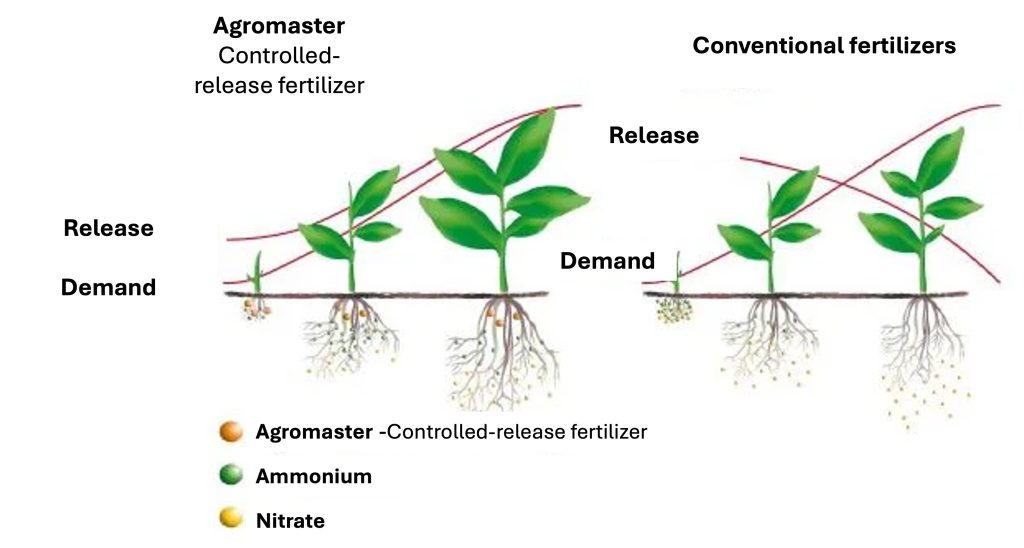
Controlled-release nutrition vs. conventional fertilization: Agromaster® synchronizes nutrient release with plant demand, improving uptake efficiency and reducing losses throughout the growth cycle.
This is achieved by wrapping nutrients with a coating that regulates nutrient release based on soil temperature. Products such as Agromaster® provide a steady supply of nitrogen, phosphorus, and potassium throughout the growing period, better matching the crop’s uptake pattern.
By synchronizing nutrient availability with plant demand, growers can significantly reduce nutrient losses. This improved efficiency allows total application rates to be reduced, often by up to 30% compared to conventional mineral fertilization, without compromising crop performance.
In perennial crops like asparagus, where nutrient management affects both current yield and future productivity, this consistency is particularly valuable.
Can Nutrient Leaching Be Reduced Without Harming Soil Biology?
Yes, nutrient leaching can be reduced without negatively affecting soil biology by using physical nutrient release mechanisms rather than chemical inhibitors.
Some conventional slow-release strategies rely on nitrification or urease inhibitors to delay nitrogen transformations in the soil. While effective in certain conditions, these approaches can influence microbial activity.
In contrast, controlled-release fertilizers based on physical coating technology regulate nutrient availability without altering soil chemistry. This creates a more stable soil environment, supporting microbial processes that contribute to nutrient cycling and long-term soil health.
For asparagus growers, this means it is possible to improve nutrient efficiency while maintaining a biologically active and productive soil system.
What Role Do Secondary Nutrients Play in Asparagus Quality?
Secondary nutrients play a critical role in asparagus quality, particularly in long-term plantations where nutrient balance affects both yield and crop longevity.
Magnesium (Mg) is essential for photosynthesis and supports carbohydrate production and storage in the crown. These reserves are vital for spear development in the following season. Sulfur (S), meanwhile, contributes to protein synthesis and overall plant metabolism.
Deficiencies in these nutrients may not always be immediately visible but can reduce spear quality, uniformity, and long-term productivity. Ensuring a balanced secondary nutrient supply, alongside nitrogen, phosphorus, and potassium, is therefore essential.
Integrating secondary nutrients into an efficient fertilization strategy helps maintain healthy crowns and supports consistent yields over multiple growing cycles.
How Can Fertilization Strategies Improve Operational Efficiency?
Fertilization strategies can significantly improve operational efficiency by reducing the number of field applications and optimizing timing.
Using a single-application controlled-release fertilizer allows growers to shift fertilization to lower-workload periods. It also reduces the need for multiple passes through the field, saving time, labor, and fuel.
Fewer field operations also help limit soil compaction between rows, an important consideration in perennial cropping systems where soil structure must be preserved for many years.
For asparagus growers managing tight seasonal windows, these operational benefits can be just as valuable as the agronomic gains.
What Are the Practical Steps to Reduce Nutrient Losses in Asparagus?
To improve nutrient efficiency and reduce environmental losses, asparagus growers can take several practical steps:
- Assess soil type: Prioritize coated fertilizers in sandy, low-retention soils to reduce nutrient leaching risk.
- Match nutrient release to crop demand: Select a controlled-release fertilizer with a longevity that aligns with local climate conditions and the asparagus growth cycle.
- Ensure balanced nutrition: Include adequate magnesium and sulfur to support crown development and next season’s spear production.
- Work with local expertise: Collaborate with technical advisors to fine-tune application rates and ensure compliance with environmental regulations while maintaining high yields.
Supporting Long-Term Efficiency in Asparagus Production
Improving nutrient efficiency in asparagus is not only about maximizing yield, it is also about protecting soil and water resources while maintaining long-term productivity.
By aligning nutrient release with crop demand, controlled-release fertilizers help reduce losses, improve input efficiency, and support more sustainable production systems. For growers working in light soils or under regulatory pressure, this approach offers a practical way to balance performance with environmental responsibility.

Related crops