


 Whatsapp
  X
X  Mail
Mail  Copy link
 The Nitrogen:Sulfur Ratio in Plant Nutrition: Why It Matters for Crop Performance
Balanced plant nutrition is about more than simply supplying nutrients. Crops require the right balance between nutrients to achieve optimal growth, yield, and quality. One of the most important nutrient interactions in crop production is the relationship between nitrogen (N) and sulfur (S).

On this page:
Nitrogen is widely recognized as the key driver of plant growth, but its effectiveness depends strongly on sulfur availability. Without sufficient sulfur, crops cannot efficiently convert nitrogen into proteins and enzymes. As a result, the nitrogen-to-sulfur ratio (N:S ratio) has become an important indicator of balanced crop nutrition and fertilizer efficiency.
Managing this ratio effectively helps growers improve nitrogen use efficiency, crop yield, and crop quality.
The Biochemical Relationship Between Nitrogen and Sulfur
Nitrogen and sulfur work closely together in plant metabolism.
Nitrogen is a primary component of:
- Amino acids
- Proteins
- Chlorophyll
- Enzymes
Sulfur is required to form essential sulfur-containing amino acids such as:
- cysteine
- methionine
These amino acids are necessary for protein synthesis, meaning nitrogen cannot be fully utilized without adequate sulfur.
Because of this close biochemical relationship, plants tend to absorb nitrogen and sulfur in relatively consistent proportions. For many crops, the optimal N:S ratio in plant tissue ranges between 10:1 and 15:1. More specifically, for cereals, the ideal ratio is 12:1.
When the ratio becomes wider than this range, it often indicates sulfur deficiency, even when nitrogen supply is high.
Why the Nitrogen:Sulfur Ratio Is Increasingly Important
In modern agriculture, sulfur deficiencies are becoming more common. Several factors contribute to this trend:
- Reduced atmospheric sulfur deposition
- Higher crop yields removing more nutrients from the soil
- Fertilization programs focusing mainly on nitrogen
- Leaching losses in lighter soils
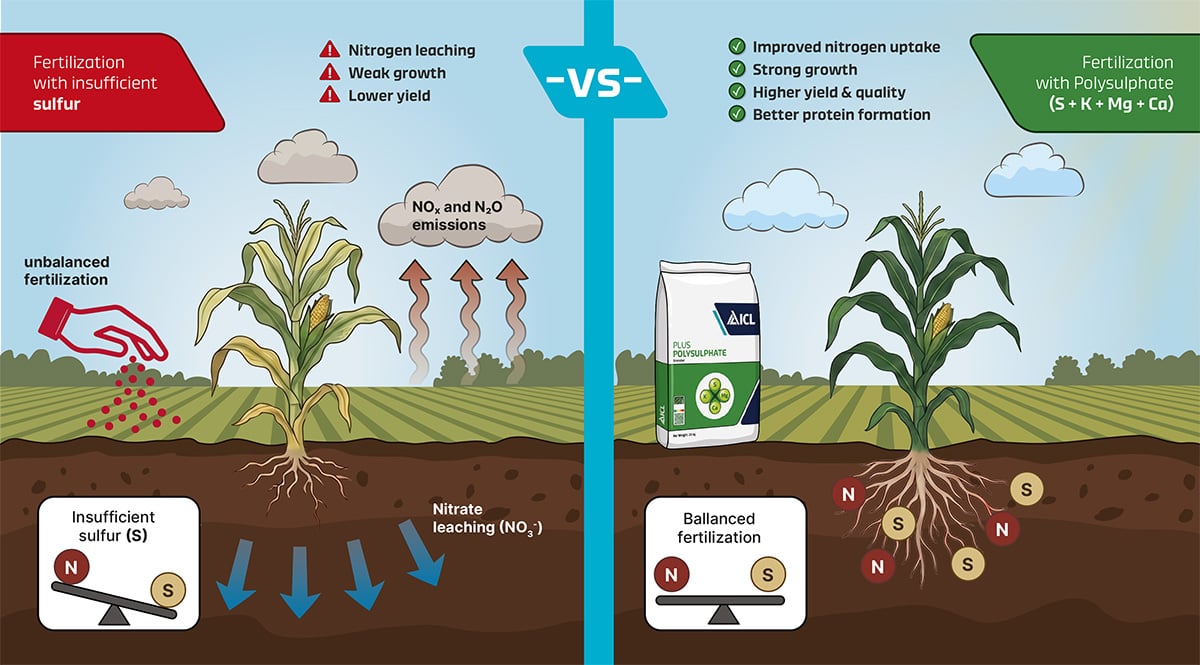
When sulfur availability is limited, plants cannot effectively metabolize nitrogen. This leads to:
- Reduced nitrogen use efficiency
- Lower protein synthesis
- Reduced yield potential
- Declining crop quality
Maintaining the proper N:S balance ensures that applied nitrogen fertilizers deliver their full agronomic value.
Symptoms of Sulfur Imbalance in Crops
Sulfur deficiency can sometimes be mistaken for nitrogen deficiency, but there are key differences.
Typical sulfur deficiency symptoms include:
- Yellowing of young leaves (nitrogen deficiency usually affects older leaves first)
- Reduced plant growth
- Lower protein content in grains
- Poor crop quality
Plant tissue analysis is often used to diagnose sulfur status. An N:S ratio higher than approximately 16:1 frequently indicates sulfur deficiency in many crops.
How Polysulphate Helps Balance the N:S Ratio
A reliable sulfur supply is essential to maintain the correct nitrogen-to-sulfur ratio. One effective solution is the use of multi-nutrient fertilizers that provide sulfur in plant-available form, such as Polysulphate.
Polysulphate is a natural mineral fertilizer derived from polyhalite and provides four essential nutrients in sulfate form:
- Sulfur (S)
- Potassium (K)
- Magnesium (Mg)
- Calcium (Ca)
This unique nutrient combination supports balanced crop nutrition while supplying sulfur required for efficient nitrogen metabolism.
Typical nutrient composition includes:
- 48% SO₃ (sulfur)
- 14% K₂O (potassium)
- 6% MgO (magnesium)
- 17% CaO (calcium)
Because all nutrients are in sulfate form, they are available for plant uptake.
Sustained Nutrient Release for Season-Long Nutrition
Another important advantage of Polysulphate is its gradual nutrient release.
Unlike highly soluble fertilizers that release nutrients quickly, Polysulphate dissolves naturally over time. This provides:
- A steady supply of sulfur throughout the growing season
- Reduced nutrient losses
- Improved nutrient availability during key crop growth stages
This steady release aligns well with crop nutrient demand and supports more efficient nutrient uptake.
Improving Nitrogen Use Efficiency with Polysulphate
Sulfur supplied gradually through Polysulphate enables plants to convert nitrogen into proteins more efficiently.
This leads to several agronomic benefits:
- Improved nitrogen use efficiency
- Better protein formation in crops
- Higher yield potential
- Improved crop quality
Field trials have shown that applying Polysulphate alongside nitrogen fertilizers can significantly improve the N:S ratio in crops, helping restore optimal nutrient balance.
Supporting Sustainable Fertilization
Modern agriculture increasingly focuses on improving nutrient use efficiency while reducing environmental impact.
Polysulphate contributes to this goal because:
- It improves nitrogen efficiency
- It provides multiple nutrients in a single application
- It is a naturally occurring mineral with minimal processing
- It has a low carbon footprint compared to many fertilizers
For growers, this means improved productivity with more sustainable nutrient management.
Conclusion
The nitrogen-to-sulfur ratio plays a critical role in crop nutrition. When sulfur is insufficient, nitrogen cannot be efficiently converted into plant proteins, reducing crop performance and fertilizer efficiency.
Ensuring a balanced N:S ratio is therefore essential for maximizing yield, improving crop quality, and optimizing nutrient use efficiency.
By supplying sulfur together with potassium, magnesium, and calcium, Polysulphate provides an effective solution for maintaining balanced plant nutrition and supporting high-performing cropping systems.

Related Crops


-
 Challenges and Role of Polysulphate Fertilizer in Acidic Soils
 - 7 Reasons Polysulphate® Is the Perfect Sulfur Fertilizer for Fall
- Go Beyond NPK: The Polysulphate Advantage for Potato Quality and Yield
- Boulby Mine: Producing Polyhalite for Sustainable Agriculture
- Getting More Out of Your MOP with Polysulphate® in Row Crop Systems
- Boosting Brassicas with Polysulphate®
