


 Whatsapp
  X
X  Mail
Mail  Copy link
 The Role of Micronutrients in Paddy Rice Cultivation
In this series, Dr. Shin Hidaka explores rice cultivation in Japan, from its cultural roots to modern sustainable practices. Each post highlights a key aspect, offering clear insights into the cultivation of one of the world’s most important crops.

On this page:
Why Are Micronutrients Important for Rice?
Micronutrients, though required in small amounts, play an essential role in the growth and productivity of rice. Elements such as manganese, iron, boron, zinc, and molybdenum support key physiological processes including photosynthesis, enzyme activation, cell wall formation, and grain development. When these nutrients are deficient or imbalanced, rice plants show clear symptoms that can reduce yield and quality. Understanding their functions and managing their availability in paddy soils is therefore a critical part of sustainable rice cultivation.
Manganese (Mn)
What role does manganese play in rice?
Manganese is one of the essential micronutrients for paddy rice. Under flooded conditions, manganese is dissolved in the soil solution in its divalent form (Mn²⁺) and absorbed by the roots as Mn²⁺ ions. It is transported to the leaves via transpiration and is primarily found in the chloroplasts.
As a transition metal, manganese plays a vital role in physiological functions such as oxygen evolution during photosynthesis and the activation of various enzymes. It is an essential component of the electron transport system, making it critical for plant metabolism.
What happens when manganese is deficient?
Generally, under typical paddy field conditions, manganese becomes available, and deficiency is rare. However, in aging paddy fields or sandy soils, manganese can leach out easily, leading to an absolute shortage of plant-available manganese in the topsoil. Fields with easily reducible manganese levels below 10 ppm (optimal levels are 50–80 ppm or more) are considered to have low manganese supply capacity.
Deficiencies in potassium, silica, manganese, and magnesium during the mid to late stages of rice growth can trigger the Brown Spot disease (caused by filamentous fungi). This disease is frequently observed in sandy soils where fertilizers are prone to leaching or in so called Akiochi (i.e. late-season deterioration) stage of paddy fields where root rot is common.
Iron (Fe)
Why is iron important for rice?
Compared to other crops, paddy rice has a relatively high demand for iron and will actively absorb it when concentrations are low. Within the plant, iron exists mainly as Fe²⁺, some of which binds with specific proteins to form iron-protein complexes.
While iron is not a structural component of chlorophyll, it participates in redox reactions in both Fe²⁺ and Fe³⁺ states and is critical in:
- The electron transport system of photosynthesis
- Energy metabolism
- Activation of various enzymes
In flooded soils, free ferric oxide (Fe oxides) also plays an important role by protecting roots from toxic substances like hydrogen sulfide and organic acids, helping to prevent root rot.
How do rice plants absorb iron?
In soil, iron exists in two oxidation states: ferrous iron (Fe²⁺) and ferric iron (Fe³⁺). In aerobic soils, most of the iron is present as poorly soluble Fe³⁺. However, under flooded (anaerobic) conditions, Fe³⁺ is reduced to Fe²⁺, which is more soluble and readily absorbed by rice plants.
In general, paddy fields under flooded conditions have significantly high concentrations of Fe²⁺ in the soil solution. To prevent excessive uptake, rice roots possess an iron exclusion mechanism that suppresses iron absorption.
What are the risks of excess iron?
In fields with poor drainage, excess iron can lead to iron toxicity (known as Akagare, or “red leaf disease”), which manifests as reddish-brown spots on leaves and withering from the tips and edges.
One effective countermeasure is the use of potassium fertilizers, which enhance the root’s ability to exclude iron and thereby alleviate the symptoms.
What happens when iron is deficient?
When soil pH is high, iron precipitates as ferric hydroxide (Fe(OH)₃), a poorly soluble form, reducing iron availability to plants. Additionally, excess levels of heavy metals such as copper (Cu), manganese (Mn), and zinc (Zn) can trigger iron deficiency (chlorosis) due to antagonistic interactions, characterized by yellowing or whitening of young leaves and localized brown spotting.
In aging paddy fields or sandy soils, free iron oxides tend to leach into the subsoil, lowering iron levels in the topsoil. Ideally, the content of free iron oxide in paddy soil should be at least 0.8%. In iron-deficient fields, applying iron-rich materials such as converter slag (200 kg/10a) helps maintain root vigor and can improve rice yields.
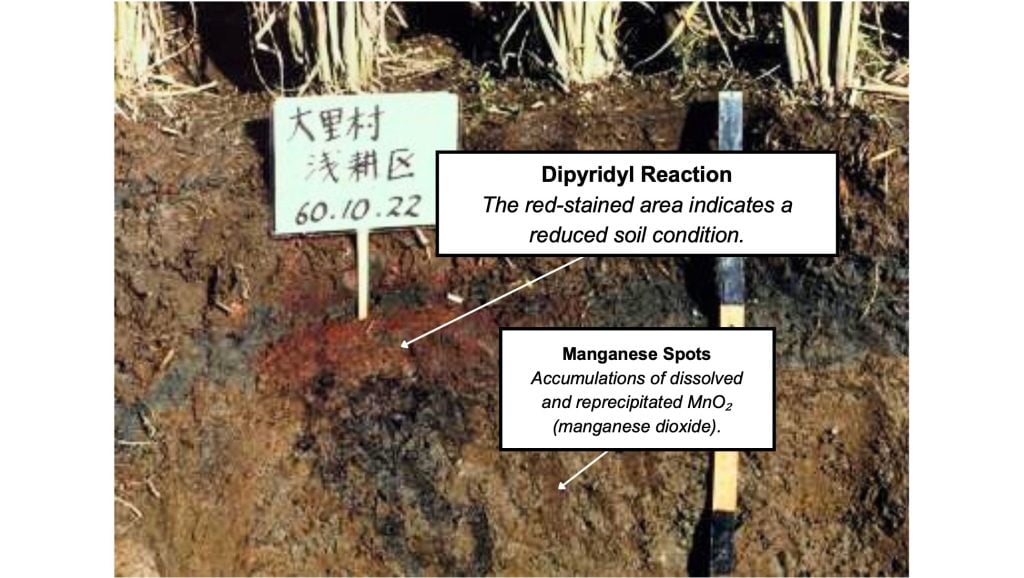
Leaching of Iron and Manganese into Subsoil in Paddy Fields.Photos courtesy of Dr. Shin Hidaka (Japan)
Zinc (Zn)
Why does rice need zinc?
Zinc is essential for protein synthesis and the production of plant growth hormones, particularly auxin. It supports stem elongation, tillering, and overall plant vigor.
How do rice plants absorb zinc?
Rice absorbs zinc primarily as divalent Zn²⁺ ions, though in high-pH soils, it may also be taken up as ZnOH⁺. Once absorbed, free zinc is transported through the xylem to growing tissues in stems and leaves, where it binds with proteins to form complexes.
How available is zinc in different soils?
In soil, zinc exists as crystalline compounds in soil minerals, in organic forms bound to plant residues and humic substances, and as exchangeable or water-soluble forms on clay particle surfaces. However, a significant portion is present as insoluble forms such as zinc sulfide (ZnS), zinc hydroxide (Zn(OH)₂), or zinc carbonate (ZnCO₃).
The availability of zinc in soil is influenced by several factors. Zinc is more soluble in acidic soils, while it becomes unavailable in neutral to alkaline conditions. Excessive phosphate application can form insoluble zinc compounds, and adsorption by oxides of iron, aluminum, or manganese suppresses plant absorption.
Field conditions also matter: in reclaimed or lowland paddies, reduced environments can lead to the formation of zinc sulfide, resulting in deficiency. Certain soil types, such as serpentine or peridotite‑derived Paleozoic soils, are naturally zinc‑deficient and therefore more prone to shortages. Also acid sulfate soils are particularly prone to zinc deficiency due to inherently low zinc content.
What happens when zinc is deficient?
Rice is highly sensitive to zinc deficiency, and symptoms can occur when soil zinc concentrations fall below 15 mg/kg. They include:
- Shortened stems and leaf blades
- Reduced tillering
- Weak growth and lodging
- Increased number of sterile grains
- a type of bronzing disorder cause by physiological stress (known in Japan as Akagare)
Can zinc levels become excessive?
Industrial pollution or mining runoff can lead to zinc toxicity. Symptoms include chlorosis on young leaves and root damages in the form of excessive branching or “lion tail” root malformation.
How efficiently manage zinc nutrition?
Surface application of zinc sulfate is an effective emergency measure in deficient fields. Long‑term management involves monitoring soil pH, avoiding excessive phosphate, and maintaining organic matter to support zinc availability.
Molybdenum (Mo)
Why is molybdenum important for rice?
Among all essential elements, molybdenum has the lowest required quantity in plants, however it plays a crucial role in nitrate assimilation. It is a component of nitrate reductase, the enzyme that helps convert nitrate into usable forms for plant growth. It is also involved in phosphate metabolism, photosynthesis, and respiration.
How is molybdenum present in soils?
Molybdenum occurs naturally in minerals such as molybdenite (MoS₂) and in oxidized forms like poorly soluble molybdenum trioxide (MoO₃). In general, molybdenum has low solubility, and its concentration in soil ranges from 0.1 to 6.0 mg/kg, varying greatly depending on soil type.
Its availability is highly dependent on soil pH: at pH 5–6 and above, it dissolves as the molybdate ion (MoO₄²⁻) and becomes more water-soluble, below that, it exists as HMoO₄⁻, often adsorbed by iron (Fe) and aluminum (Al) oxides or bound to organic matter. In more strongly acidic soils, it becomes unavailable as molecular molybdic acid (H₂MoO₄). Thus, deficiency tends to occur in acidic soils, while toxicity may occur in alkaline soils.
What happens when molybdenum is deficient?
Deficiency is most likely in strongly acidic soils. Rice plants may accumulate nitrate in their tissues and show reduced photosynthetic activity. In general, deficiency symptoms appear when molybdenum levels fall below 0.1 ppm. In rice straw, molybdenum levels are typically low, ranging from 0.2 to 0.7 ppm in most cases.
Boron (B)
Why does rice need boron?
Boron supports the structural integrity of cell walls and plays a role in transporting sugars produced during photosynthesis. It is especially important for reproductive growth, helping pollen tubes elongate and ensuring proper grain set. Boron is absorbed by plants in the form of BO₃³⁻ and transported via transpiration to the stems and leaves.
How is boron present in soils?
In soil, boron exists as boric acid (H₃BO₃) bonded with oxygen, or as its salts. In the soil solution, it appears either as molecular boric acid or as the B(OH)₄⁻ ion. The form of boron depends on soil pH. In acidic soils (pH < 7), H₃BO₃ predominates and is considered to be the plant-available boron. In neutral to alkaline soils (pH ≥ 7), H₃BO₃ concentrations decrease, and B(OH)₄⁻ becomes more prevalent.
What happens when boron is deficient?
Although rice has a relatively low demand for boron and deficiencies are rare, high-pH soils reduce the availability of plant-available boron, making deficiency more likely.
Boron deficiency affects actively dividing tissues. In rice, typical symptoms include:
- Stunted early growth
- Reduced number of panicles and grains per panicle
- Increase in sterile grains (empty husks)
- Poor heading due to inhibited pollen tube elongation
The optimal range of plant-available boron (hot-water-extractable) in soils is narrow, between 0.5 and 1.0 mg/kg. Deficiency often occurs when plant‑available boron falls below 0.3 mg/kg, especially in sandy or sandy loam soils with low cation exchange capacity or poor humus content.
Can boron become excessive?
Excess boron can cause toxicity, with symptoms such as browning of leaf tips, white spots, and progressive leaf bleaching. Boron toxicity is more likely when plant‑available boron exceeds 1.0 mg/kg in general plants or water‑soluble boron exceeds 10 mg/kg in rice. Excess boron in rice is often caused by the overuse of boron-rich fertilizer and by contaminated wastewater from plating or paint industries.
Micronutrients in Akagare Disorder in Rice
The phenomenon known as Akagare (literally “red wilting”) was first described in Japanese rice research. It refers to a physiological disorder where rice plants show bronzing or reddish leaf symptoms, weakened growth, and poor grain filling.
Akagare is not a single disease but a collective name for stress conditions tied to soil environment and micronutrient imbalances. Japanese agronomists classified it into three main types, each linked to a specific nutrient factor.
Types of Akagare
Akagare type I – Iron toxicity
Occurs in poorly drained sandy soils, black mud soils, or acid sulfate soils. Excess soluble iron is absorbed by rice roots, leading to reddish‑brown leaf spots and decline. Also known as „bronzing“.
Akagare type II – Zinc deficiency
Triggered by an absolute shortage of zinc, often in high‑pH soils or under poor drainage. Symptoms include bronzing, shortened stems, reduced tillering, and weak growth.
Akagare type III – Iodine excess
Seen in reclaimed paddy fields where decomposition of organic matter under reducing conditions leads to excessive absorption of soluble iodide. Plants show stress symptoms and abnormal bronzing.
The classification of Akagare highlights how micronutrient imbalances, whether excess iron, deficient zinc, or excess iodine, directly affect rice physiology.
Micronutrients in Rice: A Summarizing Table
| Micronutrient | Key Roles | Deficiency Symptoms | Risk Conditions (Deficiency or Excess) |
|---|---|---|---|
| Manganese (Mn) | Oxygen evolution in photosynthesis; enzyme activation; electron transport; concentrated in chloroplasts. | Rare under flooded conditions; in low‑Mn soils: shortage of available Mn, contribution to Brown Spot disease. | Deficiency: aging paddy fields, sandy soils, low reducible Mn (<10 ppm). Excess issues: not highlighted. |
| Iron (Fe) | Redox reactions; photosynthetic electron transport; energy metabolism; enzyme activation; Fe oxides protect roots from toxins. | Chlorosis (yellowing/whitening of young leaves), brown spotting; reduced vigor. | Deficiency: high pH soils (Fe(OH)₃ formation), antagonism from excess Cu/Mn/Zn, sandy/aging fields with low Fe oxides (<0.8%). Excess: poor drainage → iron toxicity (Akagare type I). |
| Zinc (Zn) | Protein synthesis; auxin production; stem elongation; tillering; vigor. | Short stems, reduced tillering, weak growth, lodging, sterile grains, bronzing (Akagare type II). | Deficiency: high‑pH soils, excessive phosphate, adsorption by Fe/Al/Mn oxides, reduced soils forming ZnS, serpentine/peridotite soils, acid sulfate soils. Excess: industrial pollution → chlorosis, root malformation (“lion tail”). |
| Molybdenum (Mo) | Nitrate assimilation (nitrate reductase); phosphate metabolism; photosynthesis; respiration. | Nitrate accumulation in tissues; reduced photosynthesis. | Deficiency: strongly acidic soils (Mo becomes unavailable as H₂MoO₄). Excess: alkaline soils (higher solubility). |
| Boron (B) | Cell wall structure; sugar transport; pollen tube elongation; grain set. | Stunted early growth; fewer panicles; more sterile grains; poor heading. | Deficiency: high‑pH soils, sandy/sandy‑loam soils with low CEC or humus; plant‑available B <0.3 mg/kg. Excess: over‑application or contaminated wastewater → leaf tip browning, white spots, bleaching. |
Conclusion
Micronutrients, though needed only in small amounts, are vital for rice growth and yield. Japanese research has shown how imbalances can trigger disorders such as Akagare, emphasizing the importance of balanced soil management and careful fertilization. Sustaining nutrient equilibrium remains key to healthy plants and reliable harvests.
