Whatsapp
  X
X  Linkedin
  Mail
Mail  Copy link
 The Six Stages of Turf Stress
How turf responds under pressure, and why preventive support matters
On this page:
How turf responds as stress develops
Stresses exert a powerful influence on our turf, and they need to be managed properly.
Drought, heat, low light, poor growing conditions, maintenance and wear all apply pressure throughout the year. They can occur in isolation but more often combine to amplify their impact.
What determines surface quality is not whether stress occurs, but how turf responds as conditions begin to change. By the time a decline is visible on the surface, the plant has already started responding internally in ways that limit how well it can cope under play and how quickly it can recover.
Turf follows a predictable sequence of responses as pressure builds, often well before symptoms are visible. Once those internal processes shift towards conservation and survival, maintenance options begin to narrow, and management becomes reactive rather than planned.
Understanding the stages of turf stress explains why early, preventive support is more effective than trying to recover performance once turf is already struggling.
Stage 1: Early detection
Conditions begin to shift
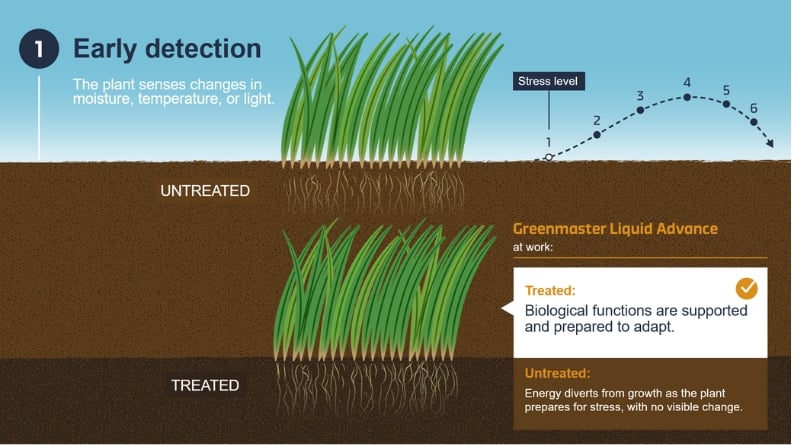
The first stage happens quietly. Turf begins to sense subtle changes such as insufficient nutrition, declining soil moisture, reduced light, rising temperatures or increasing wear. Internal signals activate, and the plant starts preparing to reduce its own internal energy demand.
At this point, the surfaces still look acceptable. With no visible symptoms, it is easy to assume no specific action is required.
Stage 1
Untreated
Where preventive support is not in place, these early signals trigger preparation for rapid slowdown. Photosynthetic activity is reduced, and growth begins to slow down in response to ongoing pressure. As a result, turf quality may begin to decline. This is why we need to precondition the turf against stress.
Treated
The Greenmaster Liquid Advance formulations have been specifically designed to precondition turf against the development of stress. They contain a balanced liquid nutrition package combined with MTU® and pidolic acid, working inside the plant to maintain energy production and nitrogen assimilation under stress. By supporting these core physiological processes before stress develops, turf is better able to maintain color, growth efficiency, and surface quality when challenged by excessive heat, drought, low light, or wear.
Where Greenmaster Liquid Advance has been applied ahead of stress, turf enters the stress phase in a more stable condition. Chlorophyll levels are maintained, nitrogen use remains efficient, and photosynthetic systems are better protected as conditions begin to change. Instead of reacting abruptly, the plant adjusts more gradually.
The result is a softer transition into stress, with early shutdown signals moderated rather than triggered sharply.
Stage 2: Early adjustment
Growth starts to slow
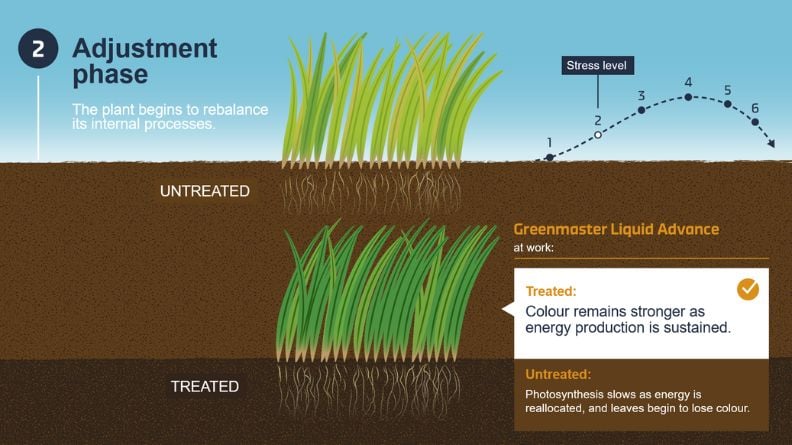
As stress levels increase, internal processes are adjusted. Photosynthesis efficiency is reduced, and growth naturally slows as part of a protective response. This is the point where the plant starts prioritizing efficiency over output.
Stage 2
Untreated
Where preventive support is not in place, this adjustment tends to be sharp. Energy production drops quickly, chlorophyll begins to break down, and carbohydrate reserves are drawn on early. Color loss often starts here, even if it is subtle, and growth levels quickly decline.
Treated
Where Greenmaster Liquid Advance has been applied ahead of the stress, the slowdown is more controlled. Energy production continues for longer, nutrient use remains more efficient, and the plant avoids an abrupt shift into conservation. Turf adjusts its pace rather than stalling.
The result is steadier growth and stronger color retention as stress continues to build.
Stage 3: Visible stress response
Defense systems activate
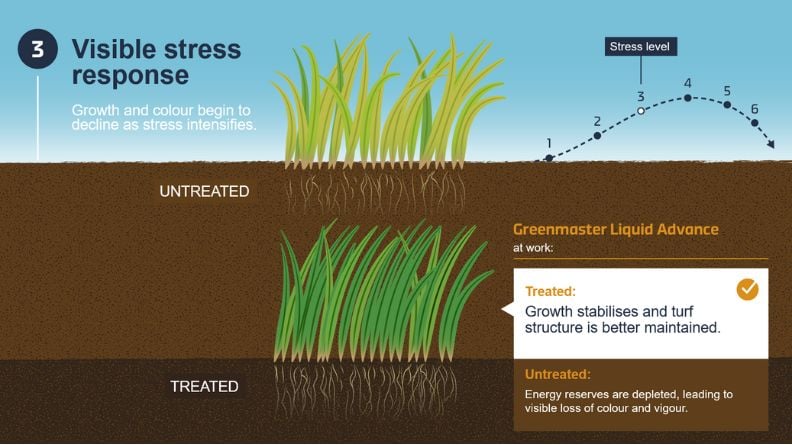
As stress persists, defense processes are activated to protect cells and maintain basic function. This stage places high demand on both energy and nitrogen, which are required to produce enzymes, proteins and other protective compounds.
Stage 3
Untreated
Where early support has not been in place, nitrogen uptake and use become less efficient just as the protective demand peaks. Energy reserves are depleted quickly, and visible symptoms such as dull color, wilting and reduced turf density begin to appear as the plant struggles to balance defense with basic functioning.
Treated
Where Greenmaster Liquid Advance has supported the plant preventively, defense responses remain effective without exhausting reserves. Photosynthesis continues at a functional level, allowing growth and repair processes to keep pace for longer under pressure.
As a result, stress symptoms develop more slowly, and turf retains structure, density and color deeper into challenging conditions.
Stage 4: Sustained stress
Pressure persists
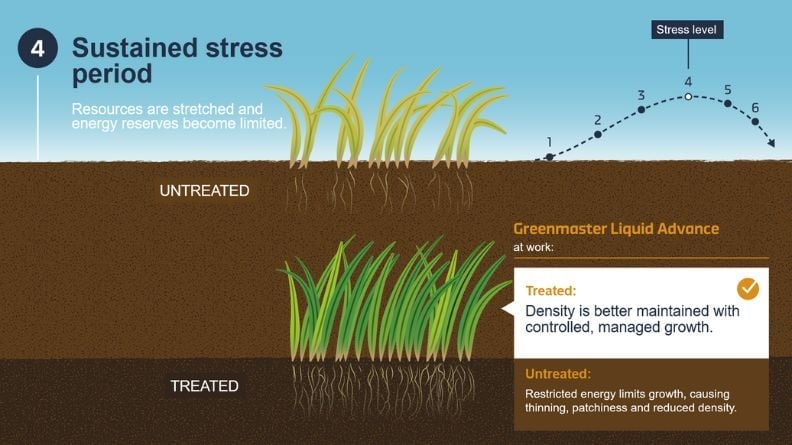
Under prolonged periods of stress, the turf response naturally shifts towards survival. Photosynthesis is suppressed, and growth becomes minimal as the plant conserves resources. Weaker plants will die.
Stage 4
Untreated
Where preventive support has not been maintained, carbohydrate and nitrogen reserves are progressively depleted. Thinning, patchiness and surface decline accelerate, often leaving little margin for recovery once conditions improve.
Treated
Where Greenmaster Liquid Advance has helped protect photosynthetic systems and nutrient efficiency, the depth of metabolic slowdown is reduced. Turf remains functional rather than exhausted, even as stress persists.
Performance still declines, but it does so gradually rather than collapsing under sustained pressure.
Stage 5: Recovery begins
Conditions improve
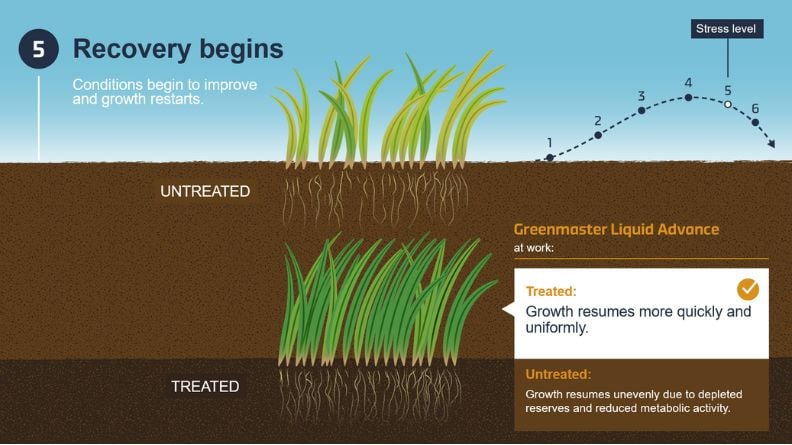
As conditions ease (moisture returns, temperatures ease or light levels improve), photosynthesis efficiency increases and the process of repairing damaged tissue begins. This is a critical transition point.
Stage 5
Untreated
Where preconditioning did not take place, recovery is often slow and uneven. Energy reserves are low, nutrient availability is limited, and the plant struggles to re-establish normal growth patterns.
Treated
Where Greenmaster Liquid Advance has supported the plant through stress, recovery can begin sooner. Photosynthetic systems restart more quickly, and available nutrients can be used immediately to drive regrowth and repair.
The result is a faster return of color and growth, with less visible hangover from the stress period.
Stage 6: Sustained recovery
Return to normal performance
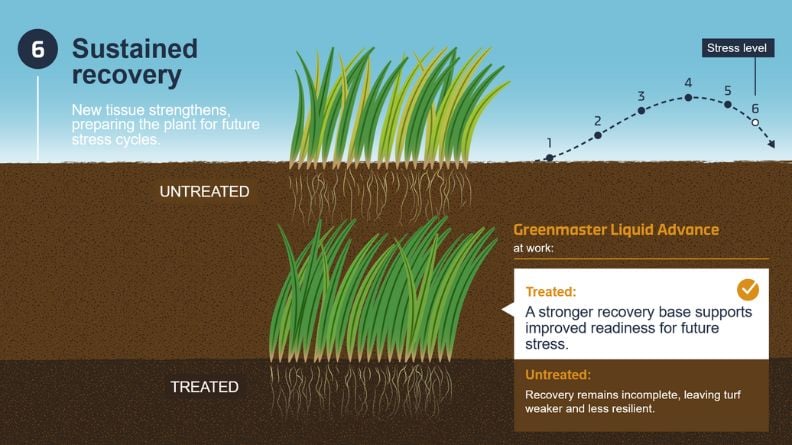
In the final stage after the period of stress, the turf then embarks on rebuilding reserves, restoring health and density and re-establishing normal growth patterns.
Stage 6
Untreated
Without a stress mitigation strategy in place, progress towards full recovery can be prolonged and uneven. Surfaces may also remain vulnerable to secondary stress or disease activity.
Treated
Where nutrient efficiency and photosynthetic performance have been maintained with Greenmaster Liquid Advance, recovery is cleaner and more controlled. Reserves are replenished without excessive growth, and surface quality stabilizes more quickly.
The outcome is a uniform, sustainable return to consistent performance.
What this means for turf management
Understanding how turf responds at each stage of stress requires managers to intervene earlier, before visible decline forces reactive decisions and limits recovery options.
Greenmaster Liquid Advance is designed for this preventive window. Applied ahead of stress, it combines readily available nutrition with MTU® and pidolic acid to support photosynthesis and nitrogen use as pressure develops.
Stress will always occur and its impact can be severe and long-lasting.
Greenmaster Liquid Advance changes how turf responds to it, helping you to manage turf stress more effectively.