Whatsapp
  X
X  Mail
Mail  Copy link
 ICL Open: Advancing Strategic Agricultural Innovation
Advancing global agriculture through partnerships that deliver next-generation fertilizers and precision farming solutions.
On this page:
ICL Open is reshaping how innovation happens across global agriculture. By connecting game-changing technology companies with ICL, a global leader with a century of agronomic expertise, the program accelerates the development of next-generation solutions that address today’s most urgent challenges, improving nutrient use efficiency, strengthening food security, and supporting the shift to more sustainable farming systems.
Through structured partnerships with startups, academic groups, and technology companies, ICL Open evaluates, adapts, and scales breakthrough concepts. This outside-in approach complements ICL’s internal R&D, helping promising ideas reach growers faster while reducing development risks and time-to-market.
A Structured Approach to Open Innovation
ICL Open works as an innovation pipeline that guides early-stage technologies from initial screening to market deployment. Each collaboration begins with understanding strategic fit, continues through rigorous proof-of-concept testing, and, if promising, moves to development within ICL business units. With 24 R&D centers worldwide and deep market access, the program offers agricultural innovators a pathway to reach global markets.
As ICL Open Innovation Lead Ziv Kohav explains, “We search for novel technologies and establish whether they fit us, or if they need some tailoring or adaptation. Then we implement exhaustive proof of concept collaborations, before moving on to further development stages.”
Strategic Innovation Domains with Direct Impact on Agriculture
Although ICL Open supports innovation across five domains, two areas, Next Generation Fertilizers and Digital Agriculture, are central to advancing sustainable crop production.
Next Generation Fertilizers
This domain focuses on improving nutrient use efficiency (NUE), reducing environmental impact, and helping growers produce more with fewer resources. Priority areas include:
- Enhanced Efficiency Fertilizers (EEF) and biostimulants that improve nutrient uptake and support plant resilience.
- Nitrogen fixation technologies to reduce dependence on traditional nitrogen inputs.
- Organic, complex, and enriched fertilizers designed to support soil health while meeting global food-security needs.
- Secondary nutrients and micronutrient innovations, including improved delivery mechanisms for calcium, magnesium, sulfur, and trace elements.
- New delivery platforms that increase plant availability and reduce environmental losses.
- Exploration of prebiotics and probiotics to improve root-zone biology and nutrient interactions.
- Technologies supporting distributed ammonia production, strengthening fertilizer access and reducing transportation emissions.
These innovations directly support ICL’s mission to provide practical, science-based solutions that enable more productive and more sustainable farming systems worldwide.
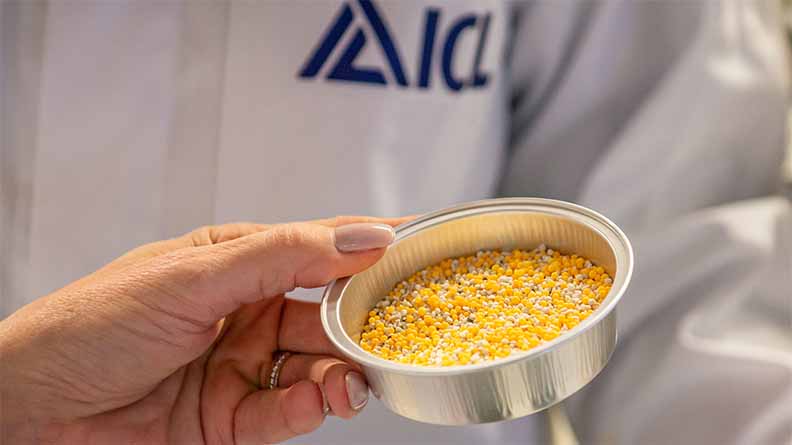
Biodegradable controlled-release fertilizer coating
Digital Agriculture
Digital tools are becoming essential components of modern crop management, and ICL Open is advancing this frontier with technologies that help growers make better decisions in real time.
Key areas include:
- AI-powered agronomic decision-support platforms to optimize fertilization strategies, improve NUE, and reduce resource waste.
- Supply-chain traceability tools that support sustainability reporting and transparency.
- Data structuring and interoperability platforms that integrate field data, input histories, and performance metrics into actionable recommendations.
Ziv Kohav, previously served as ICL’s Precision Ag Manager, paving the way for ICL’s digital agriculture initiative, work that now continues under the ICL Open program.
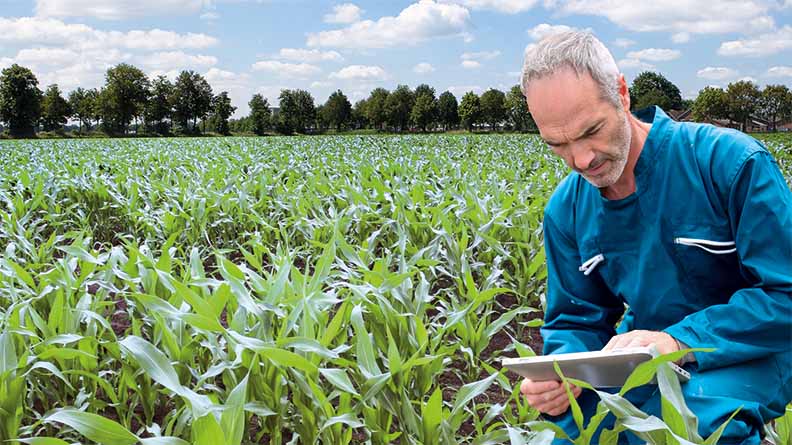
Digital tools are essential for modern crop management
Supporting Food Systems through Related Innovation Domains
In addition to our primary agriculture domains, ICL Open drives innovation in several adjacent fields that directly support global agriculture and food security.
Food Tech Solutions
Innovation in food ingredients plays an important role in global food security and the sustainability of supply chains. Work in this domain includes:
- Alternative proteins and plant-based ingredients that reduce pressure on agricultural land.
- Natural antioxidants and texturants that support safe, high-quality food production.
- Clean-label alternatives that can replace synthetic additives in food products, helping manufacturers meet consumer demand while reducing processing impacts.
These solutions complement agricultural innovation by supporting more resilient and resource-efficient food systems.
Novel Materials for Agricultural Inputs
ICL’s expertise in minerals and specialty chemicals also contributes to new input technologies:
- Expanding uses for polyhalite (Polysulphate), a natural, low-chloride source of potassium, magnesium, calcium, and sulfur.
- Opportunities to increase potash production to meet long-term global crop nutrient demand.
- Novel applications for phosphorus chemistries (P₂O₅ chain) with potential benefits in fertilizer production and nutrient delivery.
Together, these material innovations support more flexible, sustainable nutrient management strategies for growers.

Polysulphate is a natural, low-chloride source of K, Mg, Ca, and S.
Why Agricultural Innovators Partner with ICL Open
ICL Open offers a unique combination of global reach, agronomic expertise, and structured development support. Key advantages include:
- Access to ICL’s global distribution networks, enabling rapid scale-up of successful agricultural technologies.
- Regulatory expertise across fertilizer, biostimulant, and digital agriculture markets.
- World-class manufacturing capabilities with proven quality, safety, and sustainability standards.
- A comprehensive innovation ecosystem including the Planet Startup Hub (investment for pilot-ready startups), the TAMI-IMI Research Institute (advanced R&D capabilities), and the BIG Innovation Accelerator (internal innovation pipeline).
For agricultural partners, this significantly raises the probability of successful commercialization.
What Agricultural Innovators Should know before Applying
Successful collaborations rely on alignment with ICL’s unmet needs and a clear understanding of the development pathway.
- B2B Focus: ICL operates on a business-to-business model; technologies must fit this structure.
- Transferability: Even if a technology originates outside crop nutrition, it may be adaptable (e.g., plant-protection innovations with potential for plant-nutrition applications).
- Timeline: From first engagement to market launch, partnerships typically span five or more years, reflecting the robustness of the evaluation and proof-of-concept process.
- Strategic Fit: Strong proposals address specific challenges: NUE improvement, alternative nutrient sources, digital decision-making, or sustainable fertilizer production.
Driving Global Solutions through Agricultural Innovation
For ICL, open innovation enables faster development of the tools growers need to meet rising food demand while reducing agriculture’s environmental footprint. This includes:
- Fertilizer technologies that improve efficiency and reduce losses.
- Digital tools that optimize nutrient management and support sustainable practices.
- Materials science that opens new pathways for flexible, low-impact nutrient delivery.
- Food-system innovations that complement sustainable crop production.
Partners benefit from ICL’s expertise, market access, and long-term support, resources that are often difficult for startups or academic teams to secure independently. For global agriculture, this model accelerates the deployment of solutions that improve productivity, resilience, and environmental outcomes.
Ready to Collaborate?
ICL Open welcomes innovative partners working on breakthrough technologies in crop nutrition, digital agriculture, materials science, and food-system sustainability. The most successful collaborations begin with understanding ICL’s strategic priorities and presenting a clear value proposition for growers and global agriculture.
As Ziv Kohav notes, “We absolutely share your passion for new technology and innovation. Working with ICL is an exciting and rewarding experience.”
ICL Open is building the future of agricultural innovation, one partnership at a time.