


 Whatsapp
  X
X  Mail
Mail  Copy link
 Leveraging pH for Acid-Loving Fruits and Berries


On this page:
A More Integrated Approach to Fertigation
As fruit production systems become more intensive and irrigation technology becomes more precise, nutrient management strategies are evolving as well. Instead of focusing solely on nutrient delivery, many growers now consider how fertilizer choices influence water chemistry, rootzone pH, nutrient availability, and irrigation system maintenance.
This integrated approach reflects a broader trend in agriculture—innovations that stack benefits. By choosing fertilizers that feed the crop while also helping manage pH and maintain infrastructure, growers can improve nutrient use efficiency and reduce operational challenges. For acid loving berries—and for many other fruit crops across Canada—this leads to fertigation programs that support both crop performance and long-term system efficiency.
pH and Acid Loving Crops
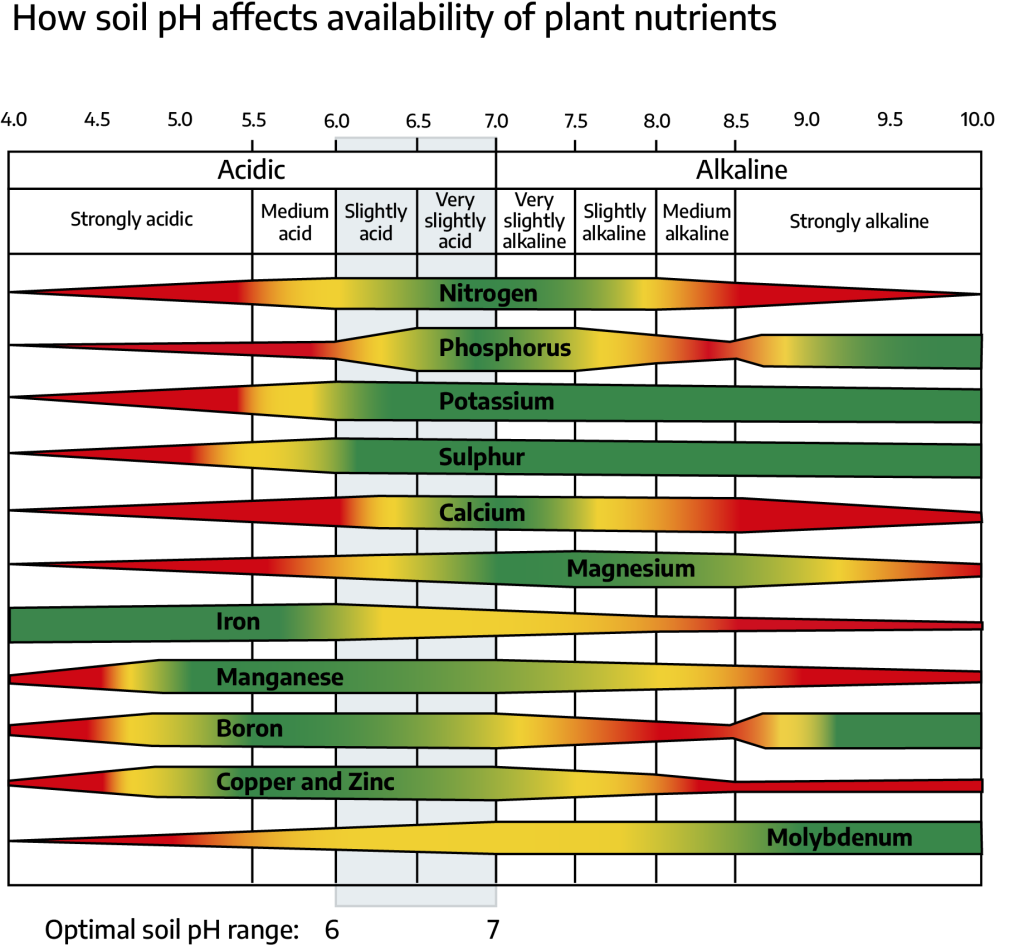
pH management is not just a soil conversation; it is also a fertilizer strategy. Crops such as blueberries, cranberries, and currants evolved in acidic environments and low pH is essential to maximize productivity. Even crops with a wider pH range—raspberries, blackberries, strawberries, apples, cherries—dependance on rootzone pH for efficient uptake of phosphorus and key micronutrients is key.
- Blueberries perform best at pH 4.5–5.5.
- Too high or too low and:
- phosphorus availability declines (6.0-7.0 ideal range).
- micronutrients such as zinc, manganese, and iron can become less available.
- Irrigation water chemistry can gradually shift rootzone conditions—even when soils were properly prepared.
While apples and cherries prefer more neutral-slightly acidic soils, they do benefit from acidifying fertigation that targets the root zone to promote nutrient uptake, especially of nutrients like phosphorus, that are prone to tie up in the soil.
Nova PeKacid® can support these systems by supplementing P & K fertigation in season while also providing irrigation system benefits. When pH of the soil or water is not a limiting factor, Nova HiPeak® and Nova PeaK® are well suited for midseason foliar and fertigation use.
Targeting the Root Zone with Acidifying Fertigation
In many production regions, irrigation water containing bicarbonates, calcium, or magnesium can raise pH around emitters over time. Growers often address this with acidifying fertilizers or ammonium sources, but excessive use of ammonium—such as Ammonium sulfate (21-0-0)—can create additional challenges.
Research in British Columbia has shown that heavy ammonium-based fertigation can contribute to rising soil Electrical Conductivity (EC) and, in some cases, yield reductions when salts accumulate. Balancing nitrogen applications while still improving nutrient availability is key.
N-free fertigation offers growers a way to target the root zone without adding unnecessary nitrogen. Using an acidifying phosphorus source such as Nova PeKacid allows delivery of both P and K while helping neutralize bicarbonates in irrigation water.
Water Quality and System Health
Irrigation water can influence both nutrient availability and system maintenance:
- Bicarbonates can nudge pH upward in the wetted zone.
- Hard water can drive precipitation reactions (e.g., calcium with phosphorus or sulfate) that create scale and restrict flow in fertigation systems.
- Fertilizer compatibility matters: mixing incompatible nutrients or ignoring water chemistry can clog emitters and reduce uniformity.
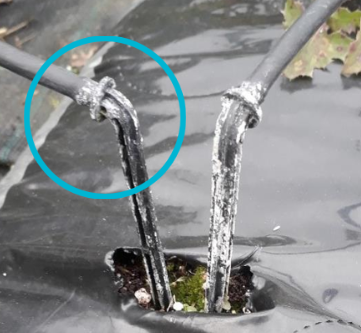
Left with PeKacid shows less build-up vs Right GSP
Practical takeaway: Fertilizer choices like Nova PeKacid that manage pH while supplying P and K can support both crop performance and irrigation reliability.
Two Fertigation Paths: Acidifying vs. Neutral PK Sources
Path 1: When you need to acidify AND supply PK
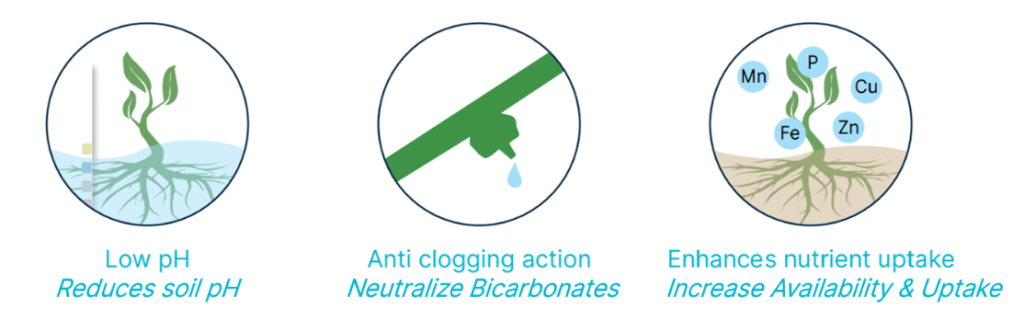
Acidifying phosphate fertilizers supply phosphorus and potassium while neutralizing bicarbonates and lowering solution pH in the fertigation stream. This helps:
- Improve P availability when pH tends to rise.
- Enhance micronutrient uptake.
- Reduce deposits and scaling inside drip lines.
- Deliver PK without extra nitrogen when N is not desired.
Nova PeKacid
- What it does: Provides P + K with a strong acidifying effect in solution.
- Formats: Available as water-soluble fertilizer and in liquid form.
- High Compatibility: A major differentiator is that Nova PeKacid 0-60-20 can be tank mixed with calcium sources; jar test always recommended
Best Fit Scenarios:
- Fertigation programs needing PK and bicarbonate neutralization; suitable for sensitive, high value fruit.
Path 2: When pH isn’t a limiting factor
Not all fruit systems require acidification during fertigation. In situations where irrigation water is already well balanced—or where crops simply require high levels of phosphorus and potassium during critical growth stages—neutral, high-purity phosphorus fertilizers may be the better choice.
This is where highly concentrated phosphorus-potassium fertilizers such as Nova HiPeak and Nova PeaK can play an important role.
Nova HiPeak (0-44-44)
- Highly concentrated P + K, neutral pH, low salt index.
- Flexible across drip, sprinkler/pivot, hydroponic, and foliar.
Nova PeaK MKP (0-52-34)
- Highly soluble monopotassium phosphate, N-free, slightly acidic.
- Useful during flowering, fruit set, ripening, and harvest when P + K are needed but N is not.
Best-fit scenarios:
- Regions where water chemistry is already balanced
- Greenhouse, tunnel, or substrate systems
- Fruits and berries needing targeted PK without acidification
Soil Program That Complements Fertigation
Polyhalite (Polysulphate) supplies S, K, Ca, and Mg in one source and is a practical broadcast/top-dress option that pairs well with fertigation.
- Set rates based on sulfur requirement; the accompanying K, Ca, and Mg arrive at meaningful levels.
- Support nitrogen assimilation and N-use efficiency
- Works alongside acidifying fertigation strategies that nutrient availability and uptake.
So Why Should Growers Change Their Practice?
Sometimes the status quo comes with hidden costs. When one product checks multiple boxes, efficiency goes up dramatically. By improving uptake, reducing the need for higher rates, and keeping irrigation systems running smoothly, there is direct profitability that growers can feel immediately. Switching to a targeted PK strategy with acidifying or neutral Nova products offers:
✔ More yield per unit of fertilizer
✔ Better system performance
✔ Lower maintenance costs
✔ Less nitrogen overapplication
✔ Improved nutrient uptake
✔ Reduced risk and higher efficiency
In today’s production environment, where growers are expected to produce more with fewer resources, solutions that combine agronomic performance with operational simplicity can help improve both sustainability and profitability.
Additional sources:
Jayasinghege, C. P. A., Bineng, C., & Messiga, A. J. (2025). Balancing nitrogen: Application rates and methods in blueberries. BC Food Web. https://bcfoodweb.ca/sites/default/files/2025-03/16-Balancing-nitrogen-Application-rates-and-methods-in-blueberries.pdf
Agriculture et Agroalimentaire Canada. (2017, June 14). Blueberry yield and soil properties: Response to long-term fertigation and broadcast. https://profils-profiles.science.gc.ca/fr/publication/blueberry-yield-and-soil-properties-response-long-term-fertigation-and-broadcast
FAQ
What are acidifying fertilizer options for blueberries or acid loving fruits?
Blueberries require an acidic root zone, and irrigation water containing bicarbonates can gradually raise pH around emitters. Nova PeKacid is an effective acidifying PK source because it provides phosphorus and potassium while also helping neutralize bicarbonates in the fertigation stream. This improves phosphorus availability and can reduce scale formation inside drip lines. When pH is not the limiting factor, neutral PK fertilizers like Nova HiPeak or Nova PeaK can be used during midseason growth stages.
What is an alternative to Ammonium sulfate (2100) for acidifying fertigation?
Ammonium sulfate acidifies the root zone, but heavy long-term use can increase soil EC and reduce yields if salt levels exceed thresholds. An alternative is Nova PeKacid, an N-free, acidifying phosphorus source that lowers solution pH and neutralizes bicarbonates without adding nitrogen. This allows growers to manage pH, deliver P and K, and avoid overapplication of Ammonium during fertigation.
Why choose an N-free acidifying fertilizer instead of Ammonium sulfate?
N-free acidifying fertilizers allow growers to lower solution pH and improve nutrient availability without adding more nitrogen. This is especially useful when crops need phosphorus and potassium but are already receiving adequate nitrogen. Nova PeKacid provides these benefits and helps maintain irrigation system cleanliness, while ammonium sulfate can contribute to rising EC when used heavily in fertigation. When pH isn’t a limiting factor, Nova HiPeak and Nova PeaK are high PK options.
Which Nova fertilizer is best for acid loving berries?
Nova PeKacid: Best when pH management is needed, water contains bicarbonates, or growers want PK delivery without N.
Nova HiPeak (0-44-44) and Nova PeaK MKP (0-52-34): Best when pH is not a challenge, and crops require high purity PK during midseason stages such as flowering, fruit set, and ripening.
What fertilizers help reduce scale and clogging in drip irrigation?
Nova PeKacid is highly soluble and supplies P and K while also acidifying the fertigation solution to help neutralize bicarbonates by reducing the formation of deposits inside irrigation lines. This supports cleaner emitters and more consistent flow.
How does polyhalite fit into a fertigation program for blueberries?
Polyhalite (Polysulphate) is a soil applied source of low salt, sulfate-based S, K, Ca, and Mg. Rates are set based on sulfur requirement. The accompanying K, Ca, and Mg support nutrient balance throughout the season and can complement fertigation or foliar strategies for improved nitrogen use efficiency, soil health benefits and optimized nutrient uptake.


