


 Whatsapp
  X
X  Mail
Mail  Copy link
 Why NPK Alone Isn’t Enough for Canola — and What to Do About It
Nitrogen, phosphorus and potassium are the foundation of every fertility program, but balanced nutrition requires more. Learn how delivering phosphorus, sulphur, potassium, calcium and magnesium in one granule can simplify fertility and support stronger crop establishment.
On this page:
Simplifying fertility with multi-nutrient granular fertilizers.
Every spring, canola and wheat fields across Western Canada reveal just how important early nutrition can be. Some fields emerge evenly and establish quickly, while others struggle despite receiving what appears to be an adequate fertility program.
For decades, starter fertilizer programs have been built around nitrogen, phosphorus and potassium—the nutrients that drive yield potential and are typically applied in the largest quantities. But canola and wheat have a higher demand for several other essential nutrients, and overlooking these nutrients can limit how effectively the crop uses applied NPK. ‘
Canola, for example, has one of the highest sulphur requirements of Prairie crops, and insufficient sulphur can reduce protein formation, oil production and yield potential. However, other essential nutrients—including potassium, magnesium and calcium—also play important roles in early establishment and nutrient use efficiency.
For growers and retailers alike, this raises an important question:
Can we simplify your fertility program without sacrificing yield potential? And the answer is yes.
Download the ICL PKpluS Guide
Early Growth Depends on More Than One Nutrient
Canola, like many row crops, establishes much of its yield potential during the earliest stages of growth. Shortly after emergence, the crop is rapidly developing:
- Root architecture
- Leaf area
- Biomass
- The foundation for flowering and pod development later in the season
Unfortunately, this is also when nutrient uptake is least efficient.
Across Western Canada, cool Prairie soils, fluctuating spring moisture, nutrient stratification and a limited root system can all reduce nutrient availability, even when soil tests indicate adequate fertility. If we miss this critical window, it often shows down the road in lost yield potential.
Why Isn’t NPK Enough for Canola?
While each essential nutrient contributes to a different aspect of plant development, but their greatest value comes from working together.
- Nitrogen drives vegetative growth and yield potential by supporting chlorophyll production, protein synthesis and overall biomass development. Efficient nitrogen use depends on an adequate supply of other essential nutrients, particularly sulphur.
- Phosphorus promotes early root development, helping young plants explore more soil for water and nutrients throughout the growing season.
- Sulphur supports amino acid production, protein synthesis and oil formation. Because sulphur works closely with nitrogen, deficiencies quickly limit yield potential.
- Potassium regulates water movement, nutrient transport and stress tolerance while supporting crop quality and movement of nutrients through the plant.
- Magnesium forms the centre of the chlorophyll molecule, driving photosynthesis and providing the energy needed for nutrient uptake and plant growth.
- Calcium strengthens cell walls and developing roots, supporting vigorous establishment and nutrient movement within the plant.
A balanced ratio helps keep soil structure loose and allows roots to access water and nutrients more evenly. When one nutrient becomes limiting, the crop cannot fully utilize the others. The goal isn’t simply supplying nutrients—it’s synchronizing their availability so young roots can encounter and take up essential nutrients when demand begins to increase.
Supplying these nutrients together helps support the interconnected processes that drive early establishment and season-long performance.
Why Use a Multi-Nutrient Fertilizer?
Five nutrients. One Granule: The ICL PKpluS Advantage
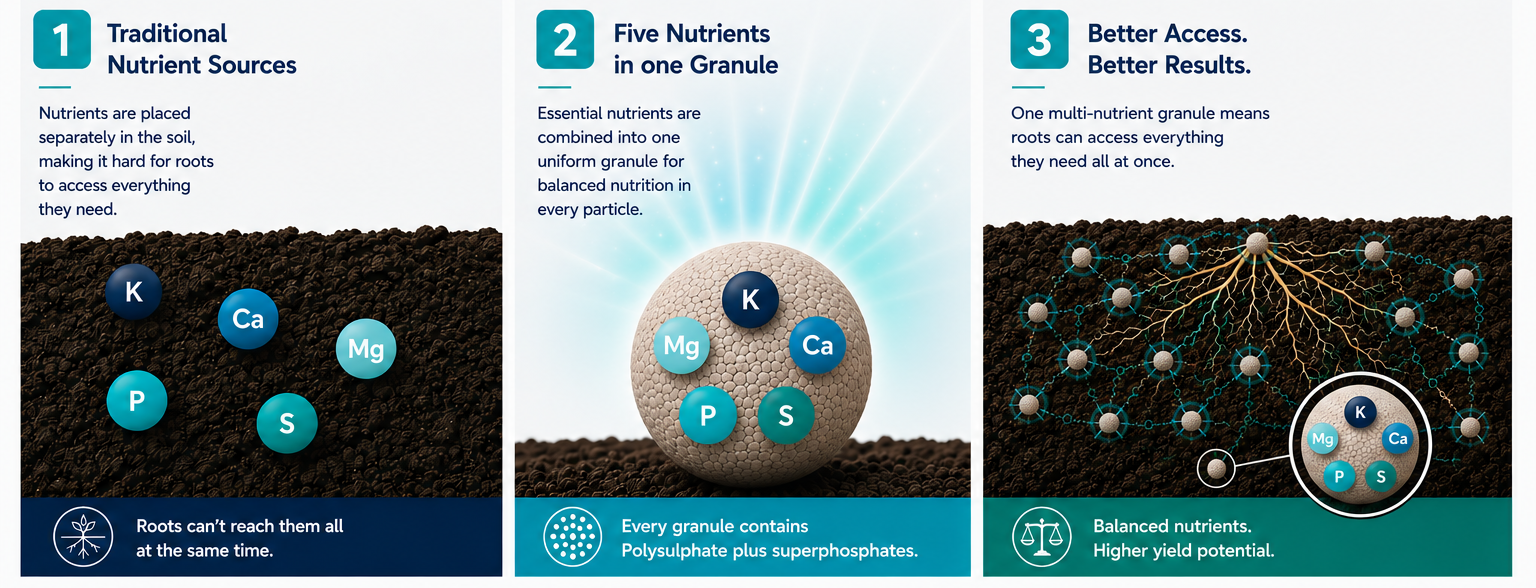
Many fertility programs rely on separate starter fertilizer products to supply phosphorus, sulphur, potassium, magnesium and calcium. While effective, this approach this approach can increase blending complexity, handling requirements and application logistics while increasing the risk that essential nutrients are not positioned together for developing roots.
ICL PKpluS® takes a different approach.
By combining superphosphates with naturally occurring mineral Polysulphate®, every granule delivers five essential nutrients together:
- Phosphorus
- Sulphur
- Potassium
- Magnesium
- Calcium
Unlike physical fertilizer blends, every ICL PKpluS granule contains the same balanced nutrient package. Wherever developing roots encounter a granule, they access all five nutrients together.
The low salt, low chloride and neutral pH (no liming effect) profile helps protect emergence and stand count in the seed row.
Simplify the blend. Maximize nutrient access.
Simplicity is where multi-nutrient fertilizers can provide an advantage. Instead of relying on multiple fertilizer sources to deliver individual nutrients, products that combine complementary nutrients in every granule help ensure developing roots have access to a balanced nutrition package.
Whether using a seed drill, air seeder or fall application system, fertilizer logistics can be challenging. A low-salt, easily blendable multi-nutrient fertilizer helps reduce product handling while ensuring essential nutrients are positioned together to support early root development.
ICL PKpluS® Fits Canola and Wheat Fertility Programs
This low-chloride formulation provides a sulphur-based source of soluble potassium, magnesium, and calcium, along with an additional 24% phosphorus to support early crop development.
| ICL PKpluS Feature | Grower Benefit |
|---|---|
| Five nutrients in every granule (S, K, P, Ca, Mg) | Balanced early nutrition and efficient nutrient uptake |
| Low salt index, low chloride | Seed safe; suitable for seed-row placement |
| Simplified logistics | Multi-nutrient product simplifies blending, storage and application |
| Just add nitrogen | Provides flexibility to optimize nitrogen timing and rates |
| Polyhalite-based | Natural mineral provides gradual release sulfate-based nutrition to meet crop demand |
Matching fertilizer placement to soil conditions, moisture and seeding practices remains essential for maximizing crop safety and nutrient efficiency.
Just Add Nitrogen: Complementing Banded NH₃ Fertility Programs
Across Saskatchewan and much of Western Canada, many growers rely on banded anhydrous ammonia (NH₃) as their primary nitrogen source because of its efficiency and suitability for high-yielding canola systems. NH₃ must be placed separately from the seed to avoid seedling injury, making it well suited to a split nutrient strategy.
A multi-nutrient fertilizer such as ICL PKpluS® complements this approach by supplying phosphorus, sulphate sulphur, potassium, magnesium and calcium together in the seed row while nitrogen is managed separately through NH₃ banding.
This approach offers several practical advantages:
- Supports balanced early-season nutrition close to developing roots
- Allows nitrogen rates to be adjusted based on yield goals and seasonal conditions
- Simplifies fertilizer blending by combining five essential nutrients into one granule
- Helps build a balanced fertility program while maintaining flexibility for nitrogen management
Rather than managing multiple individual nutrient sources, growers can focus on optimizing nitrogen placement and rate while supplying the remaining essential nutrients together during early crop establishment.
If blending with urea, consult your retailer or local ICL representative for recommendations. Where a phosphate-free sulphur source is preferred, Polysulphate Premium offers an additional option.
Why Fertilizer Placement Matters
Young roots explore only a small volume of soil, making nutrient placement just as important as nutrient supply.
Many key nutrients—particularly phosphorus—are relatively immobile in Prairie soils. Combined with cool spring temperatures, variable moisture and limited early root growth, nutrient availability can be restricted even when soil fertility is adequate.
When nutrients are applied as separate fertilizer products, developing roots must intercept multiple nutrient sources during a very limited window of crop establishment.
Positioning several essential nutrients together safely in the root zone helps improve nutrient access while simplifying fertility programs.
Agronomist Takeaway
Nitrogen and phosphorus are important, but they are only one part of the nutrition equation. Increasingly, the conversation is shifting from:
“How much NPK should I apply?”
to
“How can I deliver the right nutrients together to maximize nutrient efficiency?”
ICL PKpluS® helps growers move beyond traditional NPK programs by delivering phosphorus plus low salt, sulphate-based sulphur, potassium, magnesium and calcium in every granule— creating a balanced foundation for early crop establishment while simplifying fertility and allowing nitrogen management to remain flexible.
Contact your local retailer or ICL expert to learn more.
Frequently Asked Questions
Why use a multi-nutrient fertilizer instead of separate fertilizer products?
Multi-nutrient fertilizers supply several essential nutrients together in every granule. This helps simplify blending and handling while improving the likelihood that developing roots encounter a balanced nutrient supply during early crop establishment. With ICL PKpluS® it has the added advantage of managing nitrogen separately for flexible application.
Why does canola need sulphur?
Canola has one of the highest sulphur requirements of Prairie crops. Sulphur is essential for protein synthesis, oil production and efficient nitrogen utilization, making it critical throughout the growing season.
Why does fertilizer placement matter?
Young canola roots explore only a small volume of soil. Placing nutrients close to developing roots improves the likelihood they are available when crop demand is highest.
What are the advantages of a multi-nutrient fertilizer?
A multi-nutrient fertilizer places several essential nutrients together in every granule, improving nutrient accessibility while simplifying blending, storage and fertilizer application.
Is seed-row placement appropriate?
Seed-row fertilizer placement depends on soil conditions, moisture, opener width, fertilizer rate and local agronomic recommendations. Always follow provincial guidelines and product recommendations when determining safe application rates.



