


 WhatsApp
  Mail
Mail  Copy link
 How measuring DLI can improve turf management

On this page:
Why is light measurement important in turf management?
Turf professionals often notice slower growth, paler grass and longer recovery times during winter.
While temperature and moisture are factors, the main limiting factor is often light, specifically, the amount of usable light the turf receives.
The real challenge isn’t just low light levels, but the absence of data. Without measuring light, it’s easy to misidentify the cause of weak or inconsistent turf performance. This is especially true in:
- Enclosed stadiums
- Training grounds bordered by stands or buildings
- Golf greens surrounded by trees
- Sports pitches with complex shade patterns
By quantifying light exposure, turf managers can make more informed agronomic decisions.
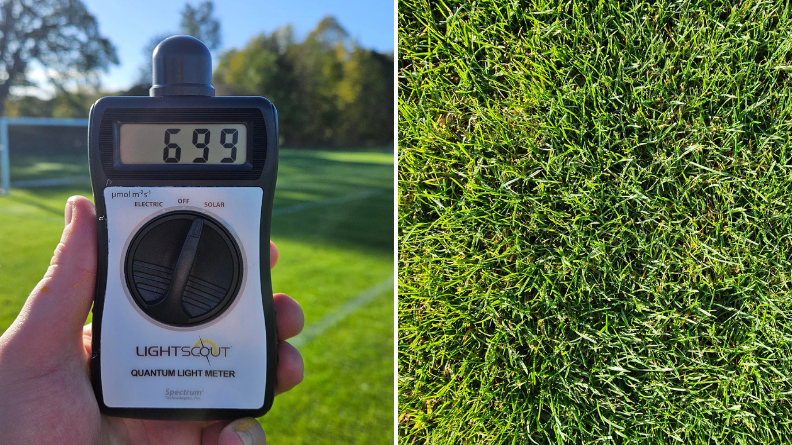
Dense, healthy turf in areas receiving stronger light.
What is DLI and why does it matter?
The Daily Light Integral (DLI) is the most effective way to measure light for turfgrass.
DLI quantifies the total amount of photosynthetically active radiation (PAR) a surface receives in one day, expressed as mol/m²/day.
Photosynthesis is fuelled by light, which in turn powers growth, colour and recovery. Regardless of how well moisture and nutrition are managed, inadequate light means less energy for the plant.
DLI Thresholds for Cool-Season Turf:
- 20–30 mol/m²/day: Optimal growth
- 10–15 mol/m²/day: Growth slows
- Below 10: Recovery is restricted
- Below 6: Turf enters energy deficit or survival mode
In winter, open areas typically record 6–10 mol/m²/day, while shaded sites may drop to just 3–4. These measurements explain many performance variations across a single site.
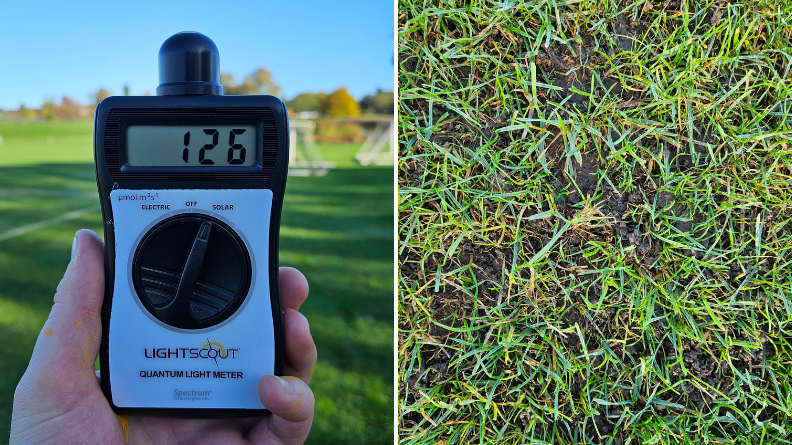
Reduced turf density where light levels are much lower.
How can you measure light on turf?
1. Define Your Objective
Before collecting data, identify your goal. Are you comparing shaded and open areas? Investigating seasonal changes? Or looking for evidence to support tree pruning or infrastructure adjustments?
Clear objectives help guide relevant and useful data collection.
2. Choose the Right Tools
- In-situ Quantum (PAR) Sensors: Provide accurate, continuous readings. Ideal for stadiums and research settings. Brands include Apogee and LI-COR.
- Portable Quantum (PAR) Sensors: Handheld devices like the Spectrum Light Scout allow spot checks and are great for mapping shade patterns.
- Weather Stations: Systems from Davis, Campbell Scientific or Pessl Instruments (Metos) often already record solar radiation and calculate DLI.
3. Collect Data Consistently
Use uniform sensor height and fixed times for readings. Track cloud cover and shade events for context.
Long-term averages are more meaningful than one-off readings. Repetition over time reveals critical patterns.
What do DLI Readings tell you?
Knowing your DLI values makes turf management more data-driven:
- Low DLI (<5 mol/m²/day): Plants lack the energy to respond to nitrogen or iron inputs.
- Improving DLI (>10 mol/m²/day): Turf responds more effectively to renovation, nutrition and overseeding.
Light data also helps explain performance differences to stakeholders, justify shade management actions, and support species selection:
- Ryegrass: Prefers high light
- Fescues: Tolerate shade, less wear-resistant
- Bentgrasses: Need moderate to high light
- Poa annua: Survives in low light but is disease-prone
Mapping DLI across a pitch or green helps determine where specific species will thrive, and where management changes are needed.
How does ICL use DLI in research?
At ICL, ongoing research uses continuous DLI monitoring to assess how nutritional and plant health programmes perform under low-light conditions.
All trials are scientifically designed and analysed to ensure accuracy.
Preliminary findings show that certain nutritional and biostimulant strategies can improve plants’ light-use efficiency, enhancing chlorophyll function and energy balance.
These insights will inform future recommendations as more data becomes available.
What are the benefits of measuring light?
While turf managers can’t control sunlight, measuring it unlocks significant benefits:
- Set realistic expectations based on actual conditions
- Time renovations and nutrition for maximum impact
- Make evidence-based decisions on shade and wear management
Ultimately, understanding and measuring DLI empowers better turf management across all environments.


Our knowledge
Tips & tricks, disease prevention, scientific results and more
Explore our knowledge hub