


 WhatsApp
  Mail
Mail  Copy link
 Independent Fairway Trial Highlights Drought Performance of H2Pro TriSmart and Qualibra

On this page:
Water availability, irrigation cost, and increasing summer drought pressure are creating major challenges for turf managers across golf and sports turf.
The pressure is no longer simply about keeping fairways green. Turf managers are now expected to maintain consistent playing quality, protect turf health through prolonged dry periods, and use irrigation water more efficiently under increasing scrutiny.
Independent research carried out at NIBIO Turfgrass Research Center in Norway, as part of the STERF-funded project supported by The R&A Golf Course 2030 initiative and the German Greenkeepers Association (GVD), has provided important insight into how different wetting agent technologies can support those goals under drought pressure.
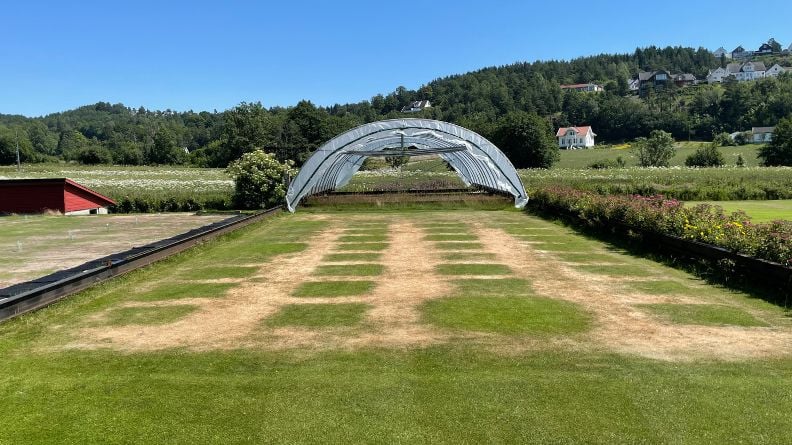
Trial Site, NIBIO Turfgrass Research Center, Norway
What the fairway drought trial evaluated
The two-year fairway trial evaluated seven commercially available soil surfactants and wetting agent technologies on a sand-based cool-season fairway containing red fescue, Kentucky bluegrass, and colonial bentgrass.
The research assessed:
- turf quality
- green coverage
- soil water content
- chlorophyll index
- irrigation water use
The 2024 season created significantly greater drought stress than 2023, allowing clearer separation between products during prolonged dry conditions. One of the key observations from the research was that differences between wetting agent technologies became more apparent during the later stages of sustained drought rather than during early dry-down periods.
That is highly relevant for turf managers because extended dry periods are often where irrigation pressure, turf decline, and surface inconsistency become hardest to manage operationally on cool-season fairways.
Independent trial shows H2Pro TriSmart reduced irrigation demand
Among the products evaluated, H2Pro TriSmart combined the lowest irrigation water requirement with consistently strong turf performance during extended drought conditions.
In the severe 2024 drought period, untreated plots required 116 mm of irrigation water to maintain the intervention threshold, compared with 90 mm for plots treated with H2Pro TriSmart. This represented a statistically significant 22% reduction in irrigation water use versus untreated turf.
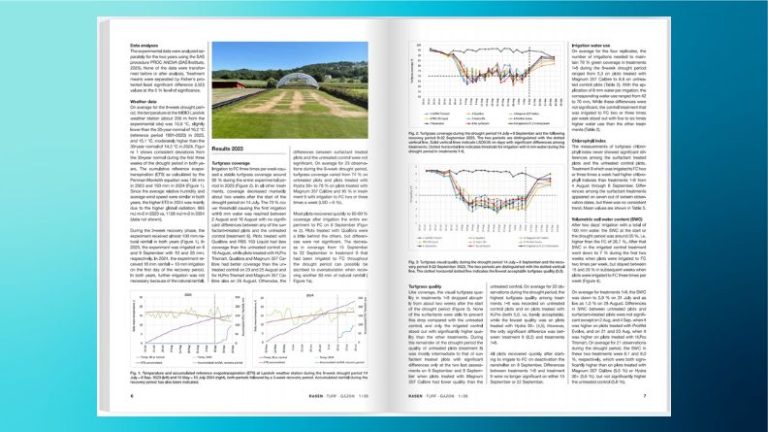
Alongside lower water use, H2Pro TriSmart maintained strong turf quality, green coverage, and soil moisture performance throughout the drought period. The trial paper described H2Pro TriSmart as delivering the “best all-round performance” under the conditions tested.
In practical terms, the findings suggest that H2Pro TriSmart helped maintain acceptable fairway performance with fewer irrigation inputs during extended dry periods.
The results reinforce the role of H2Pro TriSmart for sites prioritising:
- improved water-use efficiency
- reduced irrigation demand
- dependable drought support
- maintaining fairway performance during prolonged dry conditions
Qualibra delivered highest visual turf quality under severe drought
Qualibra also produced exceptionally strong results throughout the trial, particularly during the harshest late-stage drought conditions.
The product recorded the highest visual turf quality scores during the final stages of drought stress, highlighting strong surface presentation and turf consistency under pressure. The paper concluded that the “best turf quality” during drought stress was achieved with Qualibra.
For sites where visual quality and surface presentation are major priorities, the findings demonstrated particularly strong performance under severe drought conditions.
Different wetting agent technologies responded to drought stress
One of the clearest lessons from the research is that wetting agents should not be viewed as interchangeable technologies.
The trial demonstrated that different surfactant technologies delivered strengths in different areas of drought management.
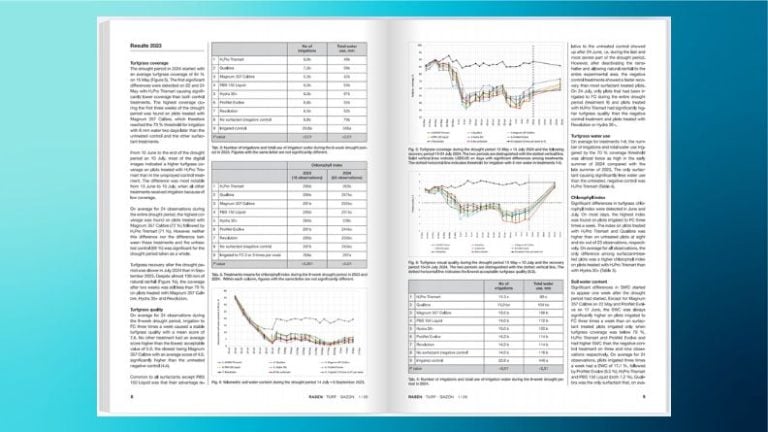
H2Pro TriSmart delivered the lowest irrigation water use alongside consistently strong overall turf performance, while Qualibra demonstrated the highest visual turf quality during the harshest stages of drought stress.
That distinction is important because drought management decisions are rarely based on one factor alone. Turf managers are balancing irrigation availability, surface presentation, turf resilience, and long-term turf performance throughout the season.
What the trial means for fairway moisture management
The findings reinforce that wetting agent selection should be linked to site priorities and management objectives.
- Sites focused on reducing irrigation demand may prioritise technologies proven to support lower water use.
- Sites focused heavily on visual presentation and surface consistency through drought periods may prioritise technologies that maintain stronger turf quality under stress.
- The research also reinforces the importance of integrating wetting agents alongside irrigation, nutrition, and wider cultural management programmes.
Wetting agents support irrigation strategy, they do not replace it
The trial also reinforced an important practical point.
No surfactant treatment maintained the same consistent turf quality as the fully irrigated control throughout the drought period. Wetting agents improved turf performance under pressure, but they did not eliminate drought stress or replace sound irrigation management.
This supports ICL’s wider integrated turf management approach, where moisture-management technologies are used strategically alongside nutrition, irrigation, and cultural practices to support turf resilience and surface performance under environmental stress.
As with all field research, responses varied between years depending on drought severity and environmental conditions. The strongest treatment separation occurred during the more severe 2024 drought period.
Supporting turf performance through increasing drought pressure
The NIBIO fairway trial demonstrated that wetting agent technologies can provide meaningful support during prolonged drought conditions.
H2Pro TriSmart delivered the lowest irrigation water requirement alongside strong all-round turf performance, while Qualibra demonstrated the highest visual turf quality during severe drought stress.
As drought pressure and irrigation scrutiny continue to increase, targeted moisture-management programmes are likely to play an increasingly important role in supporting resilient, high-performing turf surfaces.


Our knowledge
Tips & tricks, disease prevention, scientific results and more
Explore our knowledge hub