


 Whatsapp
  Facebook
  Mail
Mail  Copy link
 Introducing DLI: The light measurement every turf manager should know

On this page:
Understanding Daily Light Integral (DLI) and why it matters
It’s that time of year again. The sun hangs low all day, barely clearing rooftops or tree lines. Growth is tailing off, surfaces are thinning, and recovery is slowing.
Yet the demands keep coming. Fixtures, training sessions, and rounds of golf continue despite the changing conditions. Whether it’s high-use pitches or greens, the turf is under pressure.
Despite every effort to bolster turf health with well-timed nutrition, moisture management and plant health products, we are entering a period where a vital resource is in short supply, and there is only so much we can do about it. It’s not mismanagement. It’s just that time. Winter is here, and the light is disappearing.
We talk a lot about water, temperature and nutrition. But maybe it’s time we gave more attention to light — not just shade, and not just whether it’s sunny or overcast, but the actual amount of usable light your turf receives each day.
That measurement is known as the Daily Light Integral.
Daily Light Integral (DLI) measures the total amount of usable light energy a plant receives in a day. Expressed in moles of light per square metre per day (mol/m²/day), it represents how much photosynthetically active radiation (PAR) is available to drive photosynthesis.
To make this easier to visualise, think of PAR as calories for turf and DLI as the total calorie intake a plant gets each day. And just like us, the amount taken in matters.
Put simply, if your DLI drops below 5 mol/m²/day, your turf is entering the stress zone. Even with good nutrition, moisture control and disease prevention, the turf may not be able to photosynthesise efficiently enough to sustain growth or repair.
Around 10 to 15 mol/m²/day typically supports stable growth and performance in the cool-season grasses used across UK and Irish turf surfaces. A DLI of 20 mol/m²/day or more encourages stronger growth and greater resilience. But once levels fall below 5 mol/m²/day, turf begins to run an energy deficit — a condition common across many sites during the darkest months.
This is especially relevant for stadium environments, where even in mid-autumn, structural shade and low sun angles can drive DLI below critical thresholds long before true winter arrives.
How does low light affect turf growth and performance?
Even in open, unshaded areas, DLI levels fall sharply as we head through autumn into winter. Shorter days, low sun angles, heavy cloud cover and surrounding shade all combine to reduce the available light.
In these conditions, turf simply cannot generate enough energy to photosynthesise effectively. The result is reduced growth, slower recovery, thinner surfaces and increased disease susceptibility.
Typical DLI levels across the seasons
DLI levels vary significantly depending on both the time of year and site exposure. The table below shows indicative ranges for typical turf environments in the UK & Ireland:
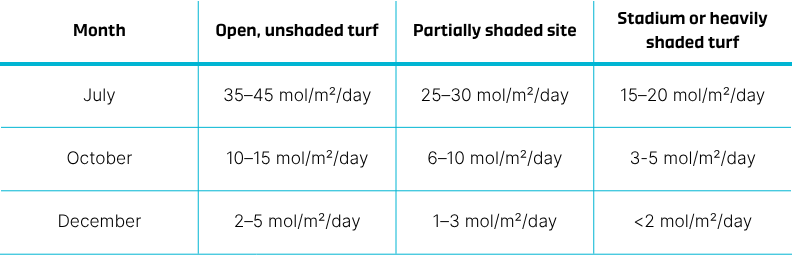
Annual Light Curve: Establishing a Seasonal Baseline
The graph below shows the estimated monthly average DLI levels for an open, unshaded turf surface in the UK & Ireland. It provides a clear view of the seasonal baseline against which more shaded or complex environments (such as stadium pitches or tree-lined greens) typically perform worse.
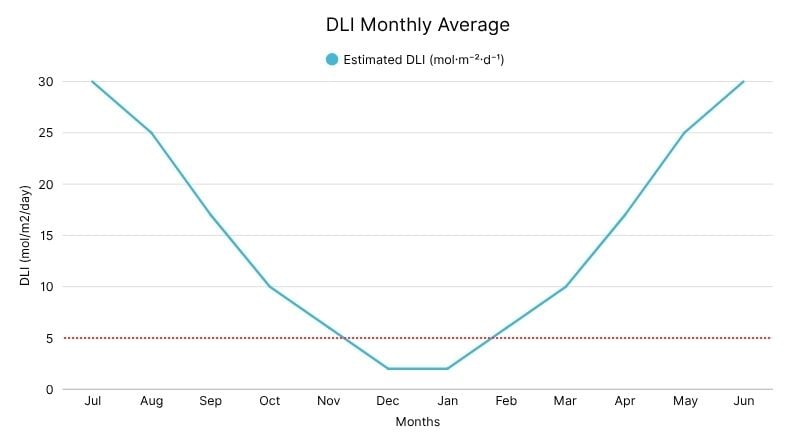
Note how values fall well below the critical 5 mol/m²/day threshold from November through January, a period when even open turf is likely to experience growth limitations.
How can you tell if turf is suffering from low light?
Symptoms of low light stress are often mistaken for other issues. They can easily be misattributed to nutrient deficiency, compaction or general wear, but the underlying problem is often a lack of available energy:
- Slower recovery after matches, training or maintenance
- Yellowing or weak, leggy growth, particularly in shaded areas
- Thinning in high-wear zones such as goalmouths or walk-off areas
- Increased disease activity
- Decline in surface performance such as ball roll or traction
These symptoms aren’t necessarily signs of poor management, they are often natural consequences of light limitation.
What can turf managers do to manage low-light conditions?
We can’t change the weather or the tilt of the earth, but we can adapt our management to reduce the turf’s energy demand and limit further stress:
- Raise mowing heights, where feasible, to increase leaf area and improve light capture
- Reduce mowing frequency to conserve carbohydrate reserves
- Avoid excessive nitrogen, which can drive soft, disease-prone growth
- Manage moisture levels carefully to reduce pathogen pressure
- Rotate training grids, goalmouths, or pin placements to allow even wear and recovery
- Prune or remove vegetation or structures that increase shading
- Monitor DLI using on-site sensors or reliable satellite-derived data, especially in stadiums with complex shade patterns
- Use lighting rigs to supplement light and restore healthy functioning levels
Even simply being aware of DLI can help explain why surfaces are reacting the way they are, and why standard inputs may be limited in their response.
For elite stadiums or training centres using supplementary lighting, understanding DLI is critical for targeting light delivery efficiently. Rather than just adding hours of light, the goal is to deliver the DLI required and bring energy levels back to where recovery and performance can resume.
Why should you monitor DLI year-round?
We routinely monitor soil moisture, temperature and nutrition. But light — the energy source that powers it all — is often overlooked.
DLI deserves a place in every agronomic toolkit. It helps us understand one of the most limiting factors in winter performance and make more informed, sympathetic management decisions.
By treating light as a measurable input, not just a background condition, we move from reactive firefighting to proactive, seasonally aware planning. That shift can make all the difference between damage control and maintaining excellent surfaces through winter and into a strong spring recovery.

Our knowledge
Tips & tricks, disease prevention, scientific results and more
Explore our knowledge hub