


 Whatsapp
  Facebook
  Mail
Mail  Copy link
 Managing winter pitch performance when light is a limiting a factor

On this page:
During the winter months, sports pitches place significant pressure on grounds teams.
Light levels plummet, temperatures drop, recovery slows, but the wear keeps coming regardless. You can manage inputs carefully, plan ahead, do everything possible and still see the surface deteriorating. That is not necessarily the result of poor decision-making, it is the reality of winter.
Expectations rarely fall to match what the plant can realistically deliver. Players and coaches still expect consistent, reliable surfaces. The responsibility to keep the pitch together sits with the turf manager at precisely the point when there is little that could help.
That is why winter decisions feel heavier. Mistakes linger. Damage picked up at this stage of winter does not disappear in a week. In many cases it stays visible until renovation. Confidence can quietly drain away if the turf decline gathers momentum, even when things are being done right.
In winter, success comes from limiting losses, not trying to create gains.
The teams that cope best during the winter are not those trying to force improvement. The experienced hands focus on holding ground, protecting density, and making sure the plant has enough energy in reserve to respond when conditions finally improve with the start of spring.
Low light sets the rules
The condition of every winter pitch is ultimately governed by light levels, whether it is formally measured or judged through experience.
“We haven’t seen the sun in days.”
“The stand’s shadow is creeping halfway across the pitch.”
“This surface won’t see direct sunlight until February.”
These are not casual remarks. They are observations tied directly to how the turf behaves.
As days shorten and nights stay cold, photosynthesis slows and energy production drops. Recovery from wear becomes inconsistent and unreliable. The turf colour fades, not because nutrition is missing, but because chlorophyll production cannot be sustained under prolonged low light. Nutrient use efficiency falls, density is lost, and the plant simply does not have the energy to respond in the way it does when growing conditions are good.
Damage sustained under low light is disproportionately expensive. Significant scarring picked up during the winter months rarely disappears before spring. Each additional stress layered on top makes recovery harder and decline more severe.
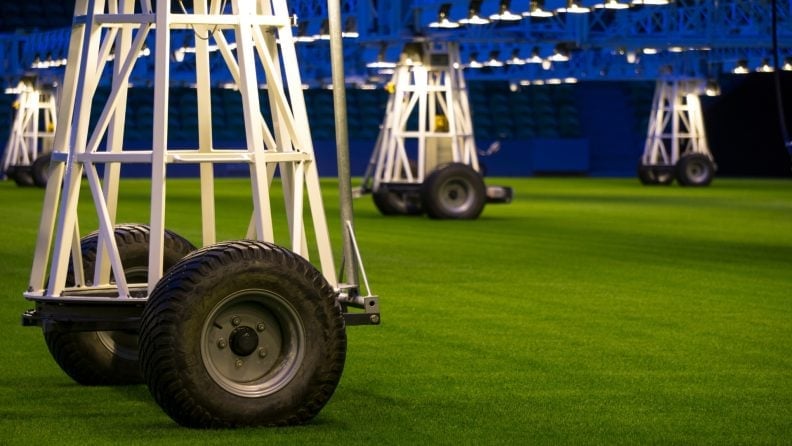
Stadia grow lights
Grow lights and undersoil heating can help mitigate the impact of any damage where they are available. But for most winter sports pitches, however, getting through the dark winter months comes down to restraint, timing, and realistic expectations rather than constant intervention.
Wear increases as recovery disappears
At the same time as light drops, wear pressure usually increases.
Fixtures stack up. Rainfall rises and surfaces stay wet for longer. Softer ground cuts up more easily. Goal mouths, centre corridors, and shaded wings decline first, then the problem spreads.
The temptation at this point is understandable. Extra nutrition to chase colour. Heavier inputs to compensate for what the environment is not providing.
This is often where decline accelerates.
Under low light, forced growth produces soft leaf that cannot tolerate wear. Excess moisture reduces oxygen in the profile and weakens roots at the worst possible time. Cultural work without a recovery window leaves the plant exposed rather than strengthened.
Good winter pitch management is often defined by what you choose not to do. Avoid sudden height of cut changes. Be cautious with topdressing when conditions make recovery unreliable. Keep disease under control so it does not become another drain on already limited energy reserves.
Nutrition as a control tool, not a reaction
Through the winter months, nutrition should be about control and consistency.
Background feeding provides stability, but the form, timing, and size of nitrogen inputs matter more than total quantity. Smaller, regular inputs help maintain leaf strength, density, and presentation without creating growth flushes the environment cannot support.
Liquid nutrition fits this approach because it allows adjustment in measured steps. Foliar uptake reduces reliance on cold soils and gives grounds teams a way of supporting the plant without pushing it beyond its limits.
This is where Greenmaster Liquid Advance fits in practice. Developed for periods of sustained pressure, it combines balanced liquid nutrition with MTU and pidolic acid to support nutrient use efficiency under stress.
The focus is not growth. It is maintaining turf health, colour, density, and surface consistency when recovery is restricted.
In practical terms, this can help narrow the gap between higher-light areas and those stuck in prolonged shade, particularly on heavily used winter pitches where rotation and rest are limited.
Finishing winter with confidence
The grounds maintenance teams that finish the season well rarely do anything dramatic in mid-winter.
They work to a clear plan. They track nitrogen inputs carefully. They avoid peaks and troughs. They act early in problem areas rather than waiting for failure. They use weather breaks wisely and accept when conditions say no.
Small wins matter. Holding density in a goalmouth. Keeping colour and leaf strength steady through a heavy run of fixtures. Preventing one difficult period from becoming a long-term issue.
The winter months will always be uncomfortable on sports pitches. But by accepting that low light sets the rules, using nutrition as a control tool rather than a reaction, and choosing restraint over force, it is possible to come through winter with the surface intact and the plant ready to respond when conditions improve.
Winter is not about pushing the grass forward. It is about protecting what you have so spring recovery is possible, not a rebuild from scratch.



Our knowledge
Tips & tricks, disease prevention, scientific results and more
Explore our knowledge hub