


 Whatsapp
  X
X  Mail
Mail  Copy link
 Breaking Fertilizers Down to Their Elements
Precision chemistry and lab analysis deliver tailored fertilizers, testing, and nutrient efficiency.

On this page:
Through GPS technology, farmers can pinpoint the placement of seed and fertilizer to within a half inch of an exact location in the field. Similar innovation has also advanced fertilizer technology. We have the capacity to calibrate formulations to meet crop demand, improving nutrient use efficiency while minimizing the possibility of over-application.
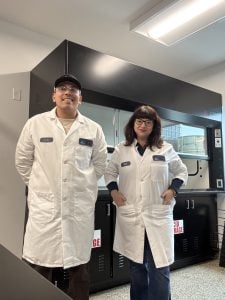
New advances hold tremendous promise because we can now fine-tune fertilizer even further. As a formulation and quality control chemist for ICL, I’m part of the new generation of professionals actively developing new formulations, conducting compatibility testing and contributing to the regulatory and marketing process. Most exciting of all, I oversee a new laboratory at our facility in Fresno, Calif., where we produce crop nutrition solutions for ICL’s portfolio, as well as offer custom toll blending for our partners.
The lab contains two key pieces of equipment:
- Emission Spectrophotometer: Inductively Coupled Plasma Optical Emission Spectrophotometer (ICP-OES) uses plasma to vaporize liquid samples, giving us the ability to quantify different ions associated with specific molecules. Besides verifying that the product meets the quality standards specified on the label, the instrument can detect every nutrient besides nitrogen and carbon.
- Total Organic Carbon Analyzer: This device provides precise measurements of carbon in a variety of different matrices, plus the analysis of total nitrogen.
In addition, the lab has the capability to conduct pH, electrical connectivity, density and moisture analysis. This equipment is impressive to see and even more rewarding to operate because it delivers real-world data to give our customers an advantage.
Detailed Analysis in Less Time
This level of on-site testing is optimized for the fertilizer industry and enables ICL to deliver more detail in a fraction of the time.
Before the laboratory came online, we used a third-party for analysis. Results could take two to three weeks to be returned. Now, we can complete testing in 20 to 30 minutes, allowing us to make real-time adjustments in production. This responsiveness is especially important for delivering precision and efficiency to our toll-blending partners who rely on us to manufacture their unique products with quick turnaround.
The laboratory is a problem-solving hub. In the rare case when a product does not meet specifications, we can adjust manufacturing immediately. In the growing season, time is precious, and the lab helps us to make the most of every minute.
The lab also allows us to provide a level of detail not previously possible. Besides verifying that specifications comply with regulatory requirements, we provide active analysis for each of the 200+ products produced in our facility. By breaking down each molecule to its elemental form, we can detect every nutrient it contains and provide analysis for phosphorus, potassium, magnesium, copper, zinc, iron, boron and many other micronutrients and heavy metals.
Precision Yields Results
ICL’s commitment to innovation involves a strong interdisciplinary connection. As a chemist, I work closely with agronomists, sales staff and those in operations. This symbiotic relationship means we produce the best product possible that delivers results our customers are looking for.
Ultimately, our goal is to produce a better product that benefits growers. Analytical chemistry helps us do that.
We can provide detailed analysis of the micronutrients present in the fertilizer. N-P-K will always be the primary focus, with secondary nutrients such as calcium and magnesium also receiving attention. Micronutrients are usually considered tertiary, but we are gaining a better understanding of how important they are in a cropping system. Sometimes, a micronutrient is the critical link to solving a bigger issue and capturing value for our customers.
Because micronutrient demand varies by crop, soil type, geography and even individual fields, our formulation systems allow us to create targeted solutions tailored to those needs. The capabilities of the lab make this possible, supporting sustainable farming and sustainable manufacturing.
Designed around principles of green chemistry, the facility prioritizes raw materials that are safe for operators and the environment, including renewable ingredients such as seaweed used in several Fresno-produced products. With real-time formulation and manufacturing adjustments, the lab helps reduce waste and ensures every batch performs as intended.
The integration of advanced analytical tools and interdisciplinary collaboration is accelerating innovation in fertilizer formulation and quality control. By harnessing real-time data and sustainable practices, we are keeping pace with the evolving needs of growers while setting new standards for environmental stewardship and product excellence.
FAQ’s
How does GPS technology improve seed and fertilizer placement?
GPS technology allows farmers to pinpoint seed and fertilizer placement within half an inch of an exact location, improving precision and efficiency in the field.What advancements have been made in fertilizer technology?
Advances enable us to calibrate fertilizer formulations to match crop demands, improving nutrient use efficiency and minimizing over-application.What role does the laboratory in Fresno play in fertilizer production?
The Fresno lab produces crop nutrition solutions for ICL’s portfolio, offers custom toll blending, and supports real-time quality control and formulation adjustments.What key equipment does the laboratory use for testing?
The lab uses an Inductively Coupled Plasma Optical Emission Spectrophotometer (ICP-OES) and a Total Organic Carbon Analyzer to precisely measure nutrient content.What nutrients can be detected by the ICP-OES?
ICP-OES can detect all nutrients except nitrogen and carbon, including phosphorus, potassium, magnesium, copper, zinc, iron, boron, and many micronutrients and heavy metals.How fast can the laboratory deliver test results?
Testing that once took 2-3 weeks with third-party labs now takes just 20-30 minutes, enabling quick production adjustments.Why is real-time testing important for toll-blending partners?
Real-time testing allows for fast turnaround and precise formulation of unique products, ensuring high-quality and efficient delivery.How does the lab contribute to sustainability?
The lab supports green chemistry principles by using safe, renewable raw materials like seaweed, reducing waste through real-time adjustments, and promoting sustainable farming and manufacturing.How does the lab support tailored fertilizer solutions?
By analyzing micronutrient content and other elements, the lab helps create targeted formulations based on crop, soil type, geography, and field-specific needs.How does interdisciplinary collaboration improve fertilizer products?
Chemists work closely with agronomists, sales, and operations teams to ensure formulations meet customer needs, optimize performance, and drive innovation.


