Whatsapp
  X
X  Mail
Mail  Copy link
 Challenging Convention on Early-Season Phosphorus


On this page:
Challenging Convention on Early Season Nutrition
When it comes to starter fertilizers, the conversation rarely changes.
Orthophosphate versus polyphosphate.
In-furrow versus 2×2 placement.
Three to five gallons per acre of 10-34-0 or 9-18-9.
Low‑salt fertilizers earned the name “pop‑ups” because they were designed to drive rapid seed germination and early emergence at the start of the season. Farmers often apply high rates of phosphorus—even though plants can’t absorb that much—because most traditional phosphorus sources quickly tie up in the soil and become unavailable to the crop. That’s the norm.
So here’s the question: If starters are designed to support early growth—not carry the full-season nutrient load—why are we still focused primarily on high rate instead of improving efficiency?
Can we reduce phosphorus rates and still achieve equal—or even superior—early-season performance?
To answer that, we may need to look beyond the traditional orthophosphate versus polyphosphate debate.
Looking Beyond the Usual P Sources
Most starter fertilizers rely on the following phosphorus forms:
- Orthophosphate –is immediately available but quickly reacts with calcium or iron/aluminum in the soil, reducing availability. (100% ortho products are typically made using higher‑purity “white acid.”)
- Conventional polyphosphate blends – Must convert to orthophosphate before plants can use it—influenced by soil temperature, moisture, organic matter, and biological activity. During this conversion process can become tied up.
- Ortho-Poly Blends: Common products like 10‑34‑0 (about a 30/70 ortho/poly blend) are made using lower‑purity “green acid.” They’re economical, but susceptible to fixation in both alkaline (calcium) and acidic (iron/aluminum) soils.
Potassium tripolyphosphate (KTPP) offers a different approach with significantly lower rates and improved uptake—making it a valuable alternative for starter or early season programs.
What Is Potassium Tripolyphosphate (KTPP)?
Potassium tripolyphosphate (KTPP) is a high-purity inorganic phosphorus compound commonly used in food processing and industrial applications due to its stability and solubility. In agriculture, that same pharmaceutical-grade purity translates into:
- High solubility
- Clean compatibility in fertigation systems
- Consistent quality
- Reliable plant availability
As a polyphosphate, KTPP contains phosphorus chains that hydrolyze into orthophosphate over time. That means it supplies immediately usable phosphorus while also converting to available forms as conditions allow—providing sustained availability rather than a short burst followed by fixation.
Rethinking Starter Strategy
Traditional starter programs often default to higher gallons per acre because phosphorus mobility is limited in soil. The assumption is simple: apply more to ensure enough is available.
But what if availability—not rate—is the real constraint?
If the phosphorus source improves solubility, compatibility, and uptake efficiency, it may be possible to reduce total applied phosphorus while maintaining—or improving—crop response.
That’s where CHALLENGE enters the conversation.
Reduce Rates, Improve Efficiency
Unlike many conventional starters that are 100% orthophosphate or simple ortho/poly blends, CHALLENGE contains KTPP and delivers phosphorus and potassium together in a highly soluble, efficient form, reducing rates significantly.
The result? Greater early-season nutrient efficiency per unit of applied phosphorus.
Traditional Rates: Three to five gallons per acre of 10-34-0 or 9-18-9.
CHALLENGE Rates: In row crops, in the midwest, we run 1-3 gallon per acre. In specialty crops, 2-4 qt per acre of in furrow; 2 qt. per acre foliar. With the KTPP & the humic acid, you should see better uptake by plants.
A Root-Builder Powered by KTPP
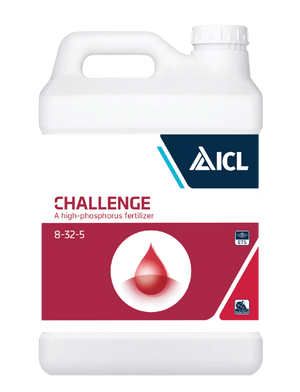
CHALLENGE 8-32-5 + amino acids is a neutral liquid starter fertilizer built around potassium tripolyphosphate.
It’s designed to do one thing exceptionally well—build roots early.
By combining pharmaceutical-grade KTPP with humic acids, lignosulfonic acids, zinc, and a proprietary enhanced translocation system (ETS), CHALLENGE focuses on nutrient efficiency and stress mitigation from day one.
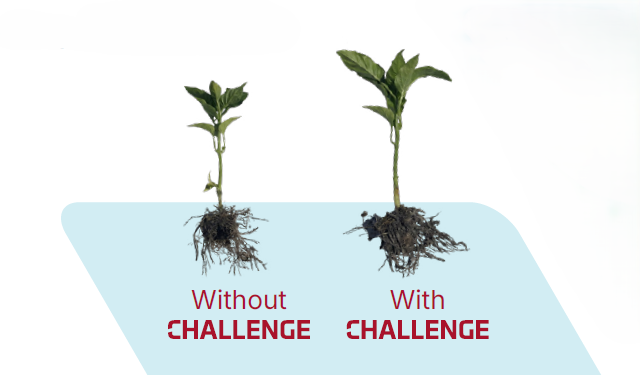
Pepper on right had 2 qt/acre of CHALLENGE 12 days after planting.
Its pH-neutral formulation (pH 7) makes it highly compatible with most pesticides and flexible for:
- Transplant water
- Drip irrigation
- Soil applications
- Foliar programs
How CHALLENGE Works
- Enhanced Phosphorus Availability
KTPP improves phosphorus solubility and plant accessibility. Early access to phosphorus and potassium drives:
- Faster root initiation
- Increased root mass
- Stronger early vegetative growth
- Humic Acids
Improve nutrient solubility and root absorption while supporting microbial activity and soil interaction.
- LignosulfonicAcids
Act as natural chelating and stress-mitigating agents, helping plants handle environmental and herbicide stress.
- ETS (Enhanced Translocation System)
Designed to stimulate internal nutrient movement, trigger growth pathways, and improve overall plant efficiency during early establishment.
Field Experience with CHALLENGE
Growers using CHALLENGE consistently describe accelerated early growth and more aggressive root systems.
One vegetable grower in South Florida shared results from transplant-water applications in peppers:
- Two quarts of CHALLENGE 8-32-5 applied at transplant
- Visual differences at 19 days after planting
- Larger root mass and stronger canopy compared to the grower standard
- Yield increases maintained throughout the season
Similar results were observed in tomatoes and watermelons, where treated plants showed:
- Thicker stems
- Increased leaf mass
- Improved uniformity
- Sustained yield advantages
“When you build a strong foundation early, plants are better equipped to handle stress later. I’ve used it on multiple vegetable crops, and time and again, it outperforms conventional starters.” – Ricky Bass
Early Phosphorus Is About Efficiency, Not Excess
Phosphorus is critical early in the season. That hasn’t changed. What may need rethinking is how we deliver it.
If we can:
- Improve solubility
- Improve uptake
- Improve translocation
- Reduce stress
- Maintain compatibility
Then perhaps starter performance doesn’t have to depend on higher gallons per acre.
Potassium tripolyphosphate offers an alternative phosphorus strategy—one focused on availability and efficiency rather than simply rate.
And when early roots are stronger, everything that follows becomes easier:
- Improved nutrient uptake
- Greater stress tolerance
- More uniform development
- Stronger yield potential
A starter fertilizer isn’t meant to feed the entire season. It’s meant to build the foundation. And foundations matter.
Learn more about CHALLENGE by contacting an ICL expert in your area.