


 Whatsapp
  X
X  Mail
Mail  Copy link
 Compatibility Strategy: Aligning Crop Nutrition and Crop Protection Inputs

On this page:
The Agronomic Value of Compatibility
Compatibility isn’t just about efficiency; it’s also about reducing risk.
As we integrate foliar and fertigation nutrition, biostimulants, and crop protection into fewer, more precise applications, compatibility becomes an important factor.
What Are the Hidden Costs of Extra Spray Passes?
Every additional trip across the field carries a cost: spray expenses, fuel, labor, equipment wear, and increasingly, crop stress. When windows are tight, weather unpredictable, and labor limited, inefficiency compounds quickly.
This is one of the reasons we are increasingly combining crop nutrition with crop protection application. Fungicide plus a foliar nutrient, for example. An insecticide alongside a stress-mitigating biostimulant. Done right, this approach improves productivity. Done poorly, it can cost far more than a few gallons of product.
Compatibility Failures Cost More Than Product Loss
Why Is Compatibility Important in Crop Nutrition and Crop Protection?
When tank mixes fail, the consequences go beyond visible precipitation or clogged screens.
Incompatibility can result in:
- Crop injury from chemical interactions
- Reduced efficacy of crop protection or nutrient products
- Nutrient lock-up and poor uptake
- Downtime from plugged emitters
- Lost yield potential due to delayed re-application
Which Nutrients Commonly Cause Tank‑Mix Problems?
Some incompatibilities are classic and predictable. Calcium and phosphorus (Ca/P) can form insoluble precipitates. Calcium and sulfur (Ca/S) interactions can create solids in solution. Hard water—especially with high calcium or magnesium—or high pH conditions can reduce phosphorus availability before it ever reaches the leaf or root.
Water quality plays an important role in pH management and optimal nutrient delivery. Bicarbonates, blocked drippers, and uneven watering or fertilier delivery impact economic gains.
When nutrients are no longer soluble, they are no longer available. And unavailable nutrients deliver zero return on investment.
Can Phosphorus Be Tank Mixed with Calcium?
With Nova PeKacid®, the Answer Is Yes
Traditionally, calcium and phosphorus are not tank mixed. Under typical conditions, they react to form insoluble calcium phosphate—risking clogged systems and tying up nutrients in forms unavailable to the plant.
Why Is Nova PeKacid Different?
Nova PeKacid’s patented low pH formulation changes this interaction, helping keep phosphorus soluble and available—even in the presence of calcium and magnesium.
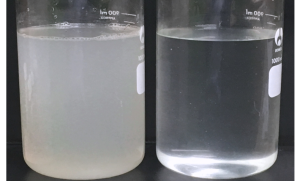
Left shows Ca, Mg + PO4. Right shows Ca, Mg + Nova PeKacid®
Compatibility Is an Agronomic and an Economic Advantage
Compatibility isn’t just about avoiding problems—it’s a real agronomic benefit.
Well-formulated foliar and fertigation products designed for tank mix performance:
- Reduce the risk of precipitation and sedimentation
- Help prevent blockages in drip systems
- Improve spray solution stability
- Make combined passes safer and more predictable
This requires high quality, high purity ingredients, and often inputs with a lower pH.
Target the Root Zone
How Do Acidifying Fertilizers Improve Compatibility and Uptake?
Highly soluble, acidifying formulations like Nova PeKacid® and Agrolution pHLow® (available in WSF and Liquid form) are engineered to dissolve completely (even when mixed with Ca) and perform reliably even under challenging water conditions. Targeting the root zone by acidifying the soil solution, we can increase nutrient uptake where it’s needed most. The dual-purpose function also keeps irrigation pipes and drippers clean too.
Micronutrient products formulated to lower solution pH, such as X-TRA—can also improve nutrient efficiency and enhance compatibility.
When products are designed to work together, the agronomic system becomes more efficient. Combining biostimulants or microbial food sources like BIOZ® with acidifying fertigation options, or foliar nutrients such as Nova PULSE® or Nova FLOW® alongside fungicides or insecticides allows growers to target plant nutrition and protection in a single, well-managed pass.
Don’t forget! Always perform a jar test before large-scale mixing. A small investment in verification can prevent significant loss in the field.
Product Highlights
Which Fertilizer Products Are Designed for High Compatibility?
- PeKacid Technology: Dual-purpose acidifying fertilizers designed with highly soluble phosphorus that improve nutrient availability and uptake at the root zone. Available in various formulations in water-soluble and liquid form.
- Nova HiPeaK LQ® 0-20-20: concentrated liquid form of our potent water-soluble phosphorus and potassium fertilizer with a neutral pH
- X-TRA various formulations: Liquid micronutrients formulated with a lower pH and Proprietary Enhanced Translocation System (ETS) for improved uptake and translocation
- BIOZ Diamond 10-0-1: nitrogen fertilizer contains molasses and yeast extract (microbe food)
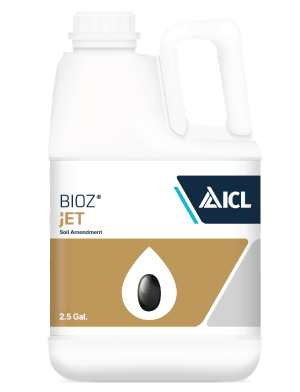
- BIOZ Jet: Concentrated liquid biochar extract for early season, more uniform growth
- Nova FLOW: 5-10-20 + 9Mg, 11S, 0.5B: fully soluble, high purity NPK alternative to magnesium nitrate
- CHALLENGE 8-32-5: high-grade liquid phosphorus fertilizer with humic and lignosulfonic acids for enhanced uptake
Pro Tip… Compatibility Extends Beyond Nutrients
How Do Adjuvants Improve Spray Coverage and Tank‑Mix Performance?
Adjuvants also play an important role in efficiency. Spray aids such as MULTI-SPRED® can enhance coverage, droplet retention, and overall spray performance—further supporting compatibility and effectiveness across combined applications.
Finding Solutions to Work in the Tank and in the Field
When nutrition and crop protection products are working together growers can reduce risk, protect efficacy, and make every pass count. In today’s production systems, compatibility isn’t convenience…it’s strategy.
Contact your local ICL expert to learn more about how our products can optimize your crop protection strategy.




Related Crops


