Whatsapp
  X
X  Mail
Mail  Copy link
 Still Planting? How to Improve Emergence, Roots, and Nutrient Efficiency This Spring


On this page:
Still planting? Then there is still an opportunity to improve nutrient efficiency.
Spring planting is well underway, but plenty of fields are still waiting. Cooler soil temperatures, delayed field conditions, crop timing, or geography have pushed some acres later in the season.
The good news is there are still plenty of opportunities to influence how a crop starts and how it performs all season long.
As an agronomist, I spend a lot of time thinking about crop nutrition—how to get the most out of every nutrient applied, from an agronomic, economic, and environmental standpoint.
What I’ve seen in the field is this: nutrition only pays when soil, roots, and biology are working together.
No matter the crop being planted, pairing fertility with biostimulants consistently improves efficiency and increases economic upside. When products like BIOZ® Diamond and BIOZ® Jet are used alongside liquid or water-soluble fertilizers, growers are not adding more inputs—they are getting more performance out of what is already applied.
Early Nutrition Sets the Foundation for the Season
Early-season nutrition is like building a house. You can have the best materials in the world, but if the foundation isn’t right, you won’t get the full value out of what you put in.
The first few weeks of spring planting shape:
- How evenly the crop emerges
- How roots explore the soil
- How efficiently the plant uses nutrients
- How well the crop handles early stress
If establishment is uneven, the crop may spend the rest of the season trying to catch up. By stimulating germination both below and above ground, products like BIOZ® Jet help drive more uniform early growth. That uniformity sets the stage for the crop to capture and preserve the hybrid’s yield potential across a wide range of growing conditions.
Nutrient Availability Is Only Part of the Equation
The Soil Environment is Key to Improving Nutrient Uptake and Availability
We often talk about nutrient availability, but availability alone does not guarantee efficiency.
True nutrient efficiency comes from creating the right environment around the seed. That means:
- Nutrients that are immediately accessible
- Active biology in the root zone
- Optimal soil structure and water retention
- Roots that can grow and establish quickly
This early window is small, but its impact is big. Uniform emergence, early vigor, and root architecture all start at planting and directly influence yield potential.
Build a Better Seed Microenvironment
One practical way to improve early performance is by combining starter fertilizers with enhanced efficiency products and biostimulants.
A balanced, pH-neutral starter program I recommend often includes:
- An enhanced efficiency starter fertilizer such as CHALLENGE 8-32-5, or
- High P and K from Nova® HiPeaK LQ 0-20-20, along with
- Microbial support from BIOZ® Diamond or BIOZ® Jet for germination and early crop growth.
Pairing nutrition with soil biology stimulation at planting improves nutrient uptake efficiency right when the crop is most vulnerable.
Why this approach works is simple. Starter fertility fuels early energy demands, while biostimulant tools like BIOZ® Diamond and BIOZ® Jet help the plant convert that nutrition into consistent early growth. As the seed imbibes water, it immediately pulls in nutrients. Balanced nutrition supports early energy and root development, while biostimulants help activate natural plant processes and improve nutrient uptake.
The goal is not more fertilizer. The goal is getting more out of what is already being applied.
Where Does A Liquid Biochar Extract Fit Into a Crop Nutrition Program?
Liquid biochar extracts like BIOZ® Jet are designed specifically for that early-season window.
BIOZ® Jet is a concentrated liquid biochar extract applied to the soil. It is made from sustainably harvested wood chips and transformed through fire into bioactive compounds that work with the plant rather than forcing growth.
Based on current research and field experience, BIOZ® Jet works primarily by:
- Stimulating biochemical pathways within the plant
- Supporting natural growth processes
- Enhancing early root and shoot development
What this looks like in the field is:
- Faster and more uniform emergence
- Increased root biomass
- Better tolerance to early-season abiotic stress
- More consistent crop establishment
In higher‑pH soils, compatibility and nutrient use efficiency become even more critical. Programs that include acidifying inputs like Nova PeKacid® or Agrolution pHLow® create a more favorable nutrient environment, and when paired with BIOZ® Jet, crops often show another level of growth and resilience as they push through ongoing abiotic stress.
When planting conditions are less than ideal, that early boost can make a noticeable difference.
Trials: Field Results That Matter
With so much riding on every harvest, it can feel risky to try new products, and so the data matters. What is exciting to see in the field, is that these are not theoretical benefits. Field trials we have done with BIOZ® Jet liquid biochar continue to show consistent responses across a variety of crops and soil types.
Corn, Wisconsin, 2024:
- In-furrow BIOZ® Jet led to more rapid emergence and improved stand uniformity
- Adding BIOZ® Jet at 8 fl. oz. per acre increased yield by 7.7 bushels per acre over fertilizer alone
- Full in-furrow programs showed a 13.2 bushel per acre response
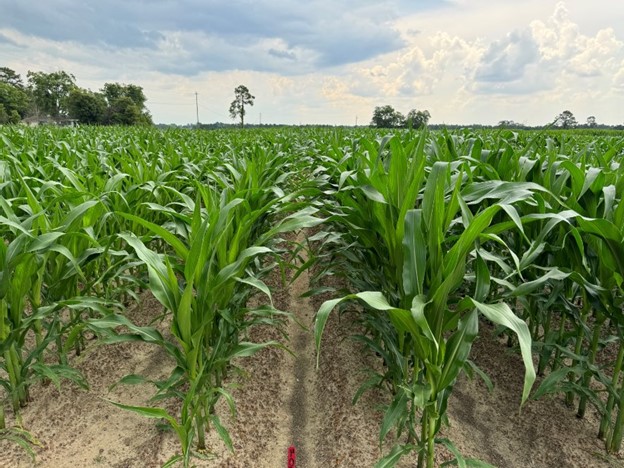
Corn, Improved stand count, Left: Control vs Right: BIOZ Jet with Agrolution pHlow
Potatoes, Wisconsin, 2024:
- Agrolution pHLow plus BIOZ® Jet increased yield by nearly 75 cwt per acre, or about 3.75 tons per acre, compared to the control
Multi-crop, multi-year vegetable trials with BIOZ® Jet:
- Increased root biomass in lettuce
- Improved root to shoot ratios in cucumbers
- Stronger early growth in tomatoes
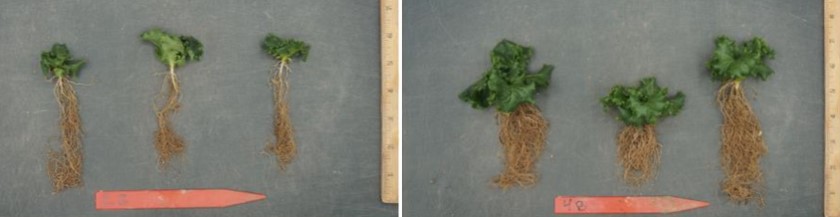
Lettuce, Increased root biomass at 4WAP, Left: Control vs Right: BIOZ Jet
These are not silver bullet results, but the outcome of putting biology to work early. Bridging the gap between nutrient acquisition and use, while stimulating plant morphology and physiology are solid ways to enhance yield potential.
Simple, Practical Ways to Use BIOZ® Jet
BIOZ Jet fits easily into existing programs and application passes.
Common use patterns include:
- In-furrow at 8-16 fl. oz. per acre
- 2×2 placement or side-dress applications
- Fertigation at 4-8 fl. oz. per acre per application during early growth stages
Low use rates and easy mixing make it practical during one of the busiest times of the season.
Creating Conditions for Efficiency by Supporting the Soil
If you are still planting, you have not missed your opportunity. You are in it right now. The most consistent results come from treating fertility and biostimulants as a single early‑season strategy, not separate decisions.
Early-season strategies that focus on soil health have an outsized influence on:
- Emergence
- Root development
- Nutrient efficiency
- Marketable yield
When you focus on the soil and seed microenvironment, not just the nutrient source, you protect yield potential and improve return on every fertilizer dollar invested.
Tools like starter fertilizers, enhanced-efficiency nutrition, and soil-applied biostimulants such as BIOZ® Jet can help crops get established more efficiently, especially when early conditions aren’t ideal.
At the end of the day, it is not only about what you apply, it is about how well the crop can use it. If you’re interested in learning more, connect with an ICL expert.