


 Whatsapp
  X
X  Mail
Mail  Copy link
 Corn Under Stress: Tassel Wrap & Why Boron Matters

On this page:
Tassel Wrap, Stress, and Boron: What We’re Seeing in the Field
In a typical season, corn moves through vegetative growth into tassel with relatively predictable timing. We expect steady development, clean tassel emergence, and a smooth transition into pollination.
But in more recent seasons, we’ve seen something different.
Across parts of the Eastern Corn Belt, tassel wrap has shown up in pockets—not field-wide, but scattered and inconsistent. In some areas, ears developed normally. In others, we saw partially filled or even “naked” cobs where pollination was clearly compromised.
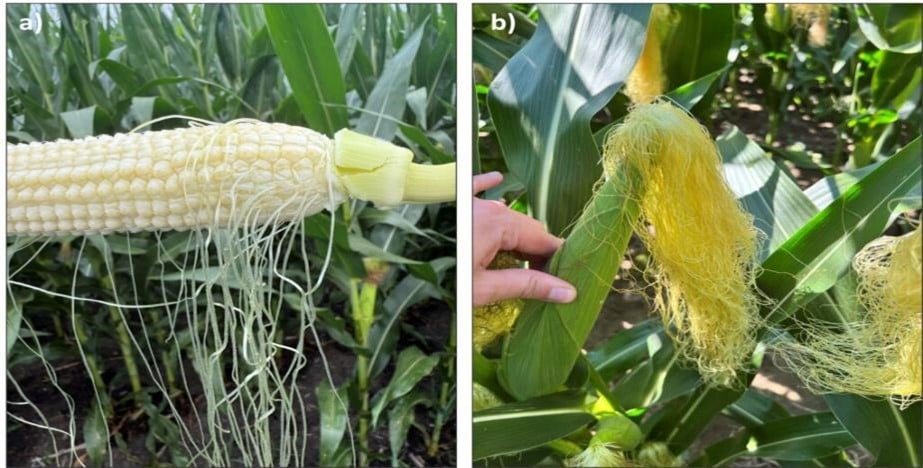
Corn ear with poor pollination (non-detached silks) at the base of the corn ear (first silks to emerge from the husk) (a) and the presence of excessively long silks (b) which can be an indication of early silk emergence and delayed pollen drop. Photo courtesy of R.L. Nielsen, Purdue University
What is Tassel Wrap?
Tassel wrapping in corn occurs when the upper leaves, including the flag leaf, fail to fully unfurl and remain wrapped around the developing tassel, delaying its emergence and pollen release. This delay can disrupt the narrow window between pollen shed and silk receptivity. In these situations, limited or uneven pollen shed can reduce fertilization, leading to poor kernel set.
Although relatively rare and not fully understood, we sure saw a lot of it in 2025.
Its cause has been linked to everything from environmental stress, planting timing, nutrient deficiencies and hybrid differences—making early scouting critical for assessing potential yield impact.
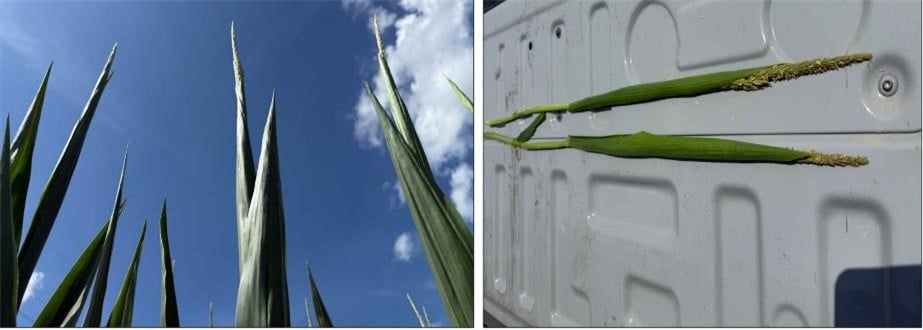
Presence of tassel wrapping occurring in corn on July 10 (a) and July 23 (b) at the Agronomy Center for Research and Education (ACRE) in West Lafayette, IN 2025. Photo courtesy of Purdue University.
Why Did We See More Tassel Wrap Last Year?
What Changed.
The biggest shift wasn’t just heat; it was how the heat behaved.
We’re used to high daytime temperatures in the mid-to-upper 90s. What stood out was the rapid overnight cooling, dropping into the 60s. That kind of swing created stress that disrupted normal plant function.
As we dug deeper, looking at tissue tests and plant response, another pattern began to emerge.
A Micronutrient Signal: Boron
In fields where tassel wrap was present, tissue testing indicated boron consistently showed up as a limiting factor. That’s not entirely surprising, but it is often overlooked.
We typically think of boron in terms of flowering and reproduction, which is correct. But in-season, its role is broader:
- Moving sugars and nutrients to developing tissues
- Supporting cell division and growth
- Enabling proper tassel development and pollination
In a normal year, soil supply and early-season fertility may be enough, but in a stress year, that margin disappears.
What We Think Is Happening
When corn experiences extreme temperature swings, the plant responds much like any living system under stress; it slows down.
We’ve observed:
- Reduced nutrient movement within the plant
- Limited sugar transport to the tassel
- Disrupted cell development during rapid growth stages
Because boron is relatively immobile, the plant can’t easily redistribute it when demand spikes.
So even if boron is present in the soil, it may not be available where and when it’s needed most. That’s where we start to see issues like tassel wrap.
Timing Is the Real Lever
When should boron be applied to reduce tassel wrap?
One of the biggest takeaways is timing. Tassel wrap generally occurs shortly before tasseling (VT) – usually around V12-V14, depending on hybrid, heat units (GDD), and growing conditions.
We often see fungicide applications go out around brown silk, focused on protecting grain fill. That works for disease but from a nutrition standpoint, it may be too late.
If we’re trying to support tassel development and pollination:
- The window is earlier—pre-tassel through VT; ideal application window will be closer to late June or early July
- Boron needs to be in place before stress limits movement
With tools like growing degree days, crop staging, and tissue testing, we can be much more precise about when the crop will need support.
Where Foliar Nutrition Fits
When is mid-season foliar nutrition a smart choice?
When we need to get ahead of nutrient demand and mid-season foliar nutrition makes sense, not just as a rescue, but as a timing tool.
In situations where:
- Soil supply can’t keep up
- Environmental conditions limit uptake
- Demand is peaking rapidly
Foliar applications allow us to deliver nutrients directly to the plant, by passing those soil constraints.
Supporting the System: Boron X-TRA + Nova PULSE®
What we’ve seen work well is pairing targeted micronutrients with functional nutrition.
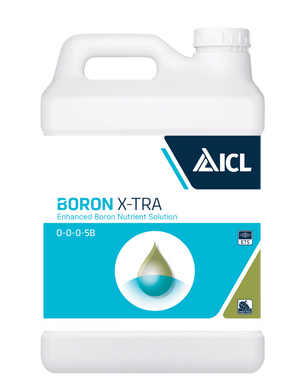
Boron X-TRA 0-0-0 +5%B: A premium liquid fertilizer featuring a unique proprietary Enhanced Translocation System (ETS) and lower pH formulation for improved uptake and compatibility
Boron helps maintain nutrient and sugar movement, supporting tassel emergence and pollination
Nova PULSE® 0-6-4 +1.3S 0.5Co 10Mo 6Zn: P-K plus micronutrients support plant metabolism and nitrogen efficiency, helping the plant stay active through stress
Together, this approach supports:
- More consistent reproductive development
- Better resilience under stress conditions
- Reduced risk of issues tied to micronutrient limitations
The Tassel Wrap Takeaway
Stress can limit nutrient movement at critical stages, so ensuring boron availability before tasseling could be key to protecting pollination and preserving yield.
Ultimately, tassel wrap isn’t caused by one factor. It’s the result of environmental stress interacting with plant physiology and nutrient availability. But, what we’re seeing suggests that micronutrients—especially boron—play a bigger role than we may have historically given them credit for. And in years where conditions are less predictable, timing and availability matter more than ever.
“We can’t control the weather—but we can better anticipate how the crop will respond to it. Making sure micronutrients are available—before the plant needs them most—may be one of the simplest ways to protect pollination and preserve yield potential.” – Tony Donoho
Connect with one of our experts to learn more about protecting your yield.
Additional sources:
Quinn, D. (2025, July 25). Wrapped tassels in corn: Now what? Purdue University Pest & Crop Newsletter.
https://extension.entm.purdue.edu/newsletters/pestandcrop/article/wrapped-tassels-in-corn-now-what/
Roozeboom, K., Sullivan, T., & Simon, L. (2025). Corn production: Pollination issues and tightly wrapped tassels. Kansas State University Agronomy eUpdate.
https://eupdate.agronomy.ksu.edu/article/corn-production-pollination-issues-and-tightly-wrapped-tassels-651-2
Grove, J. (2025, August 15). Boron deficiency – Associated with tassel wrapping in corn? Kentucky Field Crops News, 1(8). University of Kentucky.
https://graincrops.ca.uky.edu/articles/boron-deficiency-associated-tassel-wrapping-corn
Related Crop


