Whatsapp
  X
X  Mail
Mail  Copy link
 Can Micronutrients Improve Nodulation and N-Fixation?

On this page:
Get More from Every Fungicide Pass with Targeted Micronutrient Nutrition
Nodules are essential for sustainable nitrogen management. When nodulation falls short, nitrogen fixation can suffer — and that can impact crop performance long before symptoms appear above ground. Legumes like soybeans, garbanzo beans (chickpeas), alfalfa and peas require root nodules to fix atmospheric nitrogen into a plant-available form. In addition to rhizobia bacteria, crops also require micronutrients to achieve nodulation effectively. While inoculants often get the most attention, a lack of key elements like molybdenum, boron, cobalt, or zinc can also limit nodule formation and function.
Molybdenum and cobalt are essential for the enzymes involved in biological nitrogen fixation, helping support a plant’s ability to convert atmospheric nitrogen into a usable form.
Boron supports plant health and yield by strengthening meristematic tissues and cell walls, ensuring proper crop development along with nutrient/sugar transport—including to active nodules, where energy is needed to support nitrogen fixation—during high-demand growth stages. That’s why we see products like Boron X-TRA (0-0-0 +5%B) and Nova PULSE® (0-6-4 +1.3S 0.5Co 10Mo 6Zn) as a strong fit in soybean, forage or pulse crop nutrition programs. Applied proactively, they help support micronutrient availability during key growth stages when nodules are forming, functioning, and supplying nitrogen to the crop.
On-Farm Results
What we saw in the field
Garbanzos, Washington, 2025: In on-farm observations Nova PULSE, Boron X-TRA and Nova FLOW® foliar applications were associated with increased nodule numbers at both herbicide and fungicide timings, with more substantial increases observed at fungicide timing.
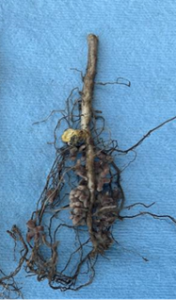
Nodules on Garbanzo bean root, Boron X-TRA with Nova PULSE®
Soybean, Iowa, 2025 In an on-farm soybean trial in Iowa, mid-season foliar nutrition applied alongside fungicide and insecticide resulted in improved nodulation and increased yield by 4.3% (Nova PULSE+ Nova FLOW).
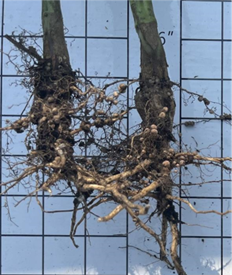
Nodules on soybean root, Nova PULSE®, BIOZ® Diamond and Nova FLOW® applied with fungicide
Results suggest that micronutrient support, specifically molybdenum, boron, and cobalt later in the season can still play an important role in nodulation and nitrogen fixation.
Why does application timing matter?
Foliar applying supporting nutrients with a pre-planned fungicide pass can:
- Reduce field passes to optimize efficiency
- Coincide with higher plant demand for N
- Support mid-season transition to reproductive growth
While both vegetative and fungicide applications showed positive results, applications at fungicide timing drove a stronger nodulation response, helping meet peak nitrogen demand and protect yield potential.
Key Takeaways
- Molybdenum and cobalt help support the enzymes involved in nitrogen fixation.
- Boron helps expanding tissues function properly, supporting sugar and nutrient movement to active nodules.
- Boron X-TRA and Nova PULSE, plus Nova FLOW can fit into legume programs during key crop protection applications mid-season.
- Timing matters, with trial observations showing stronger nodulation response at fungicide timing, or later herbicide applications.
If legumes aren’t nodulating as expected, it may be worth asking whether boron, cobalt, and molybdenum are missing from your fertility program. Connect with our experts to learn more.
FAQs
- What causes poor nodulation in soybeans?
Poor nodulation can be influenced by several factors, including soil conditions, environmental stress, ineffective inoculation, and lack of key micronutrients like cobalt, molybdenum, and boron that support nodule formation and function.
- How do cobalt and molybdenum support soybean nodulation?
Cobalt and molybdenum are essential for the enzymes involved in biological nitrogen fixation, helping support both the formation of nodules and their ability to convert atmospheric nitrogen into a usable form for the plant. Nova PULSE is a unique water-soluble fertilizer designed for foliar applications that contains both cobalt and molybdenum.
- What role does boron play in nodulation?
Boron helps expanding tissues function properly, supporting sugar and nutrient movement within the plant, including to active nodules, providing the energy needed for nitrogen fixation and helping support overall nodule activity. Boron X-TRA is a liquid micronutrient fertilizer designed for foliar application.
- When should micronutrients like boron be applied in soybeans?
Micronutrients like Nova PULSE and Boron X-TRA can be applied early in the season, alongside herbicide and with mid-season fungicide or insecticide passes, allowing growers to take advantage of planned crop protection, while also supporting nodulation and plant development during key growth stages when nutrient demand is increasing.
- How do products like Boron X-TRA, Nova PULSE and Nova FLOW fit into a soybean program?
Boron X-TRA, Nova PULSE or Nova FLOW can be used as part of a balanced fertility program to help support macro and micronutrient availability during key growth stages, including periods when nodules are forming and actively fixing nitrogen.