Whatsapp
 X
 Mail
 Copy link
Rethinking Fall Sulfur: Three Reasons to Consider Polyhalite-Based Fertilizers

On this page:
Fall fertilizer applications have to do more than fit the schedule. Nutrients applied months ahead of crop demand need to remain where they can be useful, become available at the right time and support the broader fertility plan.
Sulfur illustrates that challenge particularly well. Sulfur bentonite is a familiar fall option, but its elemental sulfur is not plant-available when applied. Soil microorganisms must first oxidize it to sulfate, and that process depends on temperature, moisture and microbial activity. Cold soil conditions can slow conversion and delay sulfur availability as crop demand begins.
For growers using fall to build base fertility, the decision is about more than pounds of sulfur. The choice comes down to what you want the application to accomplish and how those nutrients will behave between application and crop uptake.
Polyhalite-based Polysulphate® and ICL PKpluS® offer another approach, combining sulfate sulfur with gradual mineral dissolution and multi-nutrient nutrition.
Here are three reasons to consider polyhalite-based fertilizer when evaluating a fall sulfur program:
1. Consider How It Is Released
Sulfur form matters, but so does how sulfur becomes available over time.
The elemental sulfur in sulfur bentonite is relatively immobile, which can make it attractive for fall application, but crops cannot use it directly. Microbial oxidation must first convert elemental sulfur to sulfate, and cool soil conditions can slow that process.
Highly soluble sulfate fertilizers such as ammonium sulfate (AMS) take the opposite approach. Their sulfur is already plant-available, but sulfate can be more susceptible to movement under wet conditions when applied well ahead of crop uptake.
Polyhalite offers a different balance. Polysulphate and PKpluS contain sulfur already in sulfate form, but that sulfate is part of a naturally occurring mineral that dissolves gradually with soil moisture. As polyhalite dissolves, sulfate sulfur is co-released with potassium, calcium and magnesium over time, without requiring the microbial oxidation associated with elemental sulfur.
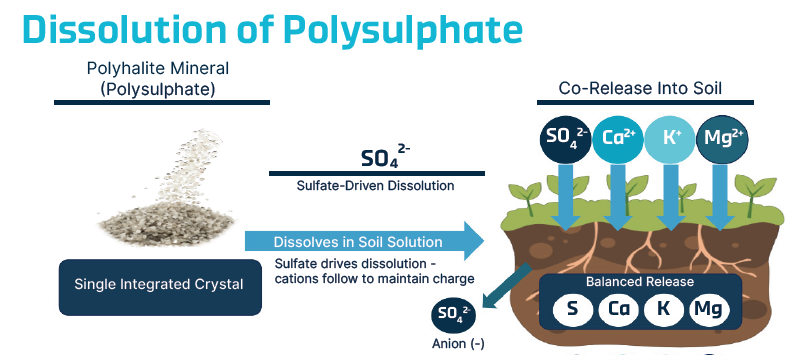
For fall fertility, that creates a useful middle ground: sulfate sulfur that does not depend on conversion, delivered through gradual mineral dissolution rather than the rapid solubility associated with fertilizers such as AMS.
2. Build Fall Fertility Without Locking in Nitrogen
Sulfur is rarely the only nutrient being considered in a fall fertility program. Growers may also be building phosphorus and potassium fertility, but conventional nutrient combinations often bring nitrogen into the application even when nitrogen is not part of the fall objective.
Both Polysulphate and PKpluS are nitrogen-free, giving growers flexibility to build base fertility while managing nitrogen source and timing separately.
Polysulphate supplies sulfur, potassium, calcium and magnesium without nitrogen. When phosphorus is also part of the plan, PKpluS supplies phosphorus, potassium, sulfur, calcium and magnesium in a single nitrogen-free granule. By comparison, commonly used phosphate fertilizers such as MAP and DAP supply nitrogen along with phosphorus.
For growers planning both phosphorus and sulfur applications, PKpluS provides another way to address both objectives while preserving flexibility around nitrogen timing and source selection.
When Fall Phosphorus and Sulfur Are Both on the Plan
For growers who apply both a phosphate fertilizer and a sulfur source, multi-nutrient granules like PKpluS can create opportunities for greater nutrient and application efficiency.
| Fertility Consideration | MAP + Sulfur Bentonite | PKpluS® |
|---|---|---|
| Fertilizer Type | Physical blend | Single multi-nutrient granule |
| Phosphorus | Yes | Yes |
| Sulfur form | Elemental S | Sulfate S from polyhalite |
| Sulfur availability | Requires microbial oxidation | No oxidation required; gradual mineral dissolution |
| Nitrogen | Yes | N-free |
| Other Nutrients | None | K + Ca + Mg |
Evaluating the complete fertility program can reveal value that is not always obvious when products are compared only by price per pound of a single nutrient.
3. Get More From Every Granule—and Every Application
Multi-nutrient fertilizers can simplify blending and logistics, reduce the need for separate fertilizer materials or applications, and help align nutrient supply with crop needs. Supplying complementary nutrients together can also support nutrient use efficiency and balanced crop nutrition.
That makes Polysulphate and PKpluS good fits for typical fall broadcast applications of P, K and S in row-crop systems, where nutrients may be applied months before the next crop is planted, as well as for fall-planted cover crops and cash crops.
The polyhalite component’s low-salt and low-chloride characteristics add further application flexibility. Research with Polysulphate has also demonstrated improved nutrient uptake and root-development responses under certain conditions, while emerging research continues to explore potential effects on the root-zone environment and soil microbial diversity.
These findings continue to broaden our understanding of polyhalite beyond the nutrients on the fertilizer analysis.
Polysulphate or ICL PKpluS: Match the Product to the Fertility Goal
The choice comes back to what you want the application to accomplish. Polysulphate provides S + K + Ca + Mg when phosphorus isn’t required; when P is also part of the fertility plan, PKpluS extends that polyhalite-based approach with P + K + S + Ca + Mg in one N-free granule.
What Matters in a Fall Sulfur Program
When nutrients are applied well ahead of crop demand, the goal is reliable nutrition without unnecessary nutrient loss or operational complexity. The right fall fertility program should:
- Maintain nutrient availability while helping minimize movement or loss before crop uptake.
- Reduce reliance on conversion, so sulfur availability is less dependent on soil conditions and microbial activity.
- Simplify operations by reducing the fertilizer materials, blends or applications needed to meet nutrient goals.
- Preserve management flexibility, including control over nitrogen source and timing.
Ultimately, fall fertility is about more than getting nutrients applied ahead of spring. It’s about choosing sources that can reliably carry the fertility plan from application to crop uptake—with fewer opportunities for nutrient loss and less operational burden along the way.
Explore ICL PKpluS® and Polysulphate® for fall fertility, or connect with an ICL expert to determine which approach best fits your crop nutrition goals.