Whatsapp
 X
 Mail
 Copy link
Herbicide Burndown: Managing Weeds While Feeding Soil Biology


On this page:
Burndown has a straightforward job: control weeds before they become a bigger problem. But when you’re already making a trip across the field, it makes sense to get more agronomic value from that pass.
Good spray coverage and uptake help the herbicide do its job. And depending on the timing and what comes next, the same application can also provide an opportunity to feed existing soil biology and support nutrient cycling.
It’s about managing the weeds while making a necessary field pass work harder for the overall crop-management program.
Why Use an Adjuvant With a Burndown Herbicide?
A burndown herbicide needs good contact with weeds and effective uptake into the plant. An adjuvant can play an important role by helping improve spray coverage and leaf absorption.
That can be especially useful when environmental conditions make herbicide performance more challenging. Think about early spring or late fall applications, when conditions aren’t always ideal and you’re trying to get the most from the application.
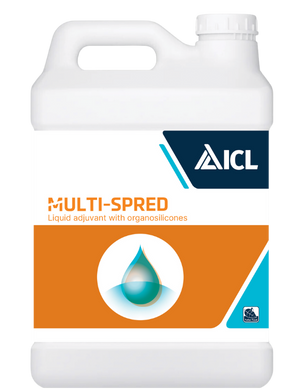
This is where an adjuvant such as MULTI-SPRED® can fit into the spray program.
- MULTI-SPRED is a 98% active adjuvant combining organosilicones, methylated seed oil (MSO) and nonionic surfactants to improve spray coverage, spreading and uptake. It can be used with herbicides, fungicides, insecticides and defoliants.
The importance of spray coverage and uptake extends beyond burndown. In cotton, for example, an adjuvant can also play a role in a defoliation spray as the crop is prepared for harvest.
When Should Burndown Herbicides Be Applied?
Whether you’re working in row crops, vegetables, cotton or another production system, burndown depends on the planting or harvest schedule, weed size and planning.
- Fall burndown is typically used after harvest to control small weeds before they become larger problems.
- Spring burndown is used to control weeds ahead of or around planting.
But what comes after the burndown matters, too. If winter wheat or a cover crop follows a fall application, or corn follows a spring burndown, there may be an opportunity to use the same pass to support the crop that comes next.
Can a Burndown Pass Also Support Soil Biology?
By introducing a microbial food source with the herbicide burndown application, we can feed the microbial community already living in the soil. Carbon-rich inputs can help stimulate soil biological and enzymatic activity involved in nutrient cycling while supporting root growth.
This is where BIOZ® Diamond can fit. Made with molasses and yeast extracts, BIOZ Diamond provides food for existing soil biology rather than adding microorganisms. Because it can be applied with an herbicide, it can be integrated into an existing burndown program.
- Spring: BIOZ Diamond can be used with an herbicide burndown application just before or after planting, but before emergence. The goal is to control weeds at the start of the season while providing early activation of soil enzymes for enhanced nutrient cycling.
In a Wisconsin corn trial, BIOZ Diamond was applied at 32 or 64 oz/acre with pre-herbicides, resulting in yield increases of 6.6 bu/A and 11.4 bu/A, respectively, compared with the control.
- Fall: BIOZ Diamond can fit when a cover crop or winter wheat follows and can benefit from the application.
Getting More Value From a Pass You’re Already Making
Every spray application has a primary job. With burndown, that job is weed control.
But depending on the timing, production system and what comes next, that application can also become part of a broader crop and soil-management strategy.
An adjuvant such as MULTI-SPRED can support spray coverage and uptake, while BIOZ Diamond can support soil biology.
Using an existing application to address more than one management objective can support operational efficiency by getting more value from every pass. That’s not just good agronomics, it can make good economic sense, too.
Talk with your local ICL representative about how to make the most of your burndown and crop-management programs.